Course material & Lecture notes
■ Nonlinear Optimization (MIT 6.7220 / 15.084; Spring 2025, 2024)
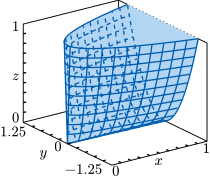
Introduction to the fundamentals of nonlinear optimization theory and algorithms.
When applicable, emphasis is put on modern applications, especially within machine learning and its sub-branches,
including online learning, computational decision-making, and nonconvex applications in deep
learning.
Course materials (Spring 2025)
Course Homepage (Spring 2025) Course materials (Spring 2024)
|
 Course page |
■ Topics in Multiagent Learning (MIT 6.7980; Fall 2026, 2025, 2024, 2023)
This graduate course, co-developed with Costis Daskalakis, studies multiagent systems through game theory, optimization, and learning theory. We cover Nash equilibria, regret minimization, learning dynamics, and extensive-form games, alongside multiagent deep reinforcement learning, information and mechanism design, team and hidden-role games, alignment, high-dimensional and kernelized learning, nonconvex games, calibration, and the complexity of finding equilibria. Applications and open research questions connect the theory to multiagent AI.
Course materials (Fall 2026)
Course Homepage (Fall 2026) Course materials (Fall 2024)
Course Homepage (Fall 2024) Course materials (Fall 2023)
Course Homepage (Fall 2023) |
 Course page |
■ Computational Game Solving (CMU 15-888; Fall 2021)
This new graduate course, co-developed with Tuomas Sandholm at CMU, focuses on multi-step imperfect-information games.
Imperfect-information games are significantly more complex than perfect-information games like chess and Go, and see emergence of signaling and deception at equilibrium. There has been tremendous progress in the AI community on solving such games since around 2003.
The course covers the fundamentals and the state of the art of solving such games.
Course materials (Fall 2021)
Course Homepage (Fall 2021) |
 Course page |
Tutorials
■ Learning and Computation of Φ-Equilibria (ACM EC’26 Tutorial)
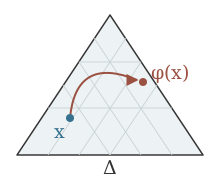
This ACM EC’26 tutorial, presented jointly with Ioannis Anagnostides and Brian Hu Zhang on June 15, 2026, explores Φ-regret minimization and the computation of Φ-equilibria. Topics include the Gordon–Greenwald–Marks reduction, expected fixed points, semi-separation, ellipsoid methods, multicalibration, TreeSwap, and profile swap regret.
Tutorial notes & slides
|
 Tutorial page |
Handouts
|
2024-04-19
html | pdf |
Near-optimal learning in imperfect-information sequential games (and other combinatorial convex settings)
MIT Theory Reading Group (3h whiteboard talk)
|
|
2016-10-20
html |
Approachability in Two-Player Games
Blackwell approachability is a celebrated concept regarding two-player games with vector payoffs. Blackwell's theorem provides a way of computing approximated Nash equilibria in large-scale games.
|
Reports of typos are always welcome! Please reach out at gfarina AT mit.edu.