Angular momentum addition
Consider a system of two particles with angular momentum
In the uncoupled basis, we describe this state by the 4 quantum numbers corresponding to the observables . We’ve seen how we can construct the Bell basis for spin-1/2 particles in particular.
We will define a coupled basis that more naturally describes the system as a whole, for a general system of angular momentum particles. Define the total angular momentum .
is an angular momentum. The terms in each component commute, and if we consider the commutator the cross terms,
We form a complete set of commuting observables . Consider the eigenstates by first writing down all states in the original basis.
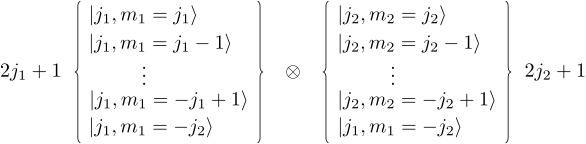
For any total , we can form a state of total angular momentum by a superposition of the states in the uncoupled basis. In a product state, if one particle has angular momentum and the other , then intuitively the total angular momentum should be . We can’t achieve a total angular momentum smaller than .
We can factorize the angular momentum system
Where each factorized (reduced) term beahves as a single particle spin- system. With this in mind we can rearrange the states in this basis
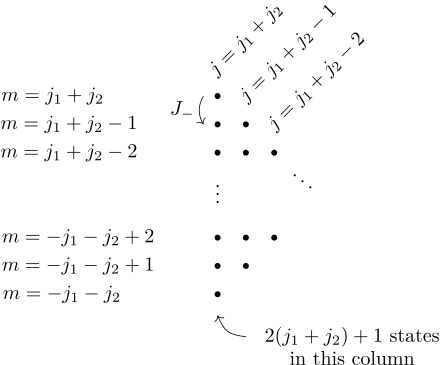
Each row corresponds to a particular eigenvalue of . Each column corresponds to a eigenvalue . We can define the total lowering operator . It is easy to show that this operator lowers the total quantum number by one.
Within a row, all states correspond to a superposition of the uncoupled states spanning the subspace. It’s easy to write a set of states that span this space. Then, finding the superposition corresponding to a particular can be done analytically.
For , the total raising operator . Write the superposition in terms of unknown coefficients , and apply the raising operator, then set to zero. Solve for the coefficients and normalize.
These eigenstates are orthogonal, so if we have some state, a state must be orthogonal. Both states can be written in terms of the spanning states. Manually computing an orthogonal vector is another way to “move” across the row.