Nuclear magnetic resonance

Consider a spin 1/2 particle in a time varying magnetic field

B⃗(t)=B0z^+B1(cos⁡ωt x^−sin⁡ωt y^). \begin{align*} \vec B(t) = B_0 \hat z + B_1 (\cos \omega t \, \hat x - \sin\omega t \,\hat y). \end{align*}

The Hamiltonian is

H(t)=−γB⃗(t)⋅S⃗=−γ(B0Sz−B1(cos⁡ωt Sx−sin⁡ωt Sy)) \begin{align*} H(t) = -\gamma \vec B(t) \cdot \vec S = -\gamma \big(B_0 S_z - B_1 (\cos \omega t \, S_x - \sin\omega t\, S_y)\big) \end{align*}

Since [H(t1),H(t2)]≠0[H(t_1), H(t_2)] \ne 0, we can’t use the simplified form of time evolution. Usually we would have to apply the time-ordered exponential, but in this case we can use a special trick.

Notice that the circularly polarized component of the field rotates in the xyxy plane. We can write that term of the Hamiltonian as the xx spin operator SxS_x rotated about the zz axis

H(t)=−γB0Sz−γB1 eiωtSz/ℏSxe−iωtSz/ℏ. \begin{align*} H(t) = -\gamma B_0 S_z - \gamma B_1 \, e^{i\omega t S_z/\hbar} S_x e^{-i\omega t S_z/\hbar}. \end{align*}

We can just as well apply the rotation to the SzS_z operator too, since rotating SzS_z about the zz axis does nothing. This allows us to write the expression as a time-independent commutator

H(t)=eiωtSz/ℏ[−γB0Sz−γB1Sx]e−iωtSz/ℏ. \begin{align*} H(t) = e^{i\omega t S_z / \hbar} \left[ -\gamma B_0 S_z - \gamma B_1 S_x \right] e^{-i\omega tS_z/\hbar}. \end{align*}

Now define a state ∣ψR,t⟩=e−iωtSz/ℏ∣ψ,t⟩\ket{\psi_R,t} = e^{-i\omega t S_z/\hbar} \ket{\psi,t} in a rotating frame. Applying the Schrödinger equation to ∣ψ,t⟩\ket{\psi,t}, written in terms of ∣ψR,t⟩\ket{\psi_R,t}

iℏddt[eiωtSz/ℏ∣ψR,t⟩]=eiωtSz/ℏ[−γB0Sz−γB1Sx]e−iωtSz/ℏeiωtSz/ℏ∣ψR,t⟩−ωSzeiωtSz/ℏ∣ψR,t⟩+iℏeiωtSz/ℏddt∣ψR,t⟩=eiωtSz/ℏ[−γB0Sz−γB1Sx]∣ψR,t⟩iℏddt∣ψR,t⟩=[(ω−γB0)Sz−γB1Sx]∣ψR,t⟩. \begin{align*} i\hbar \frac{d }{d t} \left[ e^{i\omega t S_z/\hbar} \ket{\psi_R,t} \right] &= e^{i\omega tS_z/\hbar} \left[ -\gamma B_0 S_z - \gamma B_1 S_x \right] e^{-i\omega t S_z/\hbar} e^{i\omega t S_z/\hbar} \ket{\psi_R,t} \\ -\omega S_z e^{i\omega tS_z/\hbar} \ket{\psi_R,t} + i\hbar e^{i\omega tS_z/\hbar} \frac{d }{d t} \ket{\psi_R,t} &= e^{i\omega tS_z/\hbar} \left[ -\gamma B_0 S_z - \gamma B_1 S_x \right] \ket{\psi_R,t} \\ i\hbar \frac{d }{d t} \ket{\psi_R,t} &= \left[ (\omega - \gamma B_0) S_z - \gamma B_1 S_x \right] \ket{\psi_R,t}. \end{align*}

In the rotating frame, the spin processes around an effective magnetic field

B⃗eff=(B0−ωγ)z^+B1x^. \begin{align*} \vec B_\eff &= \left( B_0 - \frac{\omega}{\gamma} \right) \hat z + B_1 \hat x. \end{align*}

This gives us the solution

∣ψR,t⟩=exp⁡(iγB⃗eff⋅S⃗t/ℏ)∣ψR,0⟩∣ψ,t⟩=exp⁡(iωtSz/ℏ)exp⁡(iγB⃗eff⋅S⃗t/ℏ)∣ψ,0⟩. \begin{align*} \ket{\psi_R,t} &= \exp \left(i\gamma \vec B_\eff \cdot \vec S t/\hbar\right) \ket{\psi_R,0} \\ \ket{\psi,t} &= \exp \big(i\omega t S_z/\hbar\big) \exp \left(i\gamma \vec B_\eff \cdot \vec S t/\hbar\right) \ket{\psi,0}. \end{align*}

Now take B0≫B1B_0 \gg B_1 and set ∣ψ,0⟩=∣z+⟩\ket{\psi,0} = \ket{z+}. If ω\omega is far from ω0=γB0\omega_0 = \gamma B_0 (off resonance), then B⃗eff∼z^\vec B_\eff \sim \hat z, and the state proceses around the zz axis. Since our state is ∣z+⟩\ket{z+} it doesn’t change.

If ω=ω0=γB0\omega = \omega_0 = \gamma B_0, then B⃗eff=B1x^\vec B_\eff = B_1 \hat x and the state in the rotating frame ∣ψR,t⟩\ket{\psi_R,t} processes around the x^R\hat x_R axis. After a time Δt=π/2γB1\Delta t = \pi/2\gamma B_1 it is ∣ψR,Δt⟩=∣yR+⟩\ket{\psi_R,\Delta t} = \ket{y_R+}

After this time Δt\Delta t, set B1=0B_1 = 0 with B0=ω0/γB_0 = \omega_0/\gamma unchanged. Then ∣ψR,t⟩=eiωtSz/ℏ∣ψR,Δt⟩\ket{\psi_R,t} = e^{i\omega t S_z/\hbar} \ket{\psi_R,\Delta t} and the state continues to process around the zz axis.

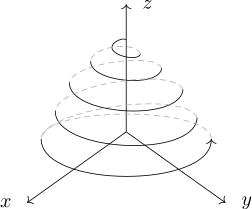
In the lab frame, this looks like the state slowly rotating from +z+z to the xyxy plane, all while quickly rotating around the zz axis.