
Learning about Hawaiian Native Hydrology, Farming, and Volcanology
Learning about Hawaiian Native Hydrology, Farming, and Volcanology
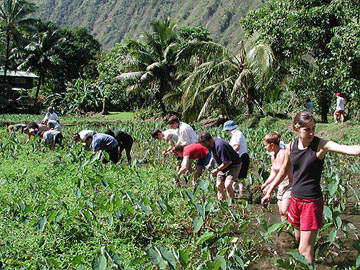
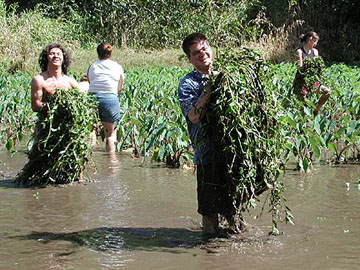
An entire day was spent in the beautiful Waipi'o valley as the guests of a native taro farmer. Students stood knee deep in water and mud as they weeded thriving taro patches (they later cooked and ate what they harvested) and learned about the Hawai'ian Ahupua'a, a system of land and water management.
 |
 |
|
| While
at the farm nestled in the beautiful Waipi’o Valley the group
wades in the mud to weed a taro patch. |
Removing weeds from the taro patch. |
They learned about the auwai (ditch) system and why it's hydrologically optimal. They washed their hair in one of the streams on the farm and ate grapefruits and tangerines that were plucked from the farm's trees. The farm was definitely one of the favorite activities and part of that was the excitement trying to reach it. Hiking down a road so steep that normal automobiles aren't allowed on it, then hiking through streams, through a river and mud - making it quite memorable. We all had a great time!
 |
 |
|
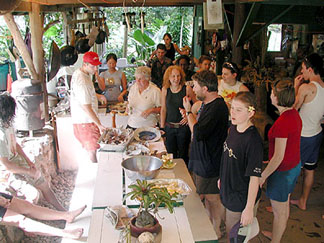
Everyone
enjoys a home-cooked meal. The menu featured taro chips, fruit from
the farm, and a type of chicken stew wrapped in banana leaf. |
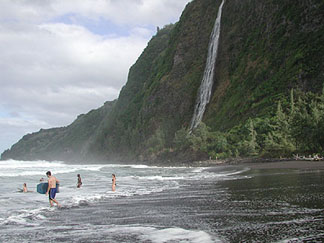
After
a hard day's work in the taro patch, everyone enjoys the warm water
at the Waipio Valley black sand beach. |
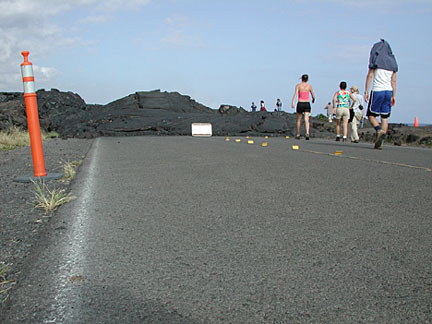 |
| Road overtaken by lava at Volcanoes National Park |
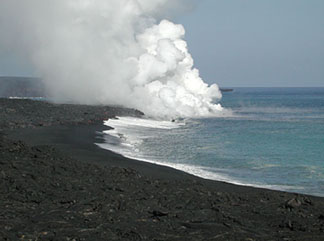 |
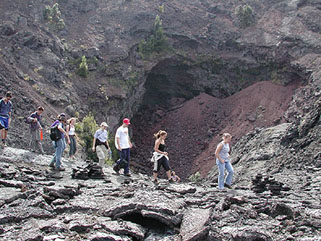 |
|
| The
only visible lava was that which was pouring into the ocean. |
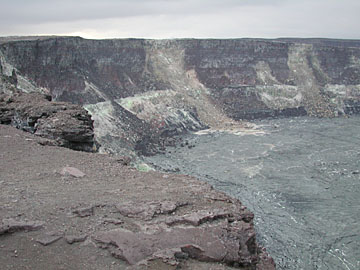
Students
took a hike into one of the smaller calderas on top of Kilauea, Hawai'i. |
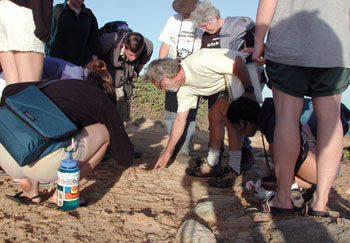 |
 |
|
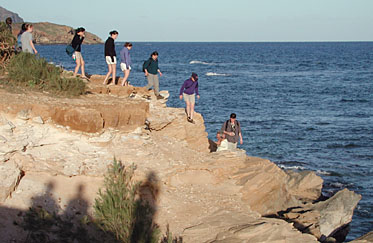
Chuck
Blay,
geoscientist, took us on a tour to investigate lithified sand dunes
in Kauai. |
 |

 |
||||||
 |
 |
 |
||||
 |
 |
 |
||||
 |
 |
 |
||||
 |
||||||
 |
|
|
|
|
|
|