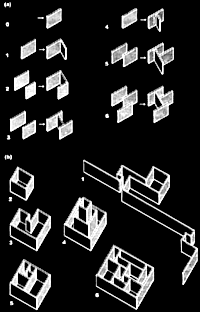
The approach for developing original grammars and design languages starts “from scratch” in theory only. In practice, original languages or styles are not created from scratch, but from past or known ones. Original design generally involves some degree of analysis or understanding of known designs--one's own or those of others--as the impetus for new designs. Indeed, students who use shape grammars in studio projects do not define grammars from scratch. Choices of shapes, relations, and rules are influenced by those seen in other conventional or grammatical projects. Often, grammars are used as an idea generator when a project, begun in a conventional way, is at a standstill. To push a project on, a student analyzes her design or some part of it, extract rules, and then plays with these rules to generate new design possibilities. One or more possibilities may then be selected for further development in the project.
Knight’s work on
grammatical transformations formalizes processes like these. In the 1980s, Knight proposed
a model for developing new design languages on the basis of existing ones  . Languages are created by transforming the rules
underlying grammars for existing languages. In other words, a known style is first
analyzed by inferring a grammar for it, the rules of the grammar are transformed, and then
the transformed rules become the basis for a new grammar and style. Knight’s model
had a dual purpose. It could be used to characterize the historical evolution of known
styles into succeeding ones. It could also be used to innovate new styles on the basis of
given ones. In Knight’s book, Transformations in Design , the model is applied to analyze stylistic changes
in the work of Frank Lloyd Wright, in De Stijl painting, and in ancient Greek ornamental
designs.
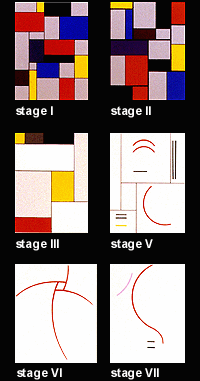
grammatical transformations in DeStijl painting |
 |
 |