
Projects I've Worked On
wavecat is a fully local personal agent that watches your screen. It develops a rich understanding of you and your needs by constantly viewing your activity. Don't worry, privacy is guaranteed since all models run locally on your device. So no data centers are needed and none of your personal data ever leaves your computer or gets sent to the cloud. You can install it and learn more at wavecat.ai.
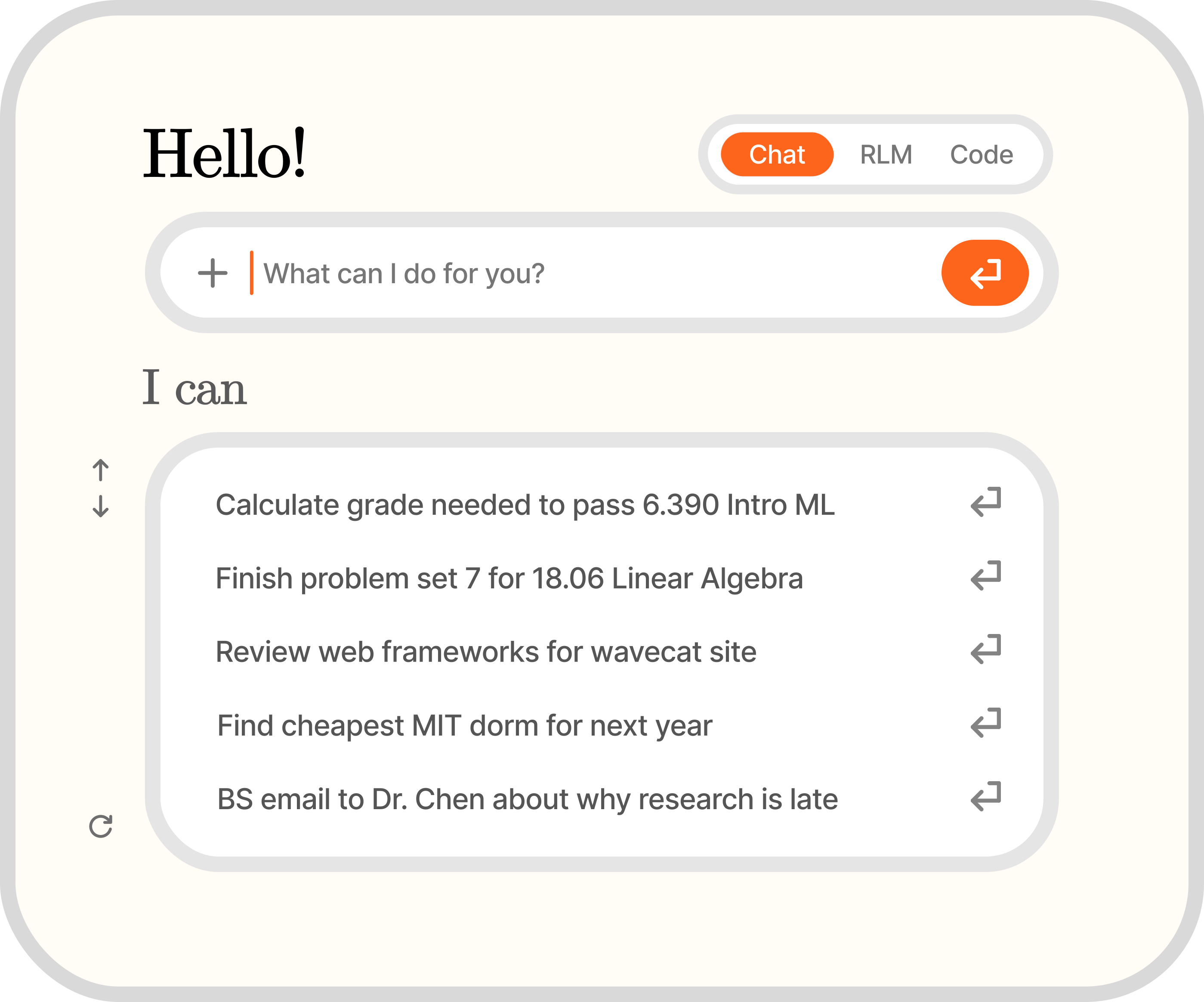
I've been running local LMs for a while, and I thought that this would be a cool way to show that it's much more than just a gimmick. There's useful things that you can do locally that you just can't or don't wanna do on a cloud setup. I hope the future of personal AI is local. It just makes sense since the context is already there, it's free, and it ensures privacy and soverignty. And this project was a great way to learn a lot about local inference engines, models, speculative decoding, constrained decoding via grammar, RLM/ReAct/CodeAct agent routines, and many other technical things.
Superconductor Discovery
In this project, I applied diffusion models — a type of generative AI model that is behind popular image generators such as Dall-E 2 and Stable Diffusion — for superconductor discovery. Specifically, this work focused on applying conditional diffusion models (with ILVR) to computationally discovery potential new families of superconductors for the first time. In the past, computational approaches to superconductor discovery could only generate new superconductors from known families and were unable to generate any new families. This work resolved that limitation.
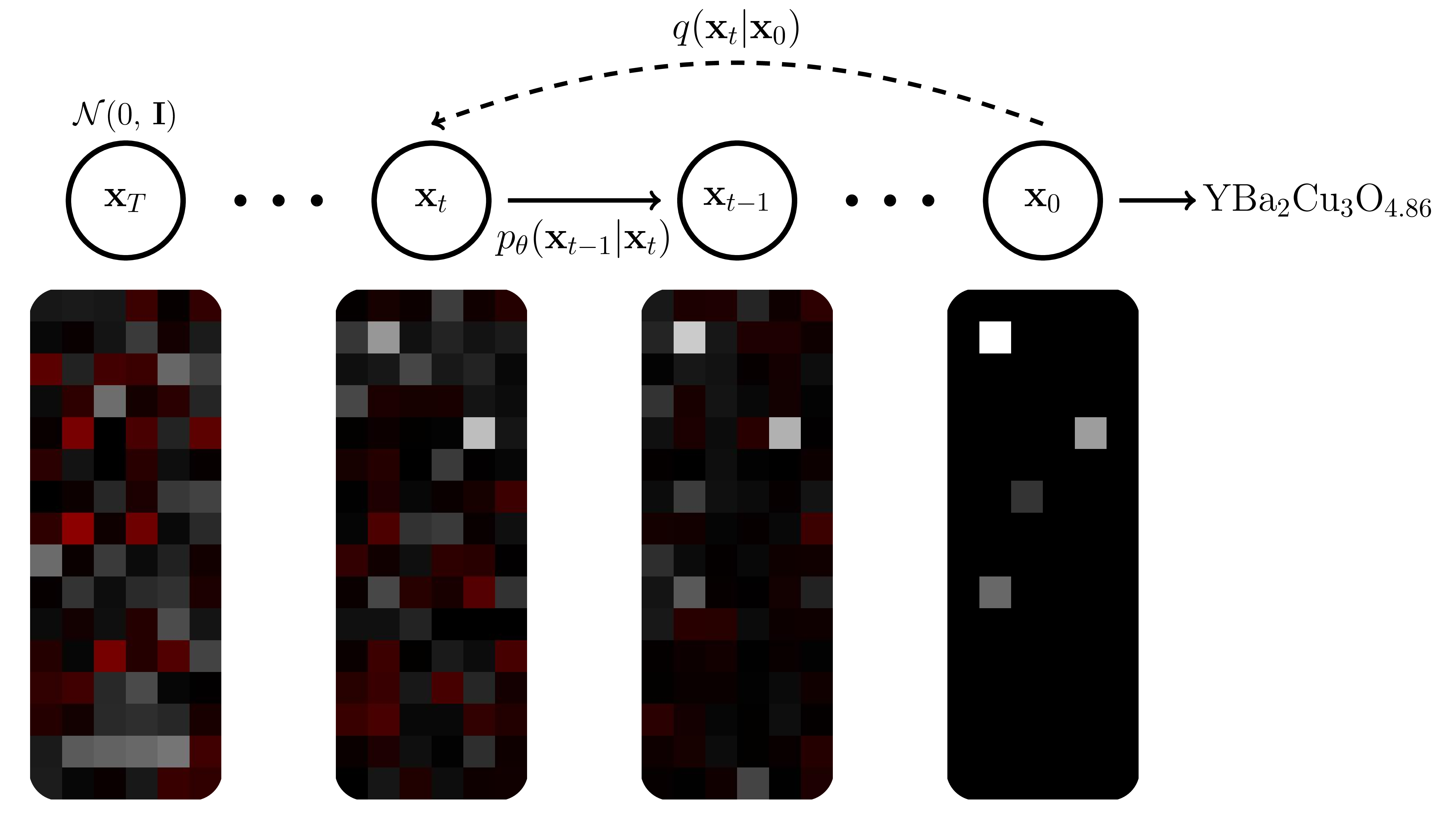
Beyond generating new families of hypothetical superconductors for the first time, this model also enables researchers to extrapolate a family of potential superconductors from any single new one they discover. The model is a powerful tool for accelerating superconductor discovery. I conducted this research with Prof. Dordevic (UAkron), who graciously accepted to mentor me on this project after I cold-emailed him. I'm incredibly grateful for his kindness.
This work was published as:
Yuan, S., Dordevic, S.V. Diffusion models for conditional generation of hypothetical new families of superconductors. Sci Rep 14, 10275 (2024). https://doi.org/10.1038/s41598-024-61040-3
Additional Details. For this work, I was named a 2024 Davidson Fellow Laureate ($50k scholarship) and a Regeneron Science Talent Search (STS) Top 300 Semifinalist. This work was also featured in an oral presentation at the 2025 APS Global Physics Summit.
Asteroid Orbit Determination
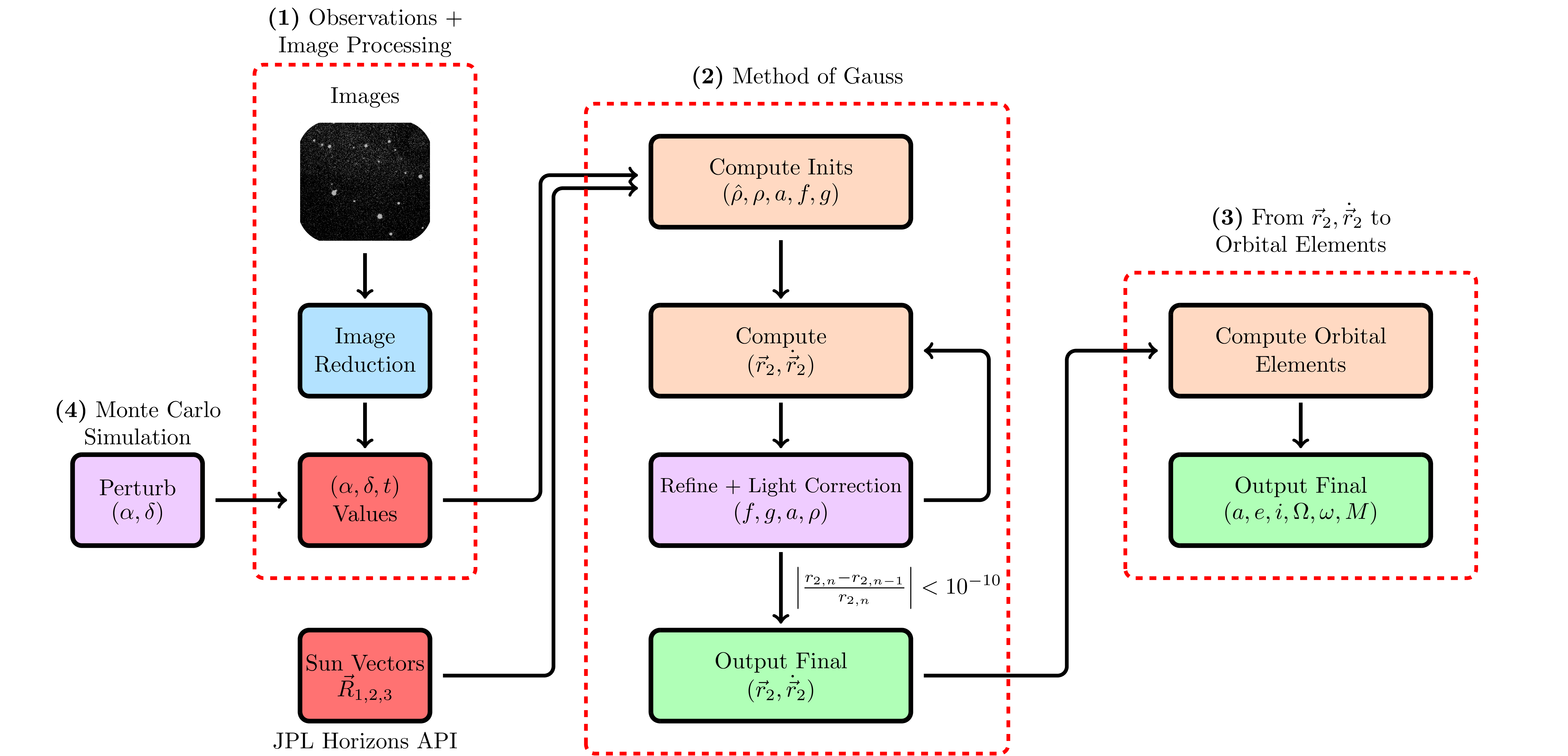
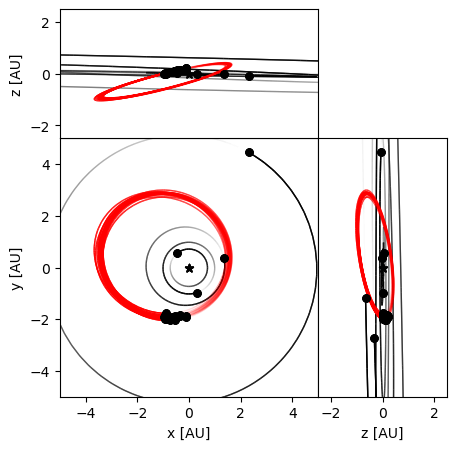
As part of the Summer Science Program (SSP) in astrophysics, I worked on determining the orbit of mars-crossing asteroid 699 Hela (aka A910 LC) together with two other teammates. We observed the asteroid over several weeks with the telescope at the Sommers-Bausch Observatory at CU Boulder and used this data to determine the orbital elements.
After collecting the observational data, we employed the Method of Gauss (MoG) to determine the orbital elements of the asteroid from three best observations. After computing the orbital elements, we ran Monte Carlo simulations to determine uncertainties and propogated the elements forward millions of years to predict the future of the asteroid.
At SSP, beyond the OD project, I worked on weekly problem sets with friends and played a lot of ping pong! The code for my OD project can be found here.
You can read our final report at:
M Judkins-Cooper*, N Marabito*, S Yuan*. Orbit Determination of Mars-Crossing Asteroid 699 Hela. https://github.com/sdkyuanpanda/SSP-CUB-2024/blob/main/ssp_team08_final_report-1.pdf
Thypher (now deprecated)
With David Fargalla and Kaku Benti, some of my friends from SSP, I built thypher.com. It's a Physics-inspired Wordle-like game, where players guess a daily 5-letter word by solving and deciphering provided equations. The name is a portmanteau of the words "theorem" and "cypher."
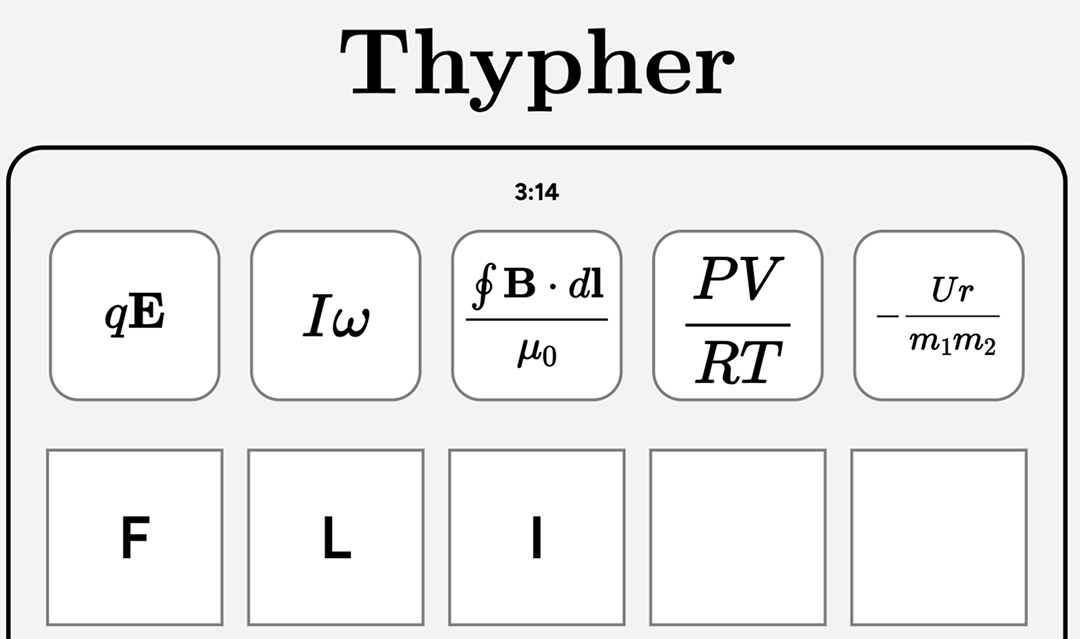
I've found that this game is a great, fun way to refresh myself on Physics equations daily — and we've gotten plenty of positive feedback from others who feel the same way. So far, in our first few months, we've garnered over 25,000 players. And we hope to grow it even further!
Firebreak Optimization
In sophomore year of high school, together with my friend Armaan Gomes, I worked on a science fair project on firebreak placement optimization with genetic algorithms. We built a cellular-automata based wildfire simulation with the Alexandridis model that was integrated with real-world data. And, with this, we applied genetic algorithms to compute realistic and effective firebreak constructions.
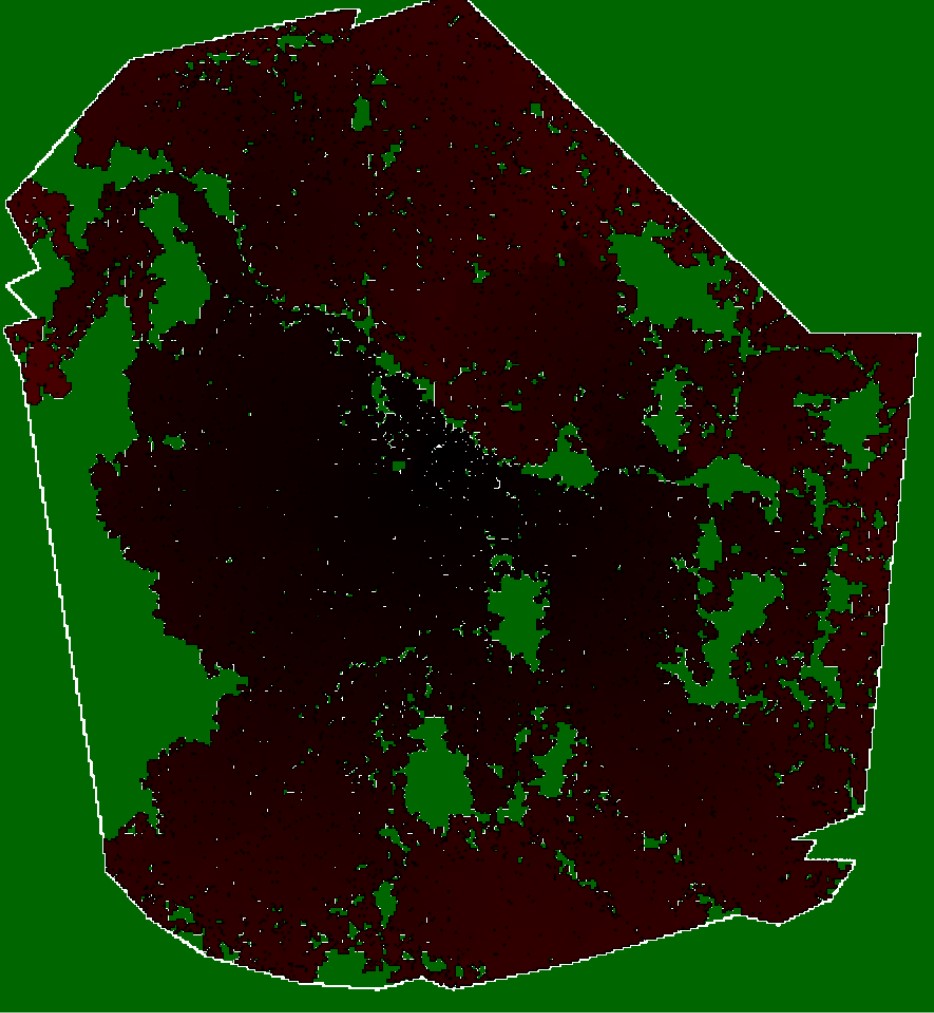
While a prototype model, our work presents a possible new method for efficient and effective firebreak construction strategy conceptualization — and further development, such as the integration of additional data, may produce a truly useful real-time assistive tool for wildfire-fighting efforts. The code for this work is publicly accessible and can be found here.
Additional Details. This work won First Place in the Computer Science category at the 2023 California Science and Engineering Fair (CSEF).
Here are some of the projects I've worked on. Recently, I've been enjoying local LMs and agent systems.