The force of nothing:
Attraction, Repulsion, and Motion in the Quantum Void
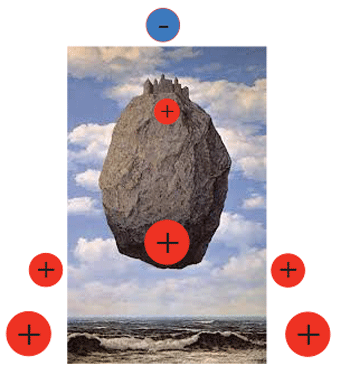
The Voice of Space: Rene Magritte 1928 The Castle of the Pyrenees: Rene Magritte 1959
Robert Jaffe, Noah Graham, Giuseppe Bimonte, Thorsten Emig, Matthias Krüger
Ramin Golestanian, Jamal Rahi, Mohammad Maghrebi, Vlad Golyk
David Gelbwaser, Kiryl Asheichyk, Dhruv Shah
Mehran Kardar
Outline
I. The Casimir force: From theory, to experimental verification, & technological relevance
II. Repulsion/Levitation? Shapes (spherical shells) and Artificial materials (metamaterials)
III. Earnshaw's theorem in electrostatics and for fluctuation-induced forces
IV. Heat radiation at near and far field
V. Propulsive force: contactless heat engine
VI. Friction of vacuum: radiation from rotating bodies
VII. Summary
Quantum physics teaches us that even the emptiest vacuum is teeming with fluctuations of electromagnetic fields. When these fluctuations are confined between objects, they produce measurable forces: the Casimir effect describes an attraction between uncharged conductors arising solely from the confinement of the quantum void. In this talk, I will explore how this subtle quantum phenomenon connects to ideas of attraction, repulsion, and mechanical work. After introducing the origin and measurement of the Casimir force, I will discuss whether it can be made repulsive, and why true levitation remains elusive in equilibrium. Extending these ideas beyond equilibrium reveals new possibilities: radiation pressure from heat, nonreciprocal materials that generate motion and work without contact, and rotating bodies that spontaneously emit light. Together, these examples show how the restless quantum vacuum continues to surprise us.