Brandeis University                           Physics Colloquium                    24 November 2009

The Shape Dependence of Fluctuation-Induced Forces


KITP workshop on: The Theory and Practice of Fluctuation-Induced Interactions


Summary

I.       Casimir force: theory and experiment, & application                                          

II.      Thermal fluctuations:  

 Critical Casimir force observed for colloids in a binary mixture    

 The wetting film of helium becomes thinner, at and below the superfluid transition 

 Fluctuation-induced forces from phonons and surface modes account for the thinning in the superfluid phase

 Missing a quantitative theory (including dimensional crossovers) below the (bulk) critical temperature

III.     Corrugated surfaces:  normal and lateral forces   

 The Proximity Force/Pairwise summation breaks down for short-wavelength deformations.

 A lateral force is demonstrated for electromagnetic fluctuations, but more precise measurements are needed.

 The lateral force from critical fluctuations has been used to manipulate colloidal particles.

 Beyond the perturbative limit by numerical or analytical schemes.          

  Precision experiments of force between an atom and a corrugated surface

(spin ecko measurements by Maarten De Kievert)

IV.    Cylinder-plate: Importance of dimensionality (for metals)

 Exact expression- dominated at large separations by long wavelength charge fluctuations

 Non-monotonic 3-body effects

 Carbon nanotubes, and the importance of material properties

V.     Compact objects

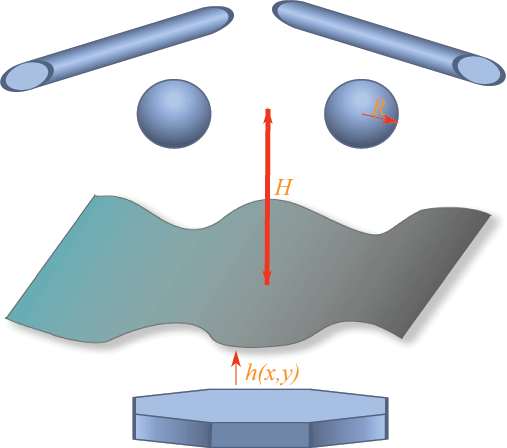
 General scattering-based for dealing with arbitrary shapes and dielectric properties

 Complete expressions for spheres at any separation

 Orientation dependence, torques, ...  for spheroids

 Applying the formalism to real materials by including their dielectric properties (ala Lifshitz), and finite temperatures

 New solvable geometries: paraboloids, wedges, cones, ...

VI.      Repulsive forces? sphere, piston       

 The force on a rectangular piston is always attractive.

 In the limit of small height, the force can be calculated for a piston of arbitrary cross section.

 Ruling out a "repulsive force" for arbitrary shapes (Earnshaw theorem)


Acknowledgements

Hao Li, Ramin Golestanian

Thorsten Emig, Andreas Hanke

Roya Zandi, Aviva Shackell, Lincoln Chayes, Joseph Rudnick

Mark Hertzberg, Antonello Scardicchio, Noah Graham, Robert Jaffe

Jamal Rahi, Alex Rodriguez, Steve Johnson