Would you like to work in a finance research lab for a semester? You will turn an idea into rigorous and practically relevant research while learning from one another and from distinguished industry experts.
Course description
This project-based course explores cutting-edge AI and machine learning research in finance. It has two main goals: i) exposure to the latest applied AI/ML research in finance; and ii) research skill development. Weekly classes feature lectures and presentations on research papers, along with guest lectures from industry experts.
Throughout the semester, students work in teams on research projects and meet regularly with faculty. By the end of the course, each team presents its findings and produces a research paper.
Student projects
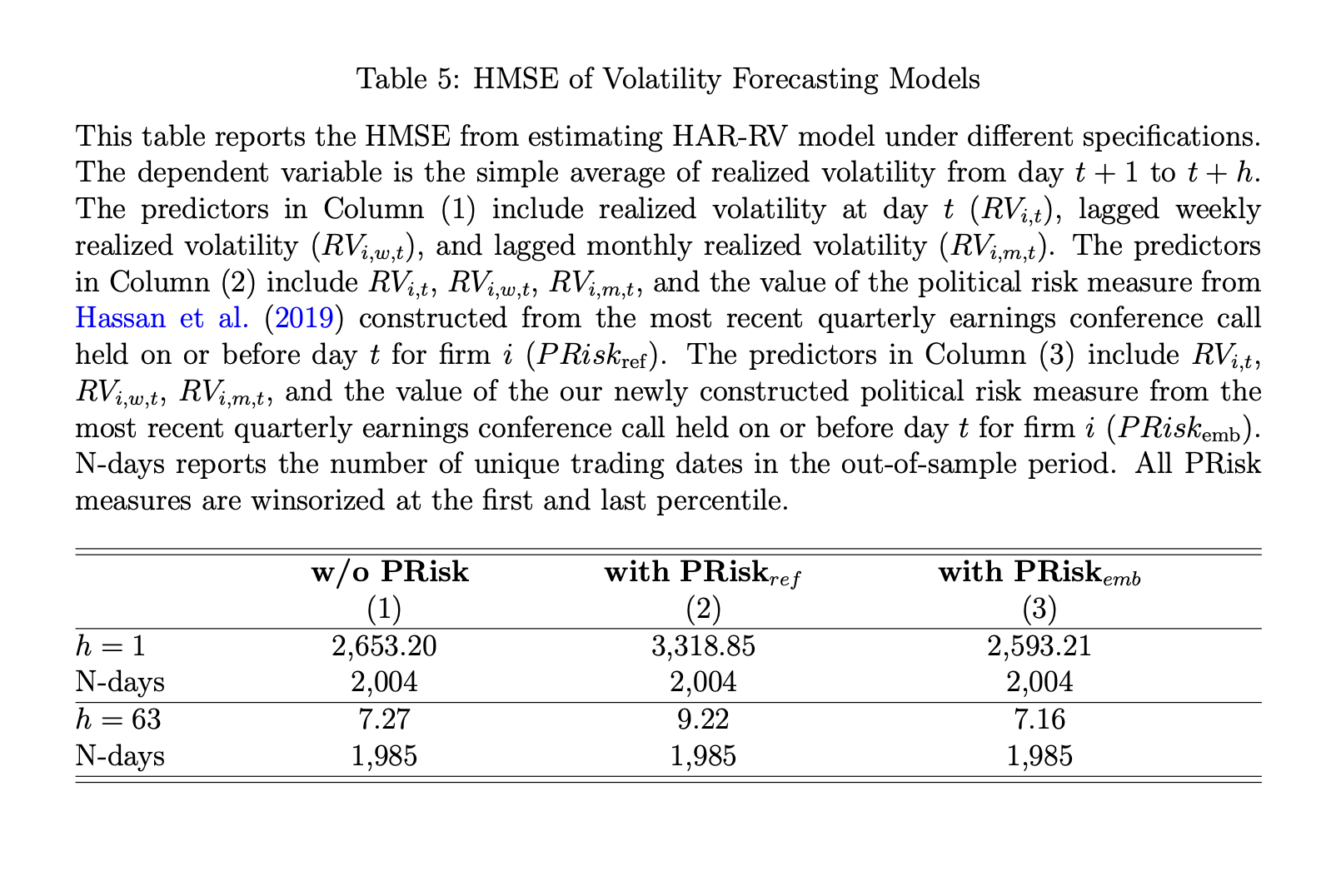
This paper builds a new embedding-based firm-level political risk measure using S&P 500 earnings calls. It embeds policy-relevant sentences and constructs the risk score from each sentence's cosine similarity to predefined uncertainty prototypes net of its similarity to certainty/irrelevance prototypes. The measure lines up well with major political episodes and generates plausible sector exposure patterns. The team further shows that their measure exhibits a stronger contemporaneous association with both realized and implied volatility than the dictionary-based measure. Finally, they find that adding their political risk measure to an existing volatility forecasting model reduces out-of-sample forecast loss, while the inclusion of the dictionary-based measure worsens forecast accuracy.
Adding the embedding-based political risk measure to the HAR-RV benchmark lowers out-of-sample HMSE at both the one-day and 63-day horizons.
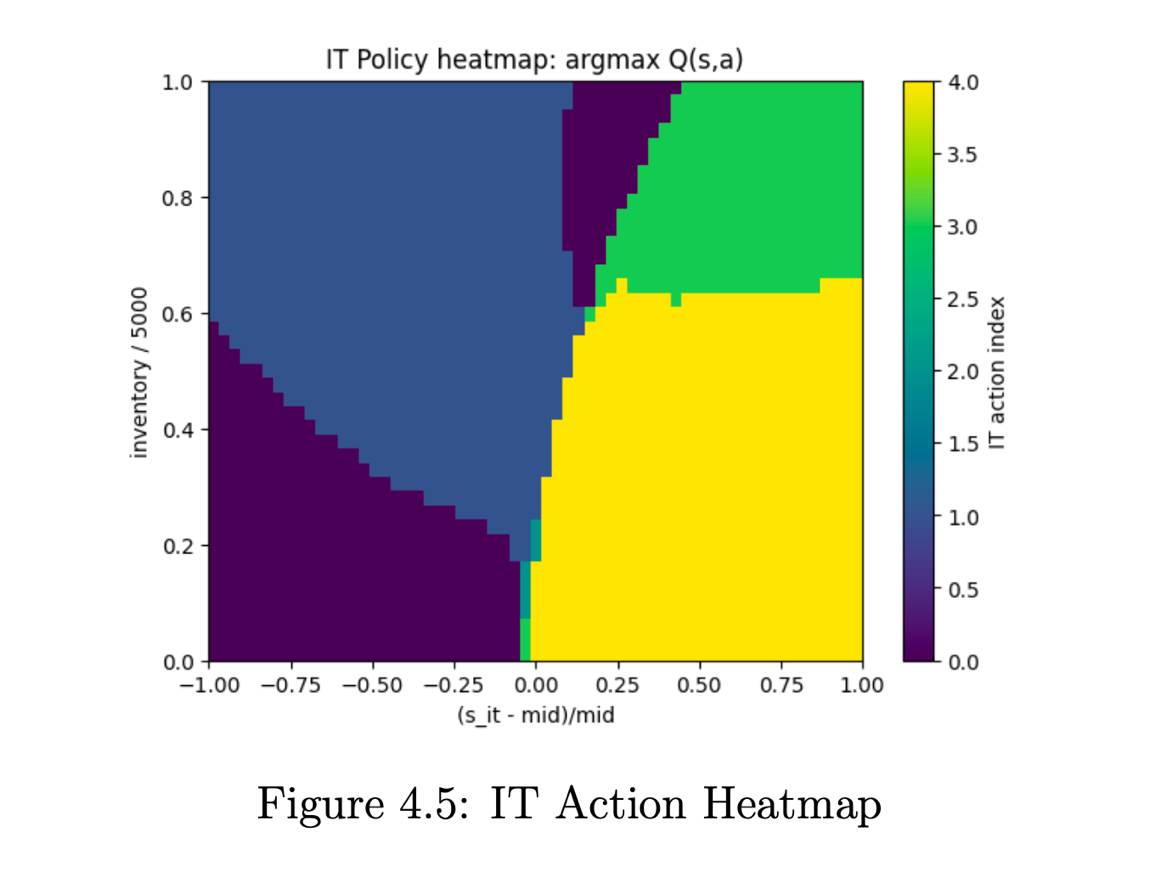
This paper builds a simulated limit-order-book market in which reinforcement learning agents trade a short-lived asset. The model helps reveal how private information, inventory risk, and competition shape price discovery and profits for AI trading agents. In the single-market-maker environment, the team shows that the RL-informed trader endogenously learns to hide its orders when prices are far from its private signal, to condition on recent price trends, and to exploit a mechanically adaptive but non-learning market maker. When two RL market makers compete, they examine how their learned quoting rules affect price efficiency and the detectability of informed trading from public data, connecting the AI-collusion literature to the concrete structure of LOB markets.
The informed trader buys when the asset is underpriced and sells when it is overpriced, while becoming more conservative as inventory grows.
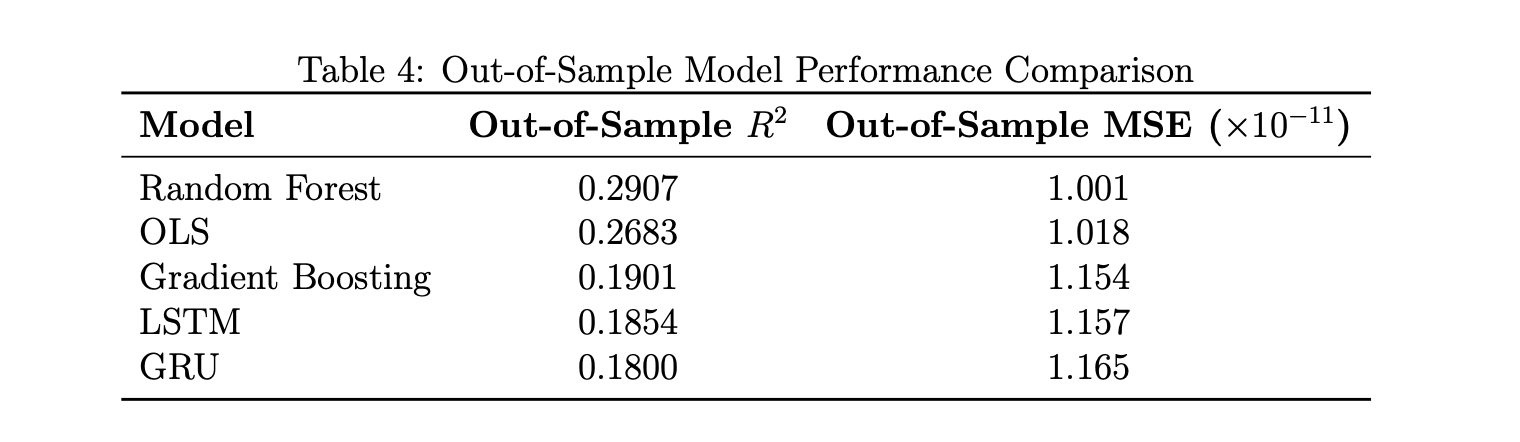
The paper tests whether high-frequency microstructure signals can predict short-horizon price impact and flag informed trading risk. Using millisecond TAQ data for ten U.S. stocks in 2011, the team builds two measures—QID (quote improvement vs deterioration) and BER (speed of top-of-book depletion)—and uses them, plus additional features, to forecast five-minute-ahead price impact. They find that (i) tree-based and linear models outperform deep learning in this noisy, data-limited setting, (ii) QID and BER add predictive power beyond standard liquidity variables, and (iii) generic feature engineering further improves accuracy across models.
Simpler models—OLS and Random Forest—outperform the more complex LSTM and GRU sequence models out of sample.
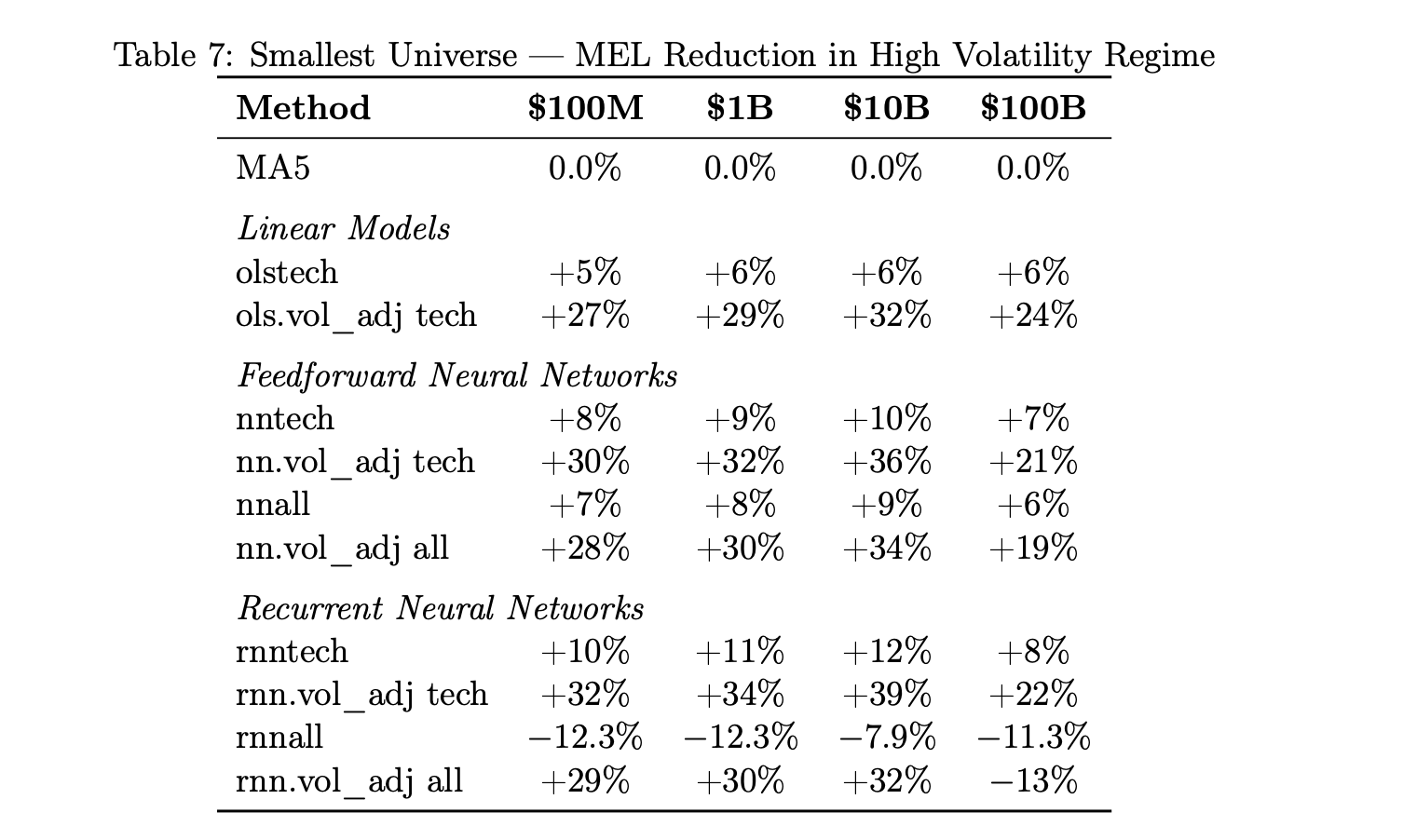
This paper extends the trading volume alpha framework of Goyenko et al. (2025) to make trade execution decisions depend on both volume and volatility. Using linear (Ridge) and neural network (RNN-LSTM) models to forecast daily volume surprises and plugging them into an economic loss function, the team finds that economically fine-tuned RNNs work best for large, liquid stocks, while simple linear models are superior for small caps. Allowing price impact to scale with volatility surprises yields modest gains for large caps but substantially cuts economic loss—by about 30-40%—for illiquid stocks in high-volatility regimes relative to volume-only RNNs.
The volatility-adjusted overlay reduces mean economic loss by roughly 20-25 percentage points versus volume-only models for the smallest-stock universe in high-volatility regimes.
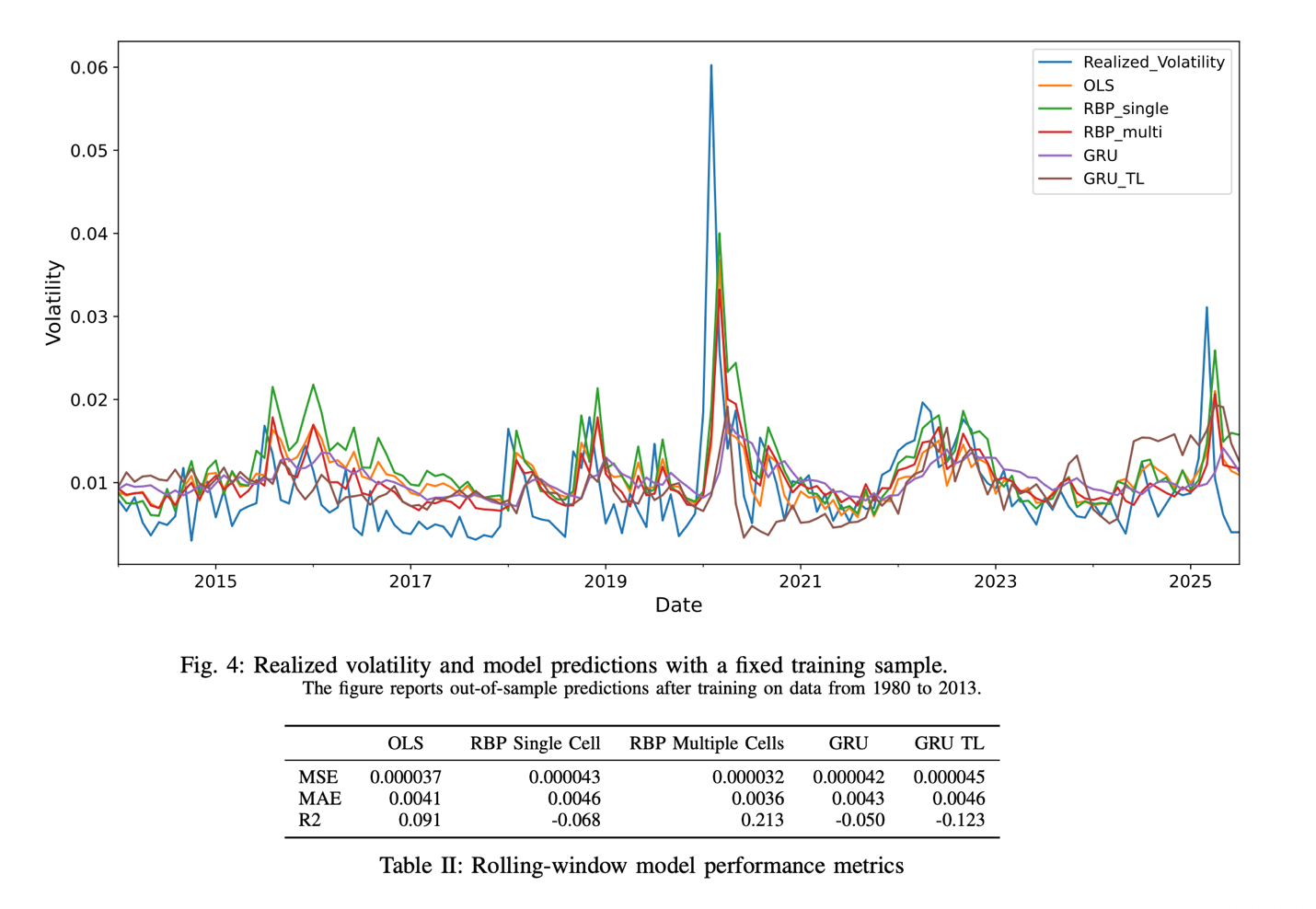
This paper compares models with different degrees of complexity and interpretability and examines their ability to predict monthly S&P500 realized volatility. The models include OLS, relevance-based prediction (RBP), gated recurrent units (GRU), and GRU augmented with transfer learning. The findings suggest that there need not always be a tradeoff between performance and model interpretability. RBP, with proper tuning, delivers the best fits for the real data. Moreover, inherently interpretable models are able to maintain high performance under scenarios where they perturb the data-generating process in different ways.
Realized volatility and out-of-sample model predictions after training on 1980-2013 and testing on 2014-2025.