 |
Date Spring 2010
Place Vienna, Austria
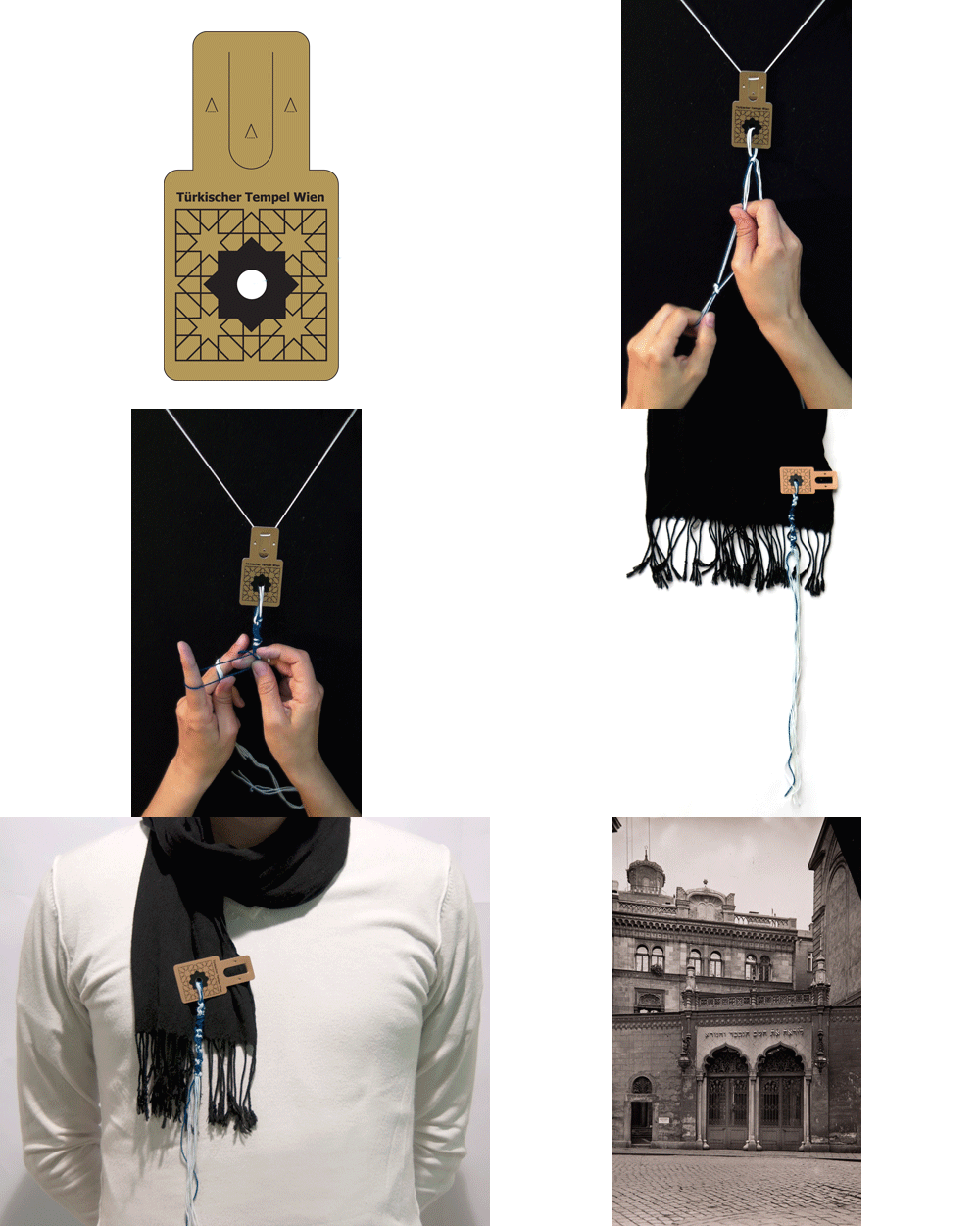
Medium mixed media: printed 10.000 medium plastic admission tags (3,8 x 7,4 cm each), video 10 min.
Design context Produced for the exhibition Turks in Vienna at the Jewish Museum Vienna / 12 May – 31 Oct. 2010 / Curated by Felicitas Heinman-Jelinek, Gabriele Kohlbauer-Fritz, Gerhard Milchram
Co-Author Dietmar Offenhuber
|
|
|
Tempelmarke [ Temple Tag ] Tempelmarke or Temple Tag is a collaborative art project by Azra Akšamija and Dietmar Offenhuber designed for the exhibition “The Turks in Vienna,” running from 12 May – 31 October 2010 at the Jewish Museum Vienna. The exhibition explores the history of the Jewish Sephardic community, which lived in Vienna under the protectorate of the Ottoman sultan and was known as the Turkish-Jewish community. Its synagogue, designed in Moorish style and called ”Das Türkische Tempel“ (”The Turkish Temple,” ), was inaugurated 1887 and destroyed by Nazis in 1938. The project Temple Tag aims to symbolically restore this extraordinary synagogue through the interaction of the museums’ visitors with the content of the exhibition via small wearable objects called Temple Tags. A Temple Tag is a hybrid of a tallit-corner and a plastic admission tag that can be attached to clothes of museum visitors. The golden rectangular tag has a hole in its center, though which tzitzit threads (three white and one blue) are led. A simple geometrical pattern is printed on the visible surface of the tag; this pattern provides reference to Moorish/Islamic geometry, Jewish symbolism, as well as to architectural elements of the former Turkish Temple (i.e. patterns of the carpet). The golden-metallic tag is reminiscent of the golden tiles that used to cover the interior dome of the synagogue. In its function, the Temple Tag object is used as a museum’s admission tag, which is given to the visitors with the ticket purchase. The tag also functions as an attachable corner of a tallit, four of which can transform the visitors’ clothes into a Jewish prayer shawl. With this, the modular character of the work comes to the fore: while an individual tag stands for an admission mark of the museum, four Temple Tags can form the four corners of a tallit. Ten tallits worn by individuals form the basis for a minyan, which can be understood as abstraction of a synagogue. Simultaneously, the shape and the function of the Temple Tag as an admission mark refers to the current existence of the synagogue only as a collection of fragmentary images, as well as to the role of the visitors as participants in the museum’s enterprise to keep the memory of the Turkish-Jewish community alive. In addition to the tag, the piece includes a video-text installation, which shows the process of knotting a Sephardic type of tzitzit. This interactive aspect of the piece is aimed at educating the visitors about the Viennese synagogue’s history and the Jewish culture.
|
||