1066 and All That
R. J. Yeatman and W. C. Sellar
(Footnotes by A.Z.)
COMPULSORY PREFACE
(This Means You)
Histories have previously been written with the object of exalting their authors. The object of this History is to console the reader. No other history does this.
History is not what you thought. It is what you can remember. All other history defeats itself.
This is the only Memorable History of England, because all the History that you can remember is in this book, which is the result of years of research in golfclubs, gun-rooms, green-rooms, etc.
For instance, two out of the four Dates originally included were eliminated at the last moment, a research done at the Eton and Harrow match having revealed that they are not memorable.
The Editors will be glad of further assistance towards the elimination, in future editions, of any similarly unhistorical matter which, despite their vigilance, may have crept into the text.
They take this opportunity of acknowledging their inestimable debt to the mass of educated men and women of their race whose historical intuitions and opinions this work enshrines.
Also, to the Great British People without whose selfsacrificing determination to become top Nation there would have been no (memorable) history.
History is now at an end (see p. 123); this History is therefore final.
W. C. S.
R. J. Y.
PREFACE TO SECOND EDITION
A first edition limited to one copy and printed on rice paper and bound in buck-boards and signed by one of the editors was sold to the other editor, who left it in a taxi somewhere between Piccadilly Circus and the Bodleian.
W. C. S.
R. J. Y.
ACKNOWLEDGEMENTS
The Editors acknowledge their comparative indebtedness to the Editors of the Historical Review, Bradshaw, the Lancet, La Vie Parisienne, etc., in which none of the following Chapters has appeared. Their thanks are also due to their wife, for not preparing the index wrong. There is no index.
PRESS OPINIONS
This slim volume...
Bookworm...We look forward keenly to the appearance of their last work.
Review of Reviews of Reviews... vague...
Vague
ERRATA
- p. 11 For Middletoe read Mistletoe.
- p. 17 For looked 4th read looked forth.
- p. 50 For Pheasant read Peasant, throughout.
- p. 52 For sausage read hostage.
Chapter 1
Caesar Invades Britain
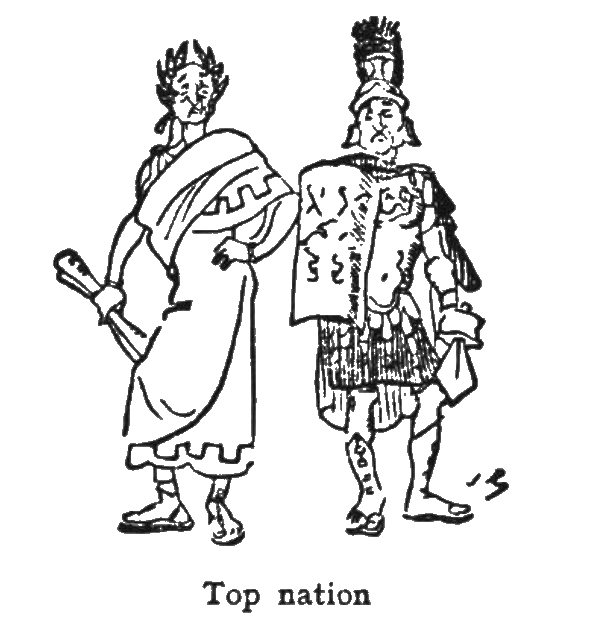
The first dateFor the other date see Chapter 11, William the Conqueror. in English History is 55 B.C., in which year Julius Caesar (the memorable Roman Emperor) Caesar was never a Roman emperor. landed, like all other successful invaders of these islands, at Thanet. Caesar did indeed land in Thanet. This was in the Olden Days, when the Romans were top nation on account of their classical education, etc.
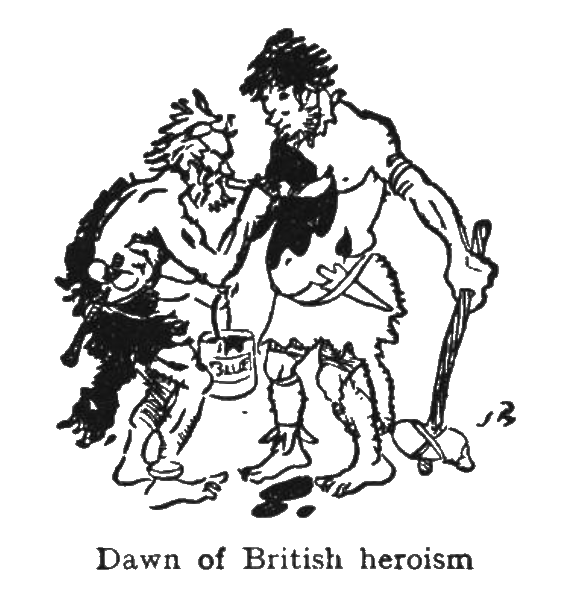
Julius Caesar advanced very energetically, throwing his cavalry several thousands of paces over the River Flumen; "Flumen" is Latin for “river”. but the Ancient Britons, though all well over military age, painted themselves true blue, or wood, and fought as heroically under their dashing queen, Woadicea, Boudica was an Iceni queen who led a revolt in 60/61 A.D.; woad is a blue dye (Isatis tinctoria) that Romans reported Britons as using for body paint. as they did later in thin red lines The Thin Red Line was an episode of the Battle of Balaclava in the Crimean War, where a thin British infantry line successfully held Russian cavalry at bay. under their good queen, Victoria.
Julius Caesar was therefore compelled to invade Britain again the following year (54 B.C., not 56, owing to the peculiar Roman method of counting), and having defeated the Ancient Britons by unfair means, such as battering-rams, tortoises, The “tortoise” (testudo) was a Roman shield-wall formation used under missile fire. hippocausts, Hypocausts were underfloor heating systems in Roman buildings. centipedes, Refers to centuries, a division of the Roman army led by centurions. axes, and bundles, set the memorable Latin sentence, Veni, Vidi, Vici, which the Romans, who were all very well educated, construed correctly.
The Britons, however, who of course still used the old pronunciation, understanding him to have called them “Weeny, Weedy, and Weaky,” As pronounced in a reconstructed Classical Latin pronunciation, which began to be popularized in England in the decades prior to the publication of 1066 and All That as a replacement to the traditional English pronunciation of Latin. lost heart and gave up the struggle, thinking that he had already divided them All into Three Parts. Caesar’s Commentarii de Bello Gallico opens with “Gallia est omnis divisa in partes tres” (all Gaul is divided in three parts).
Culture among the Ancient Britons
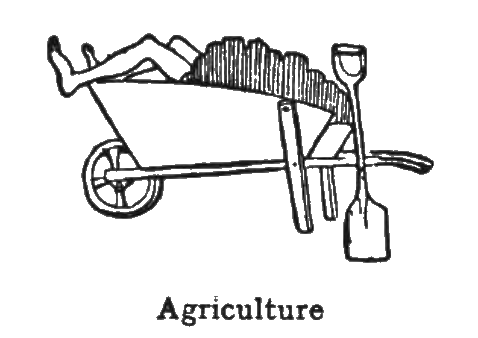
The Ancient Britons were by no means savages before the Conquest, and had already made great strides in civilization, e.g. they buried each other in long round wheelbarrows (agriculture) Barrows were Neolithic/Bronze Age burial mounds. and burnt each other alive (religion) under the guidance of even older Britons called Druids or Eisteddfods, Druids were a priestly class among Celtic peoples. An Eisteddfod is a Welsh cultural festival first recorded in the 12th century. who worshipped the Middletoe Pliny describes Celtic oak–mistletoe ceremonies. in the famous Druidical churchyard at Stoke Penge. Stoke Poges is the village where Gray wrote the Elegy Written in a Country Churchyard, which likely describes the churchyard at Stoke Poges.
The Roman Conquest was, however, a Good Thing, since the Britons were only natives at that time.
The Roman Occupation
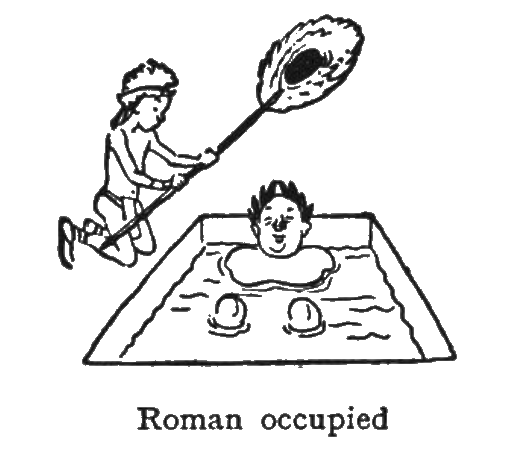
For some reason the Romans neglected to overrun the country with fire and the sword, though they had both of these; in fact, after the Conquest they did not mingle with the Britons at all, but lived a semi-detached life in villas. They occupied their time for two or three hundred years in building Roman roads and having Roman baths; this was called the Roman Occupation, and gave rise to the memorable Roman law, “HE WHO BATHS FIRST BATHS FAST,” which was a Good Thing, and still is.
The Roman roads ran absolutely straight in all directions and all led to Rome. The idiom “all roads lead to Rome” is actually of medieval, not ancient, origin. The first English instance is due to Chaucer: “right as diverse pathes leden the folk the righte wey to Rome”. The Romans also built towns wherever they were wanted, and, in addition, a wall between England and Scotland to keep out the savage Picts and Scots. This wall was the work of the memorable Roman Emperor Balbus and was thus called Hadrian’s Wall. The widely used Henry's First Latin Book contains useful stock phrases including “Balbus is building a wall” and “Do not irritate wasps”. The Balbus phrase is referenced elsewhere in English literature, e.g., by Joyce in the first Chapter of A Portrait of the Artist as a Young Man. More entertaining examples include a parody by Lewis Carroll ("Balbus was assisting his mother-in-law to convince the dragon") and in a speech supposedly made at a Cambridge dinner honoring Baden-Powell and the Boy Scout Movement, which features later in this text (see ). The Picts The Picts were peoples of northern and eastern Scotland; Latin picti (“painted”) likely refers to tattooing/body paint reported by Romans. , or painted men,e.g. The Black Watch, The Red Comyn, and Douglases of all colours. “Black Watch” is the 42nd (Highland) Regiment of Foot, a Scottish infantry unit; “Red Comyn” is John Comyn of Badenoch (1274-1306), a Scottish baron in the First War of Scottish Independence; “Douglases of all colours” refers to the Clan Douglas, whose heads held the title of Earl of Douglas (Black Douglas) or Earl of Angus (Red Douglas). were so called to distinguish them from the Britons. (See supra, woad.)
Chapter 2
Britain Conquered Again
The withdrawal of the Roman legions to take part in Gibbon’s Decline and Fall of the Roman Empire Surely this doesn't need a footnote. (due to a clamour among the Romans for pompous amusements such as bread and circumstances) “Bread and circuses” (panem et circenses) were public grain and entertainments in imperial Rome; it more generally refers to superficial appeasement for political gain. left Britain defenceless and subjected Europe to that long succession of Waves of which History is chiefly composed. While the Roman Empire was overrun by waves not only of Ostrogoths, Vizigoths, and even Goths, Ostrogoths and Visigoths were branches of the Goths who entered Roman territories in the 4th–5th centuries. but also of Vandals (who destroyed works of art) Vandals crossed into North Africa and sacked Rome in 455. and Huns (who destroyed everything and everybody, including Goths, Ostrogoths, Vizigoths, and even Vandals), The Huns, under Attila in the mid-5th century, fought various Germanic groups and the Romans. Britain was attacked by waves of Picts (and, of course, Scots) who had recently learnt how to climb the wall, and of Angles, Saxons, and Jutes who, landing at Thanet, Hengist and Horsa were brothers who are said to have landed at Thanet as early settlers/invaders of Great Britain. They possibly came from a Germanic tribe (the Jutes) on the Jutland Peninsula. soon overran the country with fire (and, of course, the sword).
Important Note
The Scots (originally Irish, but by now Scotch) were at this time inhabiting Ireland, having driven the Irish (Picts) out of Scotland; while the Picts (originally Scots) were now Irish (living in brackets) and vice versa. Historically, “Scotti” were Gaelic raiders from Ireland who settled in western Scotland (Dál Riata) from the late Roman period; the Picts were native to northern/eastern Scotland. It is essential to keep these distinctions clearly in mind (and verce visa).
Humiliation of the Britons
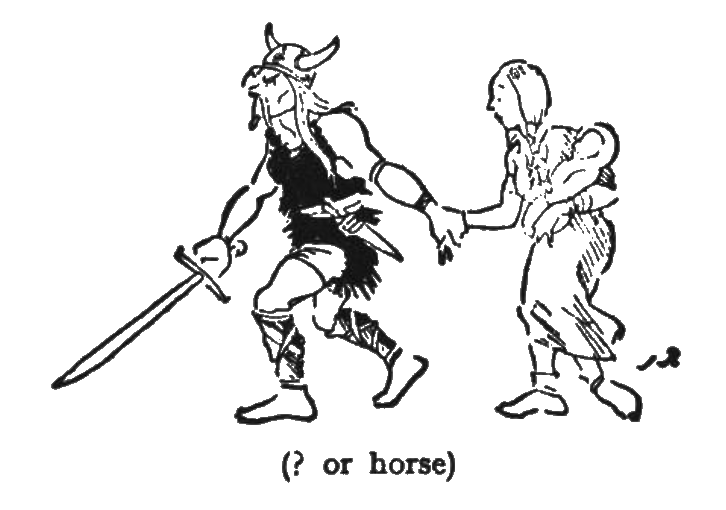
The brutal Saxon invaders drove the Britons westward into Wales and compelled them to become Welsh; it is now considered doubtful whether this was a Good Thing. Memorable among the Saxon warriors were Hengist and his wife (? or horse), Horsa. See . Hengist made himself King in the South. Thus Hengist was the first English King and his wife (or horse), Horsa, the first English Queen (or horse). The country was now almost entirely inhabited by Saxons and was therefore renamed England, and thus (naturally) soon became C. of E. This was a Good Thing, because previously the Saxons had worshipped some dreadful gods of their own called Monday, Tuesday, Wednesday, Thursday, Friday, and Saturday. Mani, Tiw, Woden, Thor, and Frigg/Freyja are Norse gods, but Saturn is Roman.
Chapter 3
The Conversion of England
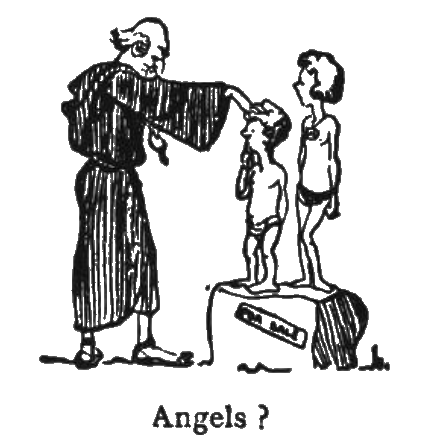
Noticing some fair-haired children in the slave market one morning, Pope Gregory, the memorable Pope, said (in Latin), “What are those?” and on being told that they were Angels, made the memorable joke “Non Angli, sed Angeli” (“not Angels but Anglicans”) and commanded one of his Saints called St Augustine to go and convert the rest. The story (reported by Bede, see ) has Pope Gregory seeing English slaves in Rome and sending Augustine of Canterbury (landed 597) to convert the English.
The conversion of England was thus effected by the landing of St Augustine in Thanet and other places, Augustine did indeed land in Thanet. which resulted in the country being overrun by a Wave of Saints. Among these were St Ive, St Pancra, the great St Bernard (originator of the clerical collar), The clerical collar is sometimes referred to as the "dog collar". St Bee, St Ebb, St Neot (who invented whisky), Neat obviously refers to the undiluted manner of drinking whisky; St. Ives, St. Bees and St. Abbs are towns/villages. St Kit and St Kin, and the Venomous Bead (author of The Rosary). The Venerable Bede (c. 673–735) wrote the Ecclesiastical History of the English People, not “The Rosary” (which, obviously, is made of beads). England was now divided into seven kingdoms The Heptarchy was the division of England into the petty kingdoms of Northumbria, Mercia, East Anglia, Essex, Kent, Sussex, and Wessex. and so ready were the English to become C. of E. that on one memorable occasion a whole Kingdom was easily converted by a sparrow. Bede recounts a counselor’s “sparrow in the hall” parable persuading King Edwin of Northumbria to accept Christianity (627).
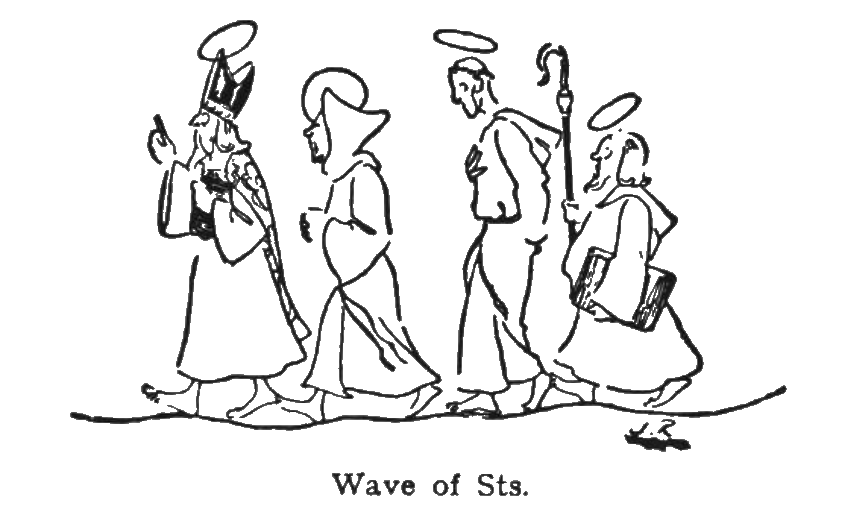
Wave of Egg-Kings
Soon after this event Egg-Kings were found on the thrones of all these kingdoms, such as Eggberd, Eggbreth, Eggfroth, etc. Old English royal names often began with Ecg‑ (sword) prefixes—e.g., Ecgberht, Ecgfrith. None of them, however, succeeded in becoming memorable except in so far as it is difficult to forget such names as Eggbirth, Eggbred, Eggbeard, Eggfish, etc. Nor is it even remembered by what kind of Eggdeath they perished.
Chapter 4
Britain Conquered Again
The conversion of Britain was followed by a Wave of Danes, accompanied by their sisters or Sagas, and led by such memorable warriors as Harold Falsetooth King Harald “Bluetooth” was a 10th‑century king of Denmark and Norway. and Magnus the Great, Actually Magnus the Good. who, landing correctly in Thanet, overran the country from right to left, with fire.And, according to certain obstinate historians, the Sword. Magnus the Good actually did not invade England despite repeated threats. After this the Danes invented a law called the Danelaw, The Danelaw was actually a region of England under Danish/Norse legal customs (roughly north/east of Watling Street). which easily proved that since there was nobody else left alive there, all the right-hand part of England belonged to them. The Danish Conquest was, however, undoubtedly a Good Thing, because although it made the Danes top nation for a time it was the cause of Alfred the Cake King Alfred the Great (r. 871–899) is said to have accidentally burned a peasant woman's cakes while in hiding during Viking wars. (and in any case they were beaten utterly in the end by Nelson). Horatio Nelson defeated a Danish fleet at Copenhagen in 1801.
By this time the Saxons had all become very old like the Britons before them and were called ealdormen; Ealdorman: high‑ranking noble/official in Anglo‑Saxon England (precursor to the later “earl”). when they had been defeated in a battle by the Danes they used to sing little songs to themselves such as the memorable fragment discovered in the Bodleian Library at Oxford:
Old-Saxon Fragment
Syng a song of Saxons
In the Wapentake of Rye
Four and twenty eaoldormen
Too eaold to die….
Pastiche of the nursery rhyme "Sing a Song of Sixpence". Wapentake is a Norse‑derived administrative division in the Danelaw.
The Danes, on the other hand, wrote a very defiant kind of Epic poetry, e.g.:
Beoleopard OR The Witan’s Whail
Whan Cnut
Cnut (Canute) ruled England 1016–1035.
Cyng the Witan
Witan: the royal council of Anglo‑Saxon England.
wold enfeoff
To “enfeoff”: to grant land in return for service under feudal law.
Of infangthief and outfangthief
Infangthief/outfangthief: medieval legal rights to try thieves caught within/without a lord’s jurisdiction.
onderlich were they enwraged
And wordwar waged
Sware Cnut great scot and lot
Scot and lot: local taxation and civic obligations in medieval/early modern towns.
Swinge wold ich this illbegotten lot.
Wroth was Cnut and wrothword spake.
Well wold he win at wopantake.
Fain wold he brakë frith
Frith: peace or truce in Old English law.
and crackë heads
And than they shold worshippe his redes
Redes: counsels or decrees.
.
Swingéd Cnut Cyng with swung sword
Howléd Witane hellë but hearkened his word
Murië sang Cnut Cyng
Outfangthief is Damgudthyng.
Chapter 5
Alfred the Cake
King Alfred was the first Good King, with the exception of Good King Wenceslas, who, though he looked 4th, really came first (it is not known, however, what King Wenceslas was King of). "Good King Wenceslas" is the carol about the historical Wenceslaus I, Duke of Bohemia. Alfred ought never to be confused with King Arthur, equally memorable but probably non-existent and therefore perhaps less important historically (unless he did exist).
There is a story that King Arthur once burnt some cakes See . belonging to Mrs Girth, a great lady of the time, at a place called Atheling. Athelney was Alfred's marsh stronghold; Atheling was a term to designate princes of the royal dynasty who were eligible for the kingship. As, however, Alfred could not have been an Incendiary King and a Good King, we may dismiss the story as absurd, and in any case the event is supposed to have occurred in a marsh where the cakes would not have burnt properly. Cf. the famous lines of poetry about King Arthur and the cakes:
`Then slowly answered Alfred from the marsh '
'And slowly answer'd Arthur from the barge' is a line from "Morte d'Arthur" by Lord Alfred Tennyson.
Chapter 6
Exgalahad and the British Navy
King Arthur invented Conferences Refers to the phrase "round table conference"; possibly more specifically to the Round Table Conferences in India that occurred within a month of the book's publishing. because he was secretly a Weak King and liked to know what his memorable thousand and one Knights wanted to do next. As they were all parfitly jealous Knights Chaucer writes of the "parfit gentil knyght" in "The Knight's Tale"; it is controversial if it is a sincere or insincere description of the knyght. he had to have the Memorable Round Table made to have the Conferences at, so that it was impossible to say which was top knight. He had a miraculous sword called Exgalahad Portmanteau of Excalibur and Galahad. with which he defeated the Danes in numerous battles. In this he was also much assisted by his marine inventions, including the water-dock and the British Navy. The odd phrase "water-dock" is used because it refers to a plant common in English fens; Alfred did indeed build a navy to fight the Danes. The latter invention occurred as follows.
Alfred noticed that the Danes had very long ships, so he built a great many more much longer ones, thus cleverly founding the British Navy. From that time onwards foreigners, who, unlike the English, do not prefer to fight against long odds, seldom attacked the British Navy. Hence the important International Law called the Rule Britannia, technically known as the Freedom of the Seas. “Rule, Britannia!” is a 1740 song; “freedom of the seas” as doctrine traces to Grotius (1609).
Humiliation of the Danes
The English resisted the Danes heroically under Alfred, never fighting except against heavy odds, till at the memorable Peace of Wedmore Alfred compelled the Danes, who were now (of course) beaten, to stop being Danes and become English and therefore C. of E. and get properly married. Treaty of Wedmore (878) was a peace treaty conditional on the baptism (not marriage) of Guthrum (the Viking leader).
For this purpose they were made to go back and start again at Thanet, after which they were called in future Thanes instead of Danes Thane: an Anglo-Saxon noble. and were on our side and in the right and very romantic.
Chapter 7
Lady Windermere. Age of Lake Dwellers
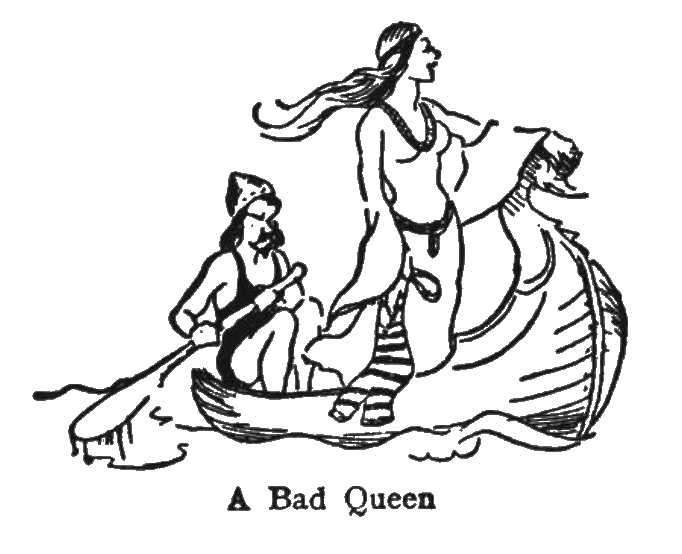
Alfred had a very interesting wife called Lady Windermere (The Lady of the Lake), “Lady Windermere” is from Wilde’s play Lady Windermere's Fan; “Lady of the Lake” is the Arthurian enchantress. who was always clothed in the same white frock, and used to go bathing with Sir Launcelot (also of the Lake) and was thus a Bad Queen. The Lady of the Lake was a lover of Sir Lancelot in the Arthurian legend. It was also in King Arthur’s time that the Anglo-Saxon Chronicle was published: this was the first English newspaper and had all the news about his victories, and Lady Windermere, and the Cakes, etc. The Anglo-Saxon Chronicle is a set of annals begun c. 890 during Alfred’s reign.
Chapter 8
Ethelread the Unready: A Weak King
Ethelread the Unready Æthelred II (r. 978–1016); epithet from Unræd = “ill-advised,” punning his name (“noble counsel”). was the first Weak King of England and was thus the cause of a fresh Wave of Danes.
He was called the Unready because he was never ready when the Danes were. Rather than wait for him the Danes used to fine him large sums called Danegeld, for not being ready. Danegeld: tribute raised/paid to buy off Viking attacks. But though they were always ready, the Danes had very bad memories and often used to forget that they had been paid the Danegeld and come back for it almost before they had sailed away. By that time Ethelread was always unready again.
Finally, Ethelread was taken completely unawares by his own death and was succeeded by Canute. Succession ran via Æthelred’s son Edmund Ironside (d. 1016) to Cnut (Canute).
Chapter 9
Canute, an Experimental King
This memorable monarch, having set out from Norway to collect some Danegeld, landed by mistake at Thanet, and thus became King. Cnut came with a Danish fleet and sailed around Kent to Wessex; the Isle of Thanet is the easternmost part of Kent (now a peninsula, not an island).
Canute and the Waves
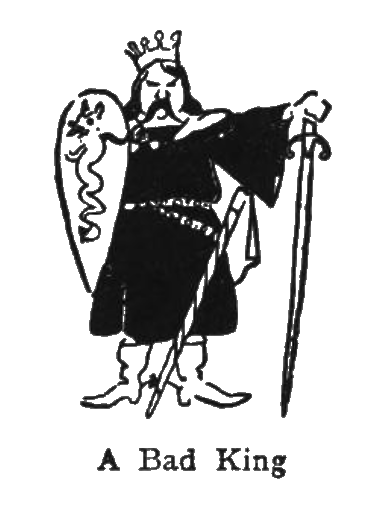
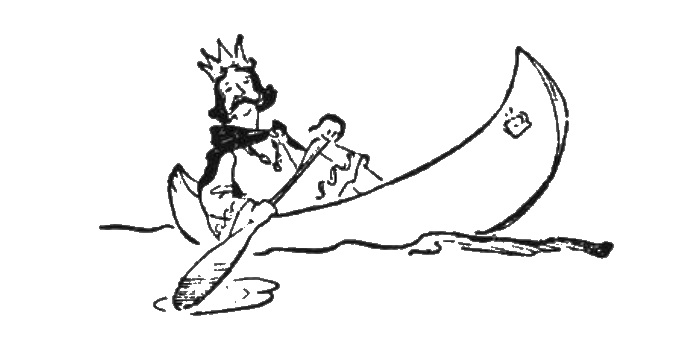
Canute began by being a Bad King on the advice of his Courtiers, who informed him (owing to a misunderstanding of the Rule Britannia) that the King of England was entitled to sit on the sea without getting wet. This both puns Canute with canoe and refers to the story of King Canute and the tide, where Canute attempts to command the tide to halt but gets wet. Henry of Huntingdon writes that this was intended as a display of humility; the king "leapt backwards and said 'Let all men know how empty and worthless is the power of kings, for there is none worthy of the name, but He whom heaven, earth, and sea obey by eternal laws.'" He then hung his gold crown on a crucifix, and never wore it again "to the honour of God the almighty King". But finding that they were wrong he gave up this policy and decided to take his own advice in future thus originating the memorable proverb, ‘Paddle your own Canute’ and became a Good King and C. of E., and ceased to be memorable. After Canute there were no more aquatic kings till William IV (see later, Creation of Piers). William IV (1765-1837) was nicknamed the "Sailor King" and also created additional peers to help pass the Great Reform Act of 1832.
Canute had two sons, Halfacanute and Partacanute, and two other offspring, Rathacanute and Hardlicanute, whom, however, he would never acknowledge, denying to the last that he was their Fathacanute. His historical heirs were Harold Harefoot and Harthacnut; he also had son Svein Knutsson and daughter Gunhilda.
Chapter 10
Edward the Confessor
On his death Canute's Kingdom was divided between two further sons, who had been previously overlooked, Aftercanute and Harold Harebrush. These were succeeded by Edward the Confessor. It was about this time that the memorable Mac Beth ('Ian Hay'), known as the Bane of Fife, murdered a number of his enemies, including Mac Duff, Lord Dunsinaney, Sleep, etc. Major John Hay Beith (1876-1952) wrote light war comedies under the pseudonym Ian Hay; Lord Macduff is the Thane of Fife in Macbeth; Dunsinane Hill is the site of Macbeth's castle in the play; Sleep is a mock reference to a person due to the line "Macbeth does murder sleep".
Edward the Confessor was with difficulty prevented from confessing to all these and many other crimes committed in his reign, as he was in the habit of confessing everything whether he had done it or not, and was thus a Weak King. Epithet “the Confessor” reflects piety; he reigned 1042–1066 and founded Westminster Abbey (consecrated 1065).
The Last English King
With Edward the Confessor perished the last English King (viz. Edward the Confessor), since he was succeeded by Waves of Norman Kings (French), Tudors (Welsh), Stuarts (Scottish), and Hanoverians (German), not to mention the memorable Dutch King-Williamanmary. Norman (1066–1154), Tudor (1485–1603), Stuart (1603–1714), Hanoverian (1714–1901); William III & Mary II were Dutch/English co-monarchs (1689–1702).
TEST PAPER I
Up to the End of 1066
- Which do you consider were the more alike, Caesar or Pompey, or vice versa? (Be brief.)
- Discuss, in latin or gothic (but not both), whether the Northumbrian Bishops were more schismatical than the Cumbrian Abbots. (Be bright.)
- Which came first, A.D. or B.C.? (Be careful.)
- Has it never occurred to you that the Romans counted backwards? (Be honest.)
- How angry would you be if it was suggested (1) That the XIth Chap, of the Consolations of Boethius A philosophical work written by Boethius while imprisoned by the Ostrogoths, often considered the last great Western work of the Classical Period. was an interpolated palimpsest? (2) That an eisteddfod See . was an agricultural implement?
- How would you have attempted to deal with (a) The Venomous Bead? (b) A Mabinogion or Wapentake? (Be quick.) The Mabinogion is a collection of medieval Welsh tales; recall and .
- What would have happened if (a) Boadicea had been the daughter of Edward the Confessor? (b) Canute had succeeded in sitting on the waves? Does it matter?
- Have you the faintest recollection of (1) Ethelbreth? (2) Athelthral? (3) Thruthelthrolth?
- What have you the faintest recollection of?
- Estimate the average age of (1) The Ancient Britons. (2) Ealdormen. (3) Old King Cole. "Old King Cole" is a nursery rhyme about the Welsh king Coel Hen.
- Why do you know nothing at all about (a) The Laws of Infangthief and Egg-seisin? (b) Saint Pancras? “Egg-seisin” parodies seisin (possession); St Pancras is a martyr and a London station.
- Would you say that Ethelread the Unready was directly responsible for the French Revolution? If so, what would you say?
N.B. Do not attempt to answer more than one question at a time.
Chapter 11
William I: A Conquering King
In the year 1066 occurred the other memorable date in English History, viz. William the Conqueror, Ten Sixty-six. This is also called The Battle of Hastings, and was when William I (1066) conquered England at the Battle of Senlac (Ten Sixty-six). The Battle of Hastings occurred on Senlac Hill.
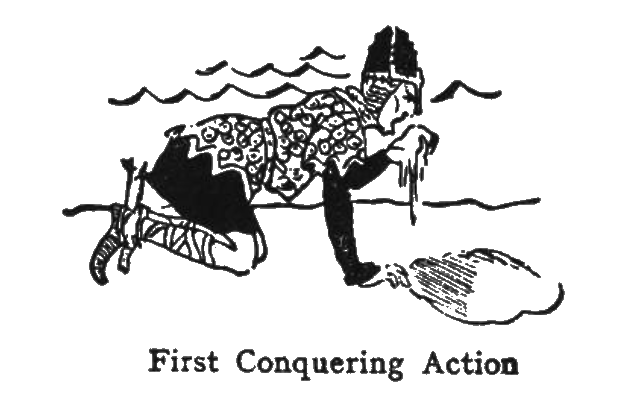
When William the Conqueror landed he lay down on the beach and swallowed two mouthfuls of sand. According to the Roman de Rou (1106), William I grabbed two handfuls of sand upon landing: 'As the ships were drawn to shore, and the duke first landed, he fell by chance upon his two hands. Forthwith all raised a loud cry of distress, "An evil sign," said they, "is here." But he cried out lustily, "See, seignors, by the splendour of God! I have seized England with my two hands; without challenge no prize can be made; all is our own that is here; and now we shall see who will be the bolder man.' This was his first conquering action and was in the South; later he ravaged the North as well. The Norman Conquest was a Good Thing, as from this time onwards England stopped being conquered and thus was able to become top nation.
Doomsday Book and the Forests
William next invented a system according to which everybody had to belong to somebody else, and everybody else to the King. This was called the Feutile System, Feudal system, obviously. and in order to prove that it was true he wrote a book called the Doomsday Book, The Domesday Book (1086) is a (surviving) book containing a survey of all landed property (and associated livestock, etc.). which contained an inventory of all the Possessions of all his subjects; after reading the book through carefully William agreed with it and signed it, indicating to everybody that the Possessions mentioned in it were now his.
William the Conqueror (1066) is memorable for having loved an old stag as if it was his father, The Anglo-Saxon Chronicle noted this in its obituary of William I: "As he forbade killing the deer, so also the boars; and he loved the tall stags as if he were their father." and was in general very fond of animals: he therefore made some very just and conquering laws about the Forests. One of these laws said that all the forests and places which were not already Possessions belonged to the King and that anyone found in them should have his ears and legs cut off (these belonged to somebody else under the Feutile System, anyway) and (if this had not already been done) should have his eyes put out with red-hot irons; Also from the Anglo-Saxon Chronicle's obituary of William I: "He made large forests for the deer, and enacted laws therewith, so that whoever killed a hart or a hind should be blinded." after this the offender was allowed to fly the country.
Another very conquering law made by William I said that everyone had to go to bed at eight o'clock. This was called the Curfew and was a Good Thing in the end since it was the cause of Gray's Energy in the country churchyard (at Stoke Penge). William I did enact an 8pm curfew to reduce the prevalence of unattended fires. Gray’s poem Elegy Written in a Country Churchyard opens with "The curfew tolls the knell of parting day".
Although in all these ways William the Conqueror (1066) was a very strong king he was eventually stumbled to death by a horse and was succeeded by his son Rufus. William I died in Rouen (1087) after a riding accident in Mantes.
Chapter 12
Rufus: A Ruddy King
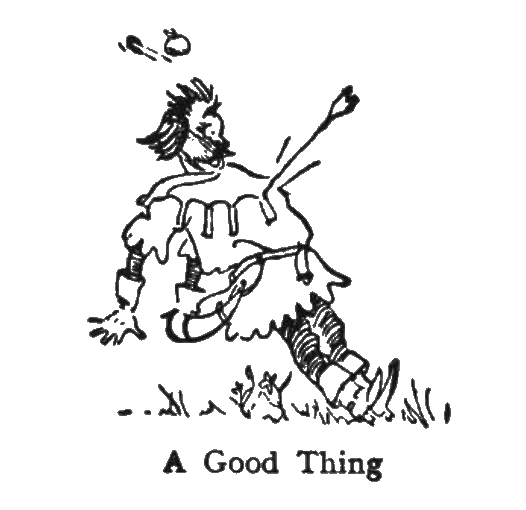
This monarch was always very angry and red in the face and was therefore unpopular, "Rufus" is Latin for red; he is believed to have red hair, but possibly had a ruddy appearance. so that his death was a Good Thing: it occurred in the following memorable way. Rufus was hunting one day in the New Forest, when William Tell (the memorable crackshot, inventor of Cross-bow puzzles) took unerring aim at a reddish apple, which had fallen on to the King's head, and shot him through the heart. William II “Rufus” died 1100 in New Forest by an arrow; later chroniclers name the killer as Walter Tirel, but this is uncertain. Sir Isaac Walton, who happened to be present at the time, thereupon invented the Law of Gravity. Izaak Walton wrote The Compleat Angler. Thus was the reign of Rufus brought to a Good End.
Chapter 13
Henry 1: A Tragic King
Henry I was famous for his handwriting and was therefore generally called Henry Beau-geste. Henry was nicknamed “Beauclerc” by late medieval historians who (likely incorrectly) believed Henry to be highly educated; beau geste is French for a gracious gesture. He was extremely fond of his son William, who was, however, drowned in the White City. The White Ship disaster (1120) killed heir William Adelin (and all 300 occupants of a vessel except a butcher); supposedly the captain drowned himself upon learning that the heir died. White City is a district of London. The future king, Stephen of Blois, was only saved because he disembarked (possibly due to the crew's excessive drinking). Henry tried to console himself for his loss by eating a surfeit of palfreys. This was a Bad Thing since he died of it and never smiled again. Legend says Henry I died from a “surfeit of lampreys” (1135); a palfrey is a riding horse. It is also said that Henry I was never seen to smile again after the death of William; this is attributed to Hume and popularized in poetry and in Dickens's A Child's History of England.
Chapter 14
The Dreadful Story of Stephen and his Aunt Matilda (or Maud)
The moment Stephen came to the throne it was realized that he was a mistake and had been christened wrong; thus everything was thrown into confusion. He is the only King Stephen in English history.
Stephen himself felt quite uncalled for, and even his Aunt Matilda was able to take him in when she began announcing that she was the real King. Henry I sought to be succeeded by his daughter, Empress Matilda, instead of his nephew, Stephen of Blois. The Anarchy (1138-1153) was a civil war between these two parties. The "Aunt" joke likely refers to Aunt Matilda Crawley, the much-liked aunt in Thackeray's Vanity Fair. Stephen, however, soon discovered that she had been malchristened, too, and was unable to say for certain whether her name was Matilda or Maud. Stephen's wife was also called Matilda; however, she was the Countess of Boulogne, and in French her name would be Maud. (A large number of Matildas/Mauds appear in this era: Henry I's queen was Matilda of Scotland / Good Queen Maud.)
After this Stephen and Matilda (or Maud) spent the reign escaping from each other over the snow in nightgowns Stephen almost captured Matilda during the Siege of Oxford, but she escaped by night "dressed in white" across the frozen Thames. while ‘God and His Angels slept’. The Anglo-Saxon Chronicle reports that "it was said openly that Christ and his saints slept" during the Anarchy.
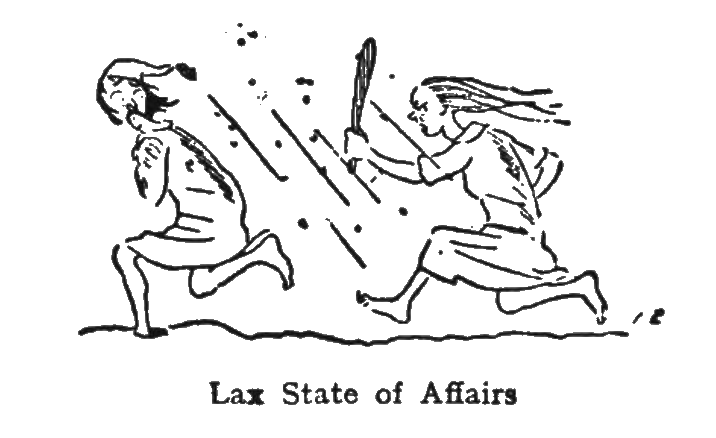
Taking advantage of this lax state of affairs, the Barons built a surfeit of romantic castles, into which they lured everybody and then put them to the torture; The Anglo-Saxon Chronicle writes that "every rich man built his castles, which they held against him: and they filled the land full of castles. They cruelly oppressed the wretched men of the land with castle-works; and when the castles were made, they filled them with devils and evil men. They took those whom they supposed to have any goods, and threw them into prison for their gold and silver, and inflicted on them unutterable tortures." nor is it recorded that the Sword was once sheathed right to the bottom, during the whole of this dreadful reign. Hence the memorable greeting so common among the Barons of the time ‘Merrie Englande!’ Merrie England refers to an idyllic pastoral image of society invented in early modern Britain as a description of pre-industrial England. It was coined in 1150 in a later edition of the Historia Anglorum, which was updated to end with the death of Stephen.
Chapter 15
Henry II: A Just King
Henry II was a great Lawgiver, and it was he who laid down the great Legal Principle that everything is either legal or (preferably) illegal. Henry II (r. 1154–1189) strengthened royal justice—issuing writs, sending itinerant justices, and developing procedures that became the common law.
He also made another very just arrangement about trials: Before Henry II's time there were two kinds of legal trial, (a) the Ideal Trial by ordeal. and (b) the Combat Trial by combat. . The Ideal form of trial consisted in making a man plunge his head in boiling ploughshares, in order to see whether he had committed a crime or not. According to Henry's reformed system a man was tried first by a jury of his equals The Assize of Clarendon (1166) expanded jury presentment alongside royal inquests. Clerical involvement in ordeals ceased after 1215. and only had to plunge his head into the ploughshares afterwards (in order to confirm the jury's opinion that he had committed the crime). This was obviously a much Better Thing.
The Combat was a system by which in civil cases the litigants decided their dispute by mortal combat, after which the defeated party was allowed to fly the country. But Henry altered all this and declared that a Grand Jury must decide first what the parties were fighting about: a reform which naturally gave rise to grave discontent among the Barons, who believed in the Combat, the whole Combat and nothing but the Combat.
Thomas à Belloc
It was at this time that Thomas à Belloc, “Thomas à Belloc” blends Thomas Becket (Archbishop of Canterbury) with Hilaire Belloc (1870-1953, a writer noted for his versatility and his Catholicism). the great religious leader, claimed that clergymen, whatever crimes they might commit, could not be punished at all; this privilege, which was for some reason known as Benefit of Clergy, was in full accord with the devout spirit of the age. “Benefit of clergy” meant clerics were tried in ecclesiastical courts; later English practice let literate laymen claim it by reading a verse.
Henry II, however, exclaimed to some of his Knights one day, ‘Who will rid me of this Chesterton beast?’ The king’s frustrated remark is remembered as “Will no one rid me of this turbulent priest?” “Chesterton” invokes G. K. Chesterton, Belloc’s friend. Whereupon the Knights pursued Belloc and murdered him in the organ at Canterbury Cathedral. Belloc was therefore made a Saint and the Knights came to be called the Canterbury Pilgrims. Shortly afterwards Henry died of despair on receiving news that his sons were all revolting. Henry’s sons rebelled in 1173–74 and again later; he died in 1189 after defeat by Richard and Philip II.
Chapter 16
The Age of Piety
The Chapters between William I (1066) and the Tudors (Henry VIII, etc.) are always called the Middle Ages, on account of their coming at the beginning; this was also The Age of Piety, since Religious fervour was then at its height, people being (1) burnt alive with faggots (The Steak), (2) bricked up in the walls of Convents (Religious Foundations), and (3) tortured in dungeons (The Confessional).
All this was not only pious but a Good Thing, as many of the people who were burnt, bricked, tortured, etc., became quite otherworldly.
Nowadays people are not so pious, even sinners being denied the benefits of fervent Religion.
Chapter 17
Richard I: A Wild King
Richard I was a hairy King with a Lion's Heart; he went roaring about the Desert making ferocious attacks on the Saladins and the Paladins, and was thus a very romantic King. Richard I (r. 1189–1199) was known as Cœur de Lion (“Lionheart”). The Paladins were the legendary knights of Charlemagne's court; Saladin was the founder of the Ayyubid dynasty and leader in the Muslim effort against the Crusader states. Whenever he returned to England he always set out again immediately for the Mediterranean and was therefore known as Richard Gare de Lyon. “Gare de Lyon” is a Paris railway station. (I highly recommend the machine that makes fresh pomegrante juice at the nearby Franprix.) He had a sword of enormous dimensions with which he used to practise cutting iron bars and anvils in half, whereas the Saladins had very sharp swords which were only useful for cutting cushions in half. In Sir Walter Scott's Talisman, Richard and Saladin meet. Richard dramatically cuts a bar of iron in half with his sword, and is then asked if he could slice a silk and down cushion standing upright on the floor. Richard responds that "no sword on earth… can cut that which opposes no steady resistance to the blow"; Saladin proceeds to slice the cushion.
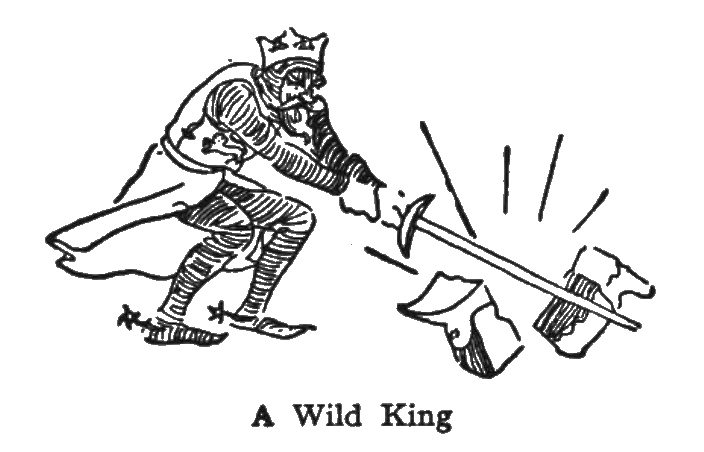
In spite of which the Crusaders under Richard never got Jerusalem back; The Third Crusade recovered Acre and coastal towns; Jerusalem remained under Saladin, with pilgrim access allowed by truce (1192). this was undoubtedly due to the treacherous behaviour of the Saladins, who used to fire on the Red Cross which the Crusaders wore on their chests in battle.
The Story of Blondin
Richard is also famous for having a minstrel boy (or Touralour) called Blondin who searched for him under the walls of all the dungeons in Europe. Supposedly the troubadour Blondel de Nesle located Richard by singing beneath various castle windows until he heard Richard continue the song they both knew. In reality, it was widely publicized where Richard was being held. This was when Richard had been caught by the blind King of Bohemia during a game of Blind King's Bluff and sold to the Holy Roman Terror. Richard was seized near Vienna (1192) by Duke Leopold of Austria and transferred to Emperor Henry VI of the Holy Roman Empire. Blondin eventually found him by singing the memorable song (or 'touralay') called O Richard et mon Droit ('Are you right, there, Richard?') which Richard himself had composed. The title echoes “Ô Richard, ô mon roi,” later popularized in Grétry’s opera Richard Cœur-de-lion (1784), and the English royal motto “Dieu et mon droit.” Richard roared the chorus so that Blondin knew which dungeon he was in, and thus the King easily escaped and returned to the Crusades, where he died soon after of a surfeit of Saladins, and was therefore known in the East as Richard Coeur de Laitue. Richard died in 1199 of a wound at Châlus in Aquitaine. "Laitue" is French for lettuce.
Chapter 18
John: An Awful King
When John came to the throne he lost his temper and flung himself on the floor, foaming at the mouth and biting the rushes. Matthew Paris, a 13th century chronicler, wrote that "John, gnashing his teeth and rolling his eyes, seized sticks and straws and, like a madman, gnawed or tore them, by these extraordinary gestures showing the grief and fury he felt". He was thus a Bad King. Indeed, he had begun badly as a Bad Prince, having attempted to answer the Irish Question N.B. The Irish Question at this time consisted of: (1) Some Norman Barons, who lived in a Pail (near Dublin), (2) The natives and Irish Chieftains, who were beyond the Pail, living in bogs, beards, etc. The Pale referred to the English-ruled district around Dublin; the idiom “beyond the Pale” means "behaviour beyond the boundary of acceptability". by pulling the beards of the aged Irish chiefs, Gerald of Wales's contemporary account says that King John "even rudely pulled them by their beards, which the Irishmen wore full and long". which was a Bad Thing and the wrong answer.
Prince Arthur A Tragedy in Little
John had a little nephew called Little Arthur, who was writing a little History of England in quite a small dungeon, and whose little blue eyes John had ordered to be put out with some weeny red-hot irons. Arthur of Brittany, captured in 1202, vanished in 1203/4; hostile chroniclers accuse John of his murder at Rouen. Callcott's Little Arthur's History of England (1835) was a popular Victorian children's history. The gaoler Hubert, however, who was a Good Man, wept so much that he put out the red-hot irons instead. Shakespeare’s King John dramatizes Hubert de Burgh refusing to blind Arthur. John was therefore compelled to do the little deed himself with a large, smallish knife, thus becoming the first memorable wicked uncle. In Marshall's popular children's history Our Island Story, Arthur is killed "by his wicked uncle's cruel, sharp knife".
The Bull
John was so bad that the Pope decided to put the whole country under an Interdict, i.e. he gave orders that no one was to be born or die or marry (except in Church porches). Pope Innocent III imposed an interdict on England (1208–1213) during the Canterbury dispute; public services were suspended. But John was still not cured of his Badness; so the Pope sent a Bull to England to excommunicate John himself. In spite of the King's efforts to prevent it the Bull succeeded in landing and gave orders that John himself was not to be born or marry or die (except in Church porches); that no one was to obey him or stand him a drink or tell him the right time or the answer to the Irish Question or anything nice. So at last John gave way and he and his subjects began once more to be born and to marry and to die, etc. etc. John was excommunicated in 1209; in 1213 he submitted and accepted England as a papal fief, restoring relations.
Chapter 19
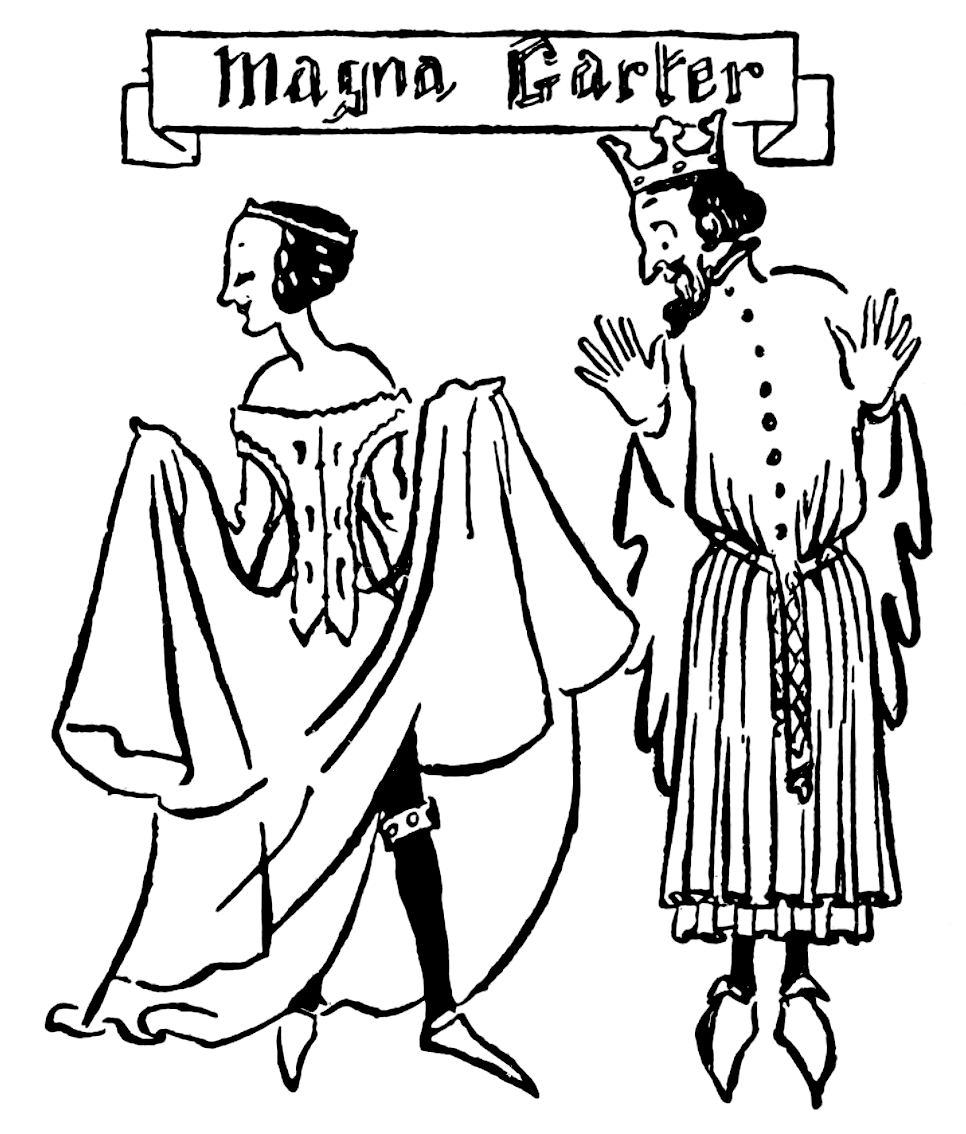
Magna Charter
There also happened in this reign the memorable Charta, known as Magna Charter on account of the Latin Magna (great) and Charter (a Charter); this was the first of the famous Chartas and Gartas of the Realm and was invented by the Barons on a desert island in the Thames called Ganymede. Magna Carta (15 June 1215) was agreed at Runnymede, a meadow by the Thames. By congregating there, armed to the teeth, the Barons compelled John to sign the Magna Charter, which said: The below is surprisingly accurate.
- That no one was to be put to death, save for some reason (except the Common People).
- That everyone should be free (except the Common People).
- That everything should be of the same weight and measure throughout the Realm (except the Common People).
- That the Courts should be stationary, instead of following a very tiresome medieval official known as the King's Person all over the country.
- That ‘no person should be fined to his utter ruin’ (except the King's Person).
- That the Barons should not be tried except by a special jury of other Barons who would understand.
Magna Charter was therefore the chief cause of Democracy in England, and thus a Good Thing for everyone (except the Common People).
After this King John hadn't a leg to stand on and was therefore known as ‘John Lackshanks’. John’s historical epithet was “Lackland,” from his early apanage.
Final Acts of Misgovernment
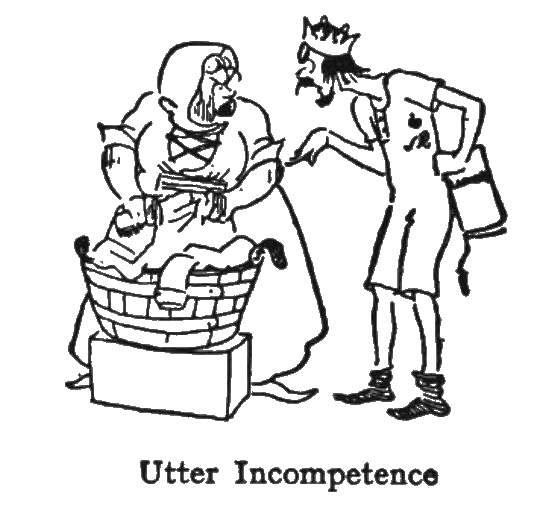
John finally demonstrated his utter incompetence by losing the Crown and all his clothes in the wash and then dying of a surfeit of peaches and no cider; thus his awful reign came to an end. In 1216 his baggage train and crown jewels were lost in the tidal flats of the Wash. He died shortly after, traditionally of dysentery, at Newark.
Chapter 20
Robin Hood and his Merrie Men
About this time the memorable hero Robin Hood flourished in a romantic manner. The Robin Hood cycle centers on Sherwood Forest and Nottingham; the earliest references appear in the 14th century, with long ballads circulating by c. 1500. Having been unjustly accused by two policemen in Richmond Park, Park in London. he was condemned to be an outdoor and went and lived with a maid who was called Marion, and a band of Merrie Men, in Greenwood Forest, near Sherborne. Amongst his Merrie Men were Will Scarlet (The Scarlet Pimpernel), Black Beauty, White Melville, Little Red Riding Hood (probably an outdaughter of his), and the famous Friar Puck who used to sit in a cowslip and suck bees, thus becoming so fat that he declared he could put his girdle round the Earth. Maid Marion and Will Scarlet are true characters; “Friar Puck” fuses Friar Tuck with Shakespeare’s Puck; The Scarlet Pimpernel is a 1905 historical novel by Baroness Orczy about the French Revolution; Whyte-Melville was a Victorian novelist who specialized in field sports.
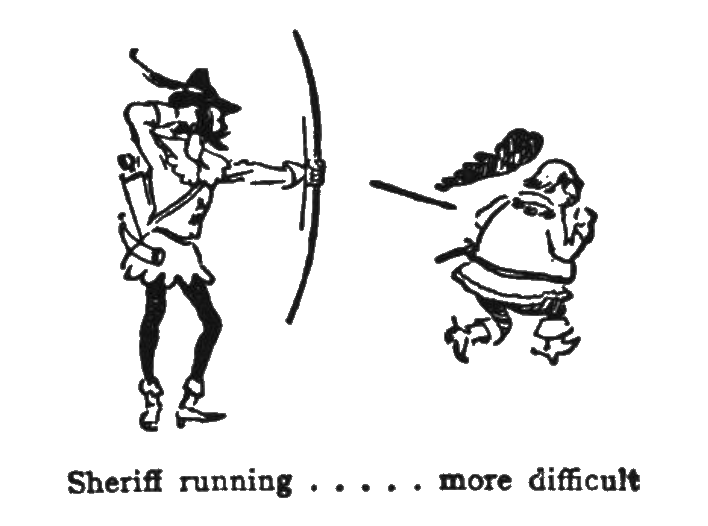
Robin Hood was a miraculous shot with the longbow and it is said that he could split a hare at 400 paces and a Sheriff at 800. He therefore spent his time blowing a horn and shooting at the Sheriff of Nottingham (who was an outwit). He always used to sound his horn first, particularly when shooting round a corner; this showed his sportsmanship and also enabled him to shoot the Sheriff running, which was more difficult.
Robin Hood was also very good at socialism and often took money away from rich clergymen and gave it to the poor, who loved him for his generosity. He died very romantically. Having taken some medicine supplied by his Wicked Aunt and feeling his strength going, he blew a dying blast on his horn and with his dying breath fired a last shot out of his bedroom window, and hit the Sheriff of Nottingham again. Late tradition places his death at Kirklees Priory, betrayed by a prioress; the “last arrow” marking his grave is a common tale.
Chapter 21
Henry III: A Nondescript King
Henry III was a confused kind of King and is only memorable for having seized all the money in the Mint, Henry III (r. 1216-1272) assembled two great hoards of gold between 1243 and 1258. (See here for a list of hoards in Great Britain.) To avoid selling off the gold and depressing its value, he introduced gold pennies to England, but the coins were overvalued and ultimately abandoned. imprisoned himself in the Tower of London This likely refers to when rebel barons, led by Simon de Montfort, chased Henry into the Tower and temporarily ruled under his name; this uprising was due to resentment against Jewish loans. It is entertaining to note another Tower-related anecdote: Henry III kept a menagerie in the Tower of London, including a leopard, a camel, and an elephant presented to him by Louis IX of France and sketched by Matthew Paris. and, finally, flung himself into the Bosom of the Pope. Henry swore to uphold the Provisions of Oxford, which attempted to limit royal power; he then sought papal absolution from his oaths in secret discussions with Pope Urban IV.

While he was in the Tower, Henry III wrote a letter to the nation saying that he was a Good Thing. This so confused the Londoners that they armed themselves with staves, jerkins, etc., and massacred the Jews in the City. See . The rebel barons killed 500 Jews in London. Later, when he was in the Pope's Bosom, Henry further confused the People by presenting all the Bonifaces of the Church to Italians. Papal “provisions” placed many Italian clerics in English benefices; Henry’s archbishop of Canterbury was Boniface of Savoy (1241–1270). And the whole reign was rapidly becoming less and less memorable when one of the Barons called Simon de Montfort saved the situation by announcing that he had a memorable Idea. Simon de Montfort led the baronial revolt and, after Lewes (1264), convened the 1265 assembly.
Simon de Montfort's Good Idea
Simon de Montfort's Idea was to make the Parliament more Representative by inviting one or two vergers, or vergesses, to come from every parish, thus causing the only Good Parliament in History. In 1265 de Montfort summoned knights of the shire and burgesses (town representatives)—often cited as a precursor to the House of Commons.
The Barons
Simon de Montfort, though only a Frenchman, was thus a Good Thing, and is very notable as being the only good Baron in history. The other Barons were, of course, all wicked Barons. They had, however, many important duties under the Banorial system. These were:
- To be armed to the teeth.
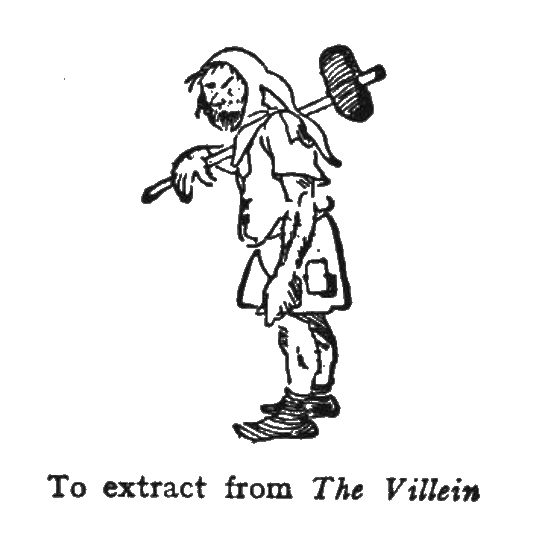
- To extract from the VilleinVillein: medieval term for agricultural labourer, usually suffering from scurvy, Black Death, etc. A villein was an unfree peasant tied to a manor; the Black Death reached England in 1348, later than Henry III’s reign. Saccage and Soccage, tollage and tallage, pillage and ullage, and, in extreme cases, all other banorial amenities such as umbrage and porrage. (These may be collectively defined as the banorial rites of carnage and wreckage.) The true terms here are socage (tenure), tallage (a tax), and saccage (a levy).
- To hasten the King's death, deposition, insanity, etc., and make quite sure that there were always at least three false claimants to the throne.
- To resent the Attitude of the Church. (The Barons were secretly jealous of the Church, which they accused of encroaching on their rites — see p. 30, Age of Piety.)
- To keep up the Middle Ages.
Note
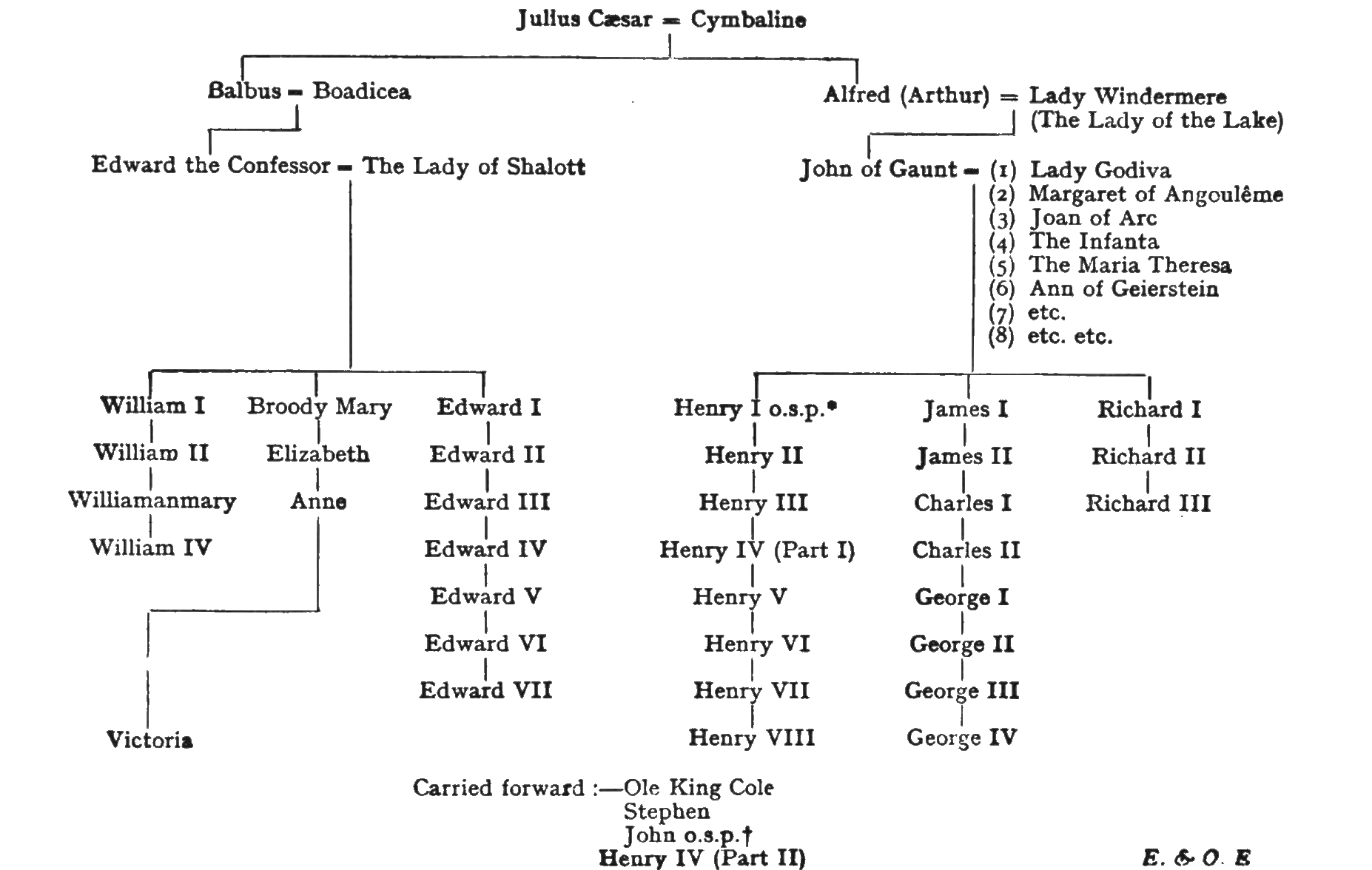
In order to clear up the general confusion of the period it is customary to give at this point a genealogical table of the Kings (and even some Queens) of England. As these tables are themselves somewhat confusing, the one on the page opposite has been to a certain extent rationalized, and will, the Editors hope, prove to be exceptionally memorable.
TEST PAPER II
Up to the End of Henry III *
- Give the dates of at least two of the following: (1) William the Conqueror. (2) 1066.N.B. Candidates over thirty need not attempt questions 10, 2, 5, 3, 4, 11, 9, or 1.
- What is a Plantagenet? Do you agree? “Plantagenet” comes from the broom plant (planta genista) emblem of Geoffrey of Anjou; the label was adopted by Richard of York near the end of the 15th century, and use then retrospectively applied to all of Geoffrey's male-line descendants.
- Trace by means of graphs, etc., (1) The incidence of scurvy in the Chiltern Hundreds during the reign of Rufus. (2) The Bosom of the Pope. (Squared paper, compasses, etc., may be used.) “Chiltern Hundreds” is a Buckinghamshire region; later, its stewardship became the legal fiction for resigning from the House of Commons.
- Expostulate (chiefly) on (a) The Curfew, (b) Gray's Energy in the Country Churchyard. See .
- Estimate the size of (1) Little Arthur. (2) Friar Puck. (3) Magna Charta.
- Fill in the names of at least some of the following: (1) . (2) . (3) Simon de Montfort.
- King John had no redeeming features. (Illustrate.)
- Arrange in this order: (1) Henry I. (2) Henry II. (3) Henry III. (Do not attempt to answer more than once.)
- (a) How far did the Lords Repellent drive Henry III into the arms of Pedro the Cruel? (Protractors may not be used.) (b) Matilda or Maud? (Write on one side of the paper only.) “Lords Appellant” belongs to Richard II’s reign; Pedro the Cruel is 14th-century Castile.
- How would you dispose of: (a) A Papal Bull? (b) Your nephews? (c) Your mother? (Be brutal.)
- Which would you rather be: (1) The Sheriff of Nottingham? (2) A Weak King? (3) Put to the Sword?
Chapter 22
Edward I: A Strong King
Long before Henry III had died (of a surfeit of Barons, Bonifaces, etc.) Edward I had taken advantage of the general confusion and of the death of Simon de Montfort (probably of a surfeit of Vergers) to become King before his reign had begun. Edward I reigned 1272–1307; Simon de Montfort was killed at Evesham (1265).
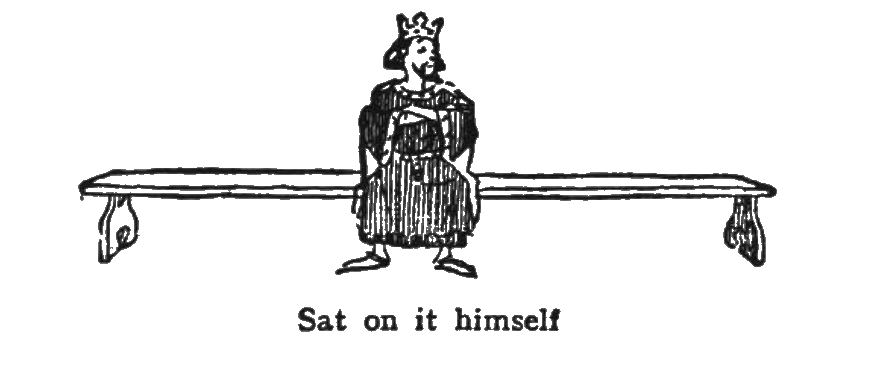
Edward I was thus a strong King, and one of the first things he did was to make a strong arrangement about the Law Courts. Hitherto there had been a number of Benches there, on all of which a confused official called the Justinian had tried to sit. Edward had them all amalgamated into one large Bench called the King's Bench, and sat on it himself. The “Justinian” here is the justiciar, the chief royal minister (not the Byzantine emperor Justinian). The Court of King’s Bench emerged from reforms separating the central courts (King’s Bench, Common Pleas, Exchequer).
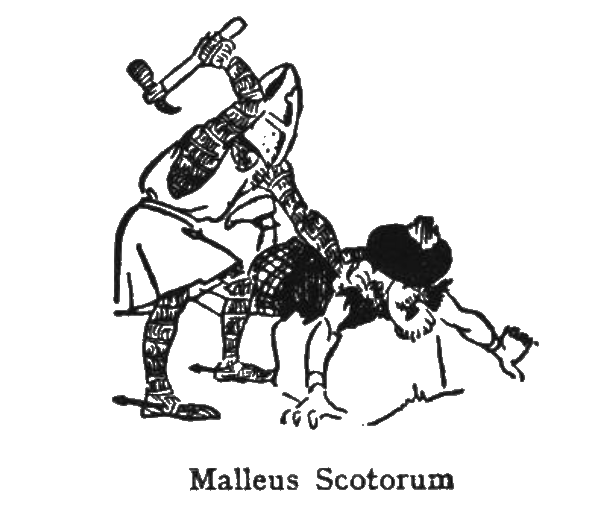
Edward I, who had already (in his Saladin days) piously decimated several thousand Turks at Nazareth, now felt so strong that he decided to Hammer the Scots, who accordingly now come right into History. Edward had crusaded in the Holy Land (1271–72). “Hammer of the Scots” was a later epithet from his Scottish campaigns.
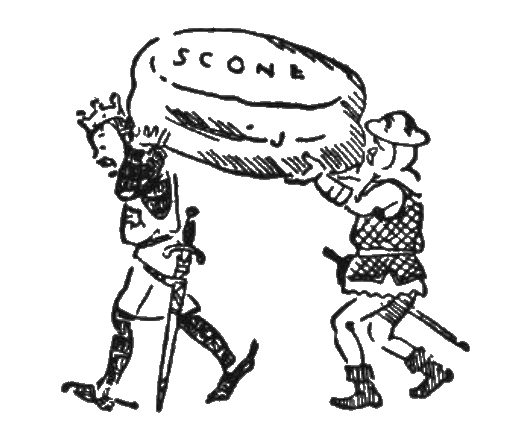
The childless Scotch King Alexander the Great had trotted over a cliff The king was Alexander III of Scotland (d. 1286). Reportedly, Le Saucier (who was likely the master of the local saltpans, or linked to the royal kitchen) told Alexander on the night of his death: "My lord, what are you doing out in such weather and darkness? How many times have I tried to persuade you that midnight travelling will do you no good?" Alexander was found dead with a broken neck near the shore the following morning; no cliff was involved, only a steep embankment. and was thus dead; so the Scots asked Edward to tell them who was King of Scotland, and Edward said that a Balliol man ought to be. Edward awarded the crown to John Balliol (1292), not to a graduate of Balliol College. Delighted with this decision the Scots crossed the Border and ravaged Cumberland with savage ferocity; in reply to which Edward also crossed the Border and, carrying off the Sacred Scone of Scotland on which the Scottish Kings had been crowned for centuries, buried it with great solemnity in Westminster Abbey. The Stone of Scone was taken to Westminster in 1296 and set beneath the coronation chair. A more modern anecdote is that it was removed by Scottish students in 1950 and returned in 1996.
This was, of course, a Good Thing for the Scots because it was the cause of William the Wallace (not to be confused with Robert Bruce), who immediately defeated the English at Cambuskenneth (Scotch for Stirling) and invaded England with ferocious savagery. William Wallace defeated the English at the Battle of Stirling Bridge (1297). Cambuskenneth Abbey stands nearby. In answer to this Edward captured the Bruce and had him horribly executed with savage ferocity. Wallace was executed in London (1305) by Edward. Robert the Bruce was later king (1306–1329). Soon after, Edward died of suffocation at a place called Burrowin-the-Sands and was succeeded by his worthless son Edward II. Edward I died at Burgh by Sands (1307).
Chapter 23
Edward II: A Worthless King
Edward II had a wave of favourites or hangers-on at Court, of whom the worst were the Suspenders and the Peers Gaveston. Edward's court favourites were Piers Gaveston and, later, the Despensers (father and son). There were two memorable Suspenders, the Old Suspender and the Young Suspender, and they were Edward's reply to the continual applications of the Barons for a confirmation of all the charters and garters of the Realm. The baronial demands produced confirmations of Magna Carta and related “charters.” But even Edward II's worthless character cannot alone explain.
The Battle of Bannockburn
The Scots were now under the leadership of the Bruce (not to be confused with the Wallace), who, doubtful whether he had slain the Red Comyn or not, Robert the Bruce killed John “the Red” Comyn in 1306. armed himself with an enormous spider Legend claims that Bruce hid in a cave while fleeing the 1306 Battle of Metheven; a spider was attempting to weave a web across the cave's roof and failed twice before succeeding. Inspired, Bruce continued his campaign against the English and eventually emerged victorious. and marched against the English, determined if possible to win back the Great Scone by beating the English three times running.
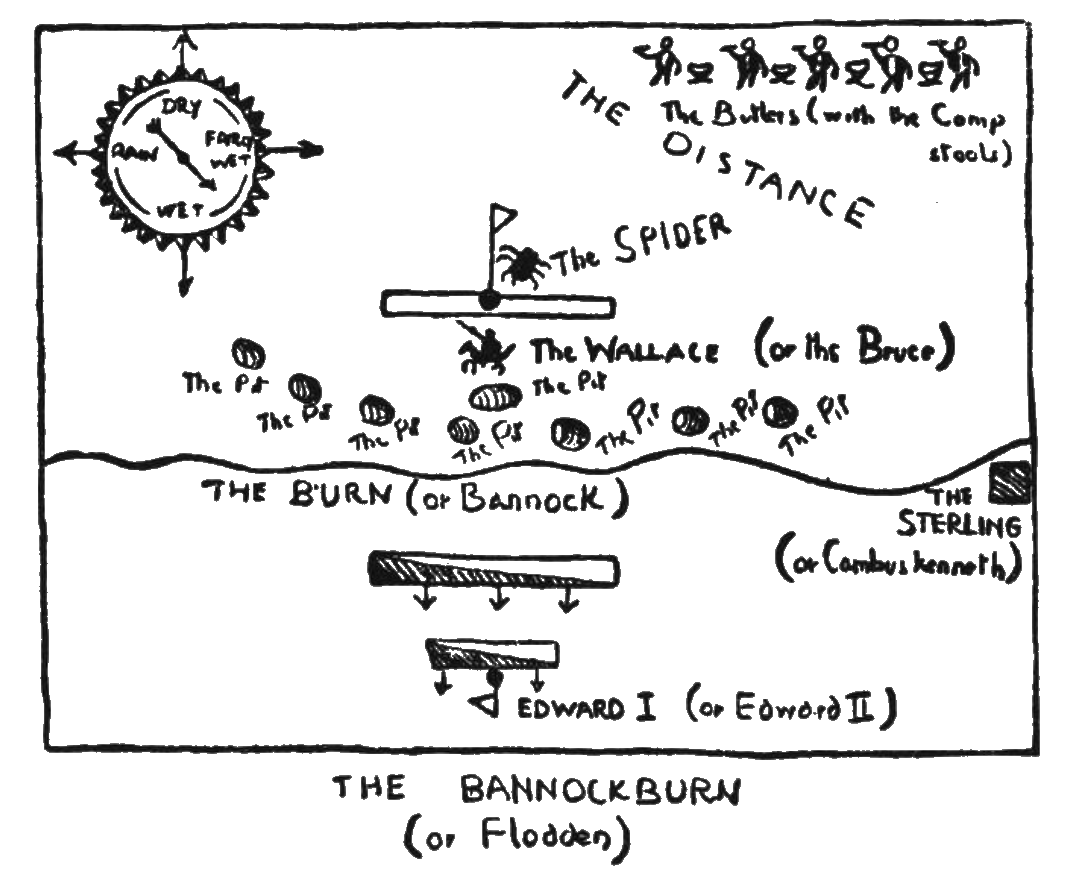
The fact that the English were defeated has so confused Historians that many false theories are prevalent about the Bannockburn Campaign. What actually happened is quite clear from the sketch map shown above. The causes of the English defeat were all unfair and were:
- The Pits. Every time the Wallace Bruce. saw some English Knights charging at him he quickly dug one of these unnatural hazards into which the English Knights, who had been taught to ride straight, galloped with flying colours.
- Superior numbers of the English (four to one). Accustomed to fight against heavy odds the English were uneasy, and when the Scots were unexpectedly reinforced by a large body of butlers with camp stools the English soldiers mistook them for a fresh army of Englishmen and retreated in disgust. At the Battle of Bannockburn (1314), the English army believed that a fresh army to support the Scots was arriving over Gillies' Hill; in reality, the servants of the Scottish camp had simply grown tired of idly watching the battle, and joined with sticks for weapons. Nonetheless, the confusion caused the English to retreat.
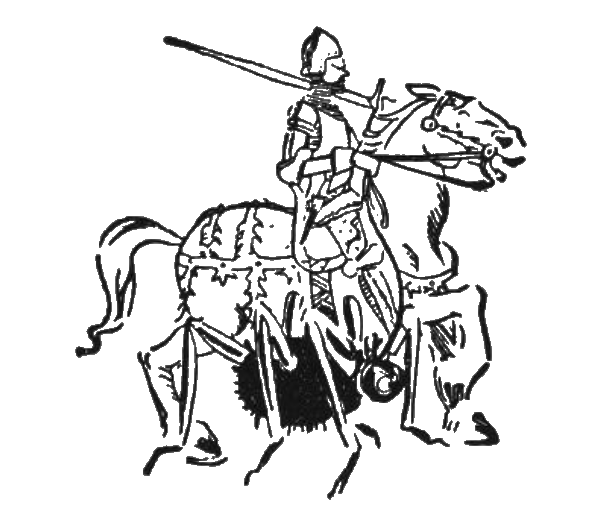
- Foul riding by Scottish Knights. This was typified even before the battle during an exhibition combat between the Brace and the English Champion, Baron Henry le Bohunk, when Brace, mounted on a Shetland pony, galloped underneath the Baron and, coming up unexpectedly on the blind side, struck him a foul blow behind and maced him up for life. At the outset Bruce killed Henry de Bohun with a single axe-stroke while mounted.
Memorable Screams of Edward II
Edward II was so weak that he kept banishing his favourites and then unbanishing them again. The Barons therefore became so impatient that they deposed Edward without even wailing to arrange for any false claimants to the throne. Thus Edward III became King. Edward II was deposed in 1327 in favour of his son Edward III.
Shortly afterwards horrible screams were heard issuing from the Berkeley where Edward II was imprisoned and the next day he was horribly dead. But since not even the Barons would confess to having horribly murdered him, it is just possible that Edward had merely been dying of a surfeit in the ordinary way. Edward II died at Berkeley Castle (1327); the manner of his death is uncertain in the sources.
Chapter 24
Edward III: A Romantic King
Edward III had a very romantic reign which he began by confining his mother in a stronghold for the rest of her life, Edward claimed the English throne by deposing his mother, Isabella of France, who had deposed her husband with the help of her lover Mortimer. and inventing a law called the Gallic Law according to which he was King of France, Edward claimed the French crown because his mother was the sister of the last direct line Capetian king of France. Edward argued the line continued to him since women were excluded from the throne; French jurists argued that the crown could not even be inherited through the female line and thus supported Philip VI, the first king of the House of Valois. and could therefore make war on it whenever he felt inclined.
In order to placate Edward, the French King sent him a box of new tennis balls. When the parcel was opened the Prince of Wales, who was present, mottoed to himself memorably (in Bohemian) 'Ich Dien', which means 'My serve', and immediately invaded France with an army of archers. “Ich dien” (“I serve”) is the motto of the Prince of Wales and appears with ostrich feathers on the Black Prince’s badge. The tennis-ball taunt belongs to the later story of Henry V, not to Edward III. This prince was the memorable All-Black Prince, and the war was called the Hundred Years? War, because the troops signed on for a hundred years or the duration.
The Battle of Cresy
This decisive battle of the world was fought during a total eclipçe of the sun and naturally ended in a complete victory for the All-Black Prince, who very romantically 'won his Spurs'His father the King had betted him a pair of hotspurs that he could not do this. by slaughtering one third of the French nobility. The Battle of Crécy (1346) was an English victory marked by massed longbow fire; the “eclipse” detail is part of later embroidery. The Black Prince distinguished himself there.
The Six Burglars of Calais
Edward III then laid siege to Calais in order to be ready to return to England if necessary, and on the capitulation of the town ordered the six richest citizens to come forth with halters round their necks and wearing only their shorts, and to surrender all the keys in the city. The inhabitants therefore at once appointed the six chief burglars of Calais and Edward agreed with this, romantically commanding that they should be put to death as soon as they came in. His Queen, however, pointed out what a much more romantic thing it would be to pardon them and make them barons in the Exchequer. Edward therefore pardoned them in spite of his private feelings that the original plan was more romantic still. After the siege of Calais (1347), six leading citizens, including Eustache de Saint Pierre, offered themselves for execution; Queen Philippa interceded for their pardon.
After this Edward had all the wool in England kept in a stable at Calais instead of in a sack in the House of Commons; this was a Bad Thing, as it was the beginning of Political Economy. Calais became the main English wool staple—designated market and customs point—for continental trade.
Wyclif and the Dullards
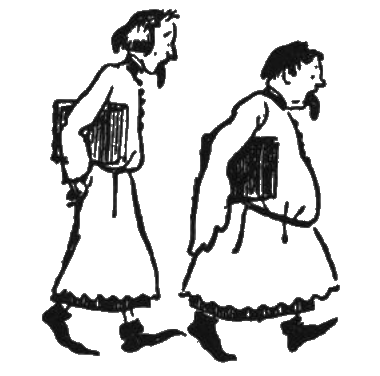
During this reign the memorable preacher Wyclif collected together a curious set of men known as the Lollards or Dullards, John Wyclif (d. 1384) advocated Scripture in English and influenced the Lollard movement, named after Middle Dutch loelen ("to mutter"). because they insisted on walking about with their tongues hanging out and because they were so stupid that they could not do the Bible in Latin and demanded that everyone should be allowed to use an English translation. They were thus heretics and were accordingly unpopular with the top men in the Church who were very good at Latin and who liked to see some Dullards burnt before every meal. Hence the memorable grace `De Heretico Comburendo, Amen', known as the Pilgrim's Grace. The statute De heretico comburendo authorizing burning for heresy was enacted in 1401, under Henry IV. The Pilgrimage of Grace (1536-37) was a Catholic revolt in Northern England.
Royal Tact
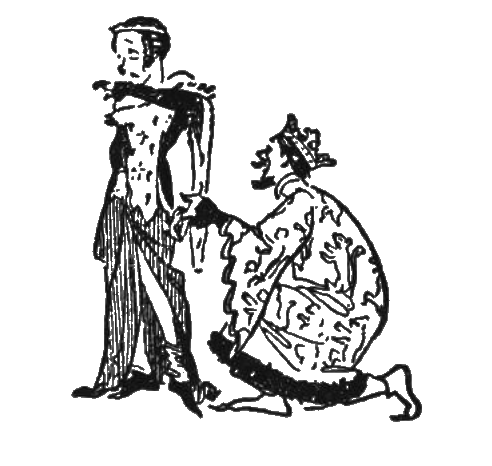
Edward III had very good manners. One day at a royal dance he noticed some men-about-court mocking a lady whose gaiter had come off, whereupon to put her at her ease he stopped the dance and made the memorable epitaph: `Honi soie qui mal y pense' (`Honey, your silk stocking's hanging down') and having replaced the garter with a romantic gesture gave the ill-mannered courtiers the Order of the Bath. (This was an extreme form of torture in the Middle Ages.) “Honi soit qui mal y pense” (“Shame on him who thinks ill of it”) is the motto of the Order of the Garter, traditionally founded by Edward III. The “Order of the Bath” is a distinct chivalric order, formalized later; medieval knighting sometimes included ritual bathing.
Chapter 25
Richard II: An Unbalanced King
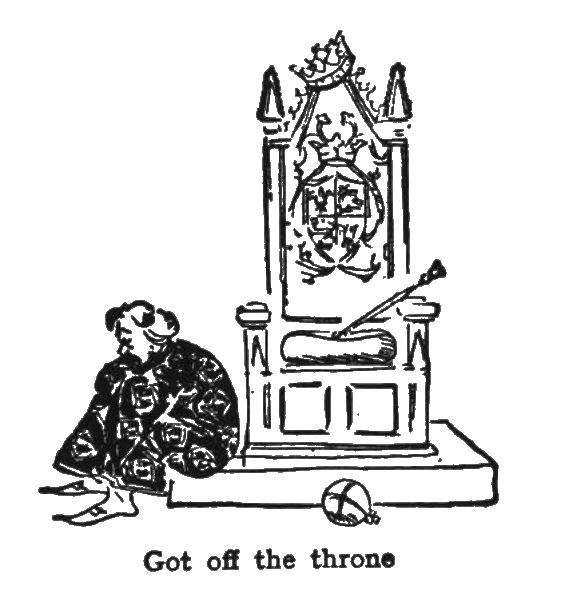
Richard II was only a boy at his accession: one day, however, suspecting that he was now twenty-one, he asked his uncle and, on learning that he was, mounted the throne himself and tried first being a Good King and then being a Bad King, without enjoying either very much: then, being told that he was unbalanced, he got off the throne again in despair, exclaiming gloomily: `For God's sake let me sit on the ground and tell bad stories about cabbages and things.' Whereupon his cousin Lancaster (spelt Bolingbroke) quickly mounted the throne and said he was Henry IV Part I. Henry Bolingbroke deposed Richard II in 1399 and became Henry IV. Richard’s quote recalls Shakespeare’s “Let’s sit upon the ground / And tell sad stories of the death of kings.” In Lewis Carroll's "The Walrus and the Carpenter" includes the lines "'The time has come,' the Walrus said, / To talk of many things: / Of shoes — and ships — and sealing-wax — / Of cabbages — and kings"
Richard was thus abdicated and was led to the Tower and subsequently to Pontefract Castle where he died of mysterious circumstances, probably a surfeit of Pumfreys (spelt Pontefracts). Richard II died at Pontefract Castle (1400); later tradition names starvation or murder. “Pontefracts” alludes to the town’s liquorice cakes, which are the first example of consuming liquorice mixed with sugar.
Appendix
The Pheasants Revolt
They did this in several reigns under such memorable leaders as Black Kat, Straw Hat, John Bull, and What Tyler. The Peasants’ Revolt of 1381 was led by Wat Tyler, with John Ball as a preaching figure. It is believed that the third leader was Jack Straw, but it is possible that this was a pseudonym for Wat Tyler.
I. Objects: (a) to obtain a free pardon for having revolted. (b) to find out which was the gentleman when Adam delved and Eve span. John Ball gave a famous sermon that included the line “When Adam delved and Eve span, who was then the gentleman?” Here, "delved" refers to digging the fields, and "span" refers to spinning fabric/flax. Ball's sermon proceeds by pointing out that servitude is an "unjust oppression of naughty men" and calls upon his listeners to recover their liberty. (The answer was, of course, Adam, but the mystics of the Church had concealed this dangerous knowledge.) (c) to find out who was King and which of them was the Leader of the Rebellion. (d) to abolish the Villein.
The Pheasants' Revolts were therefore purely educational movements and were thus easily suppressed.
II. How Quelled: (a) the Pheasants were met at Smithfield by the King who At Smithfield (1381) Richard II parleyed with the rebels. (b) riding forward alone on a white horse answered object (c) by announcing (I) `I am your King', and (II) `I will be your leader'. (c) the real leader was then slain quickly by one of the Barons. Wat Tyler was killed (traditionally by the Lord Mayor, William Walworth). (d) a free pardon was granted to the Pheasants [see object (a)]. (e) all were then put to death on the ground that they were Villeins [see object (d)].
These Revolts were thus clearly romantic episodes, and a Good Thing, and the clergy were enabled to prevent the pheasants finding out the answer to object (b).
Chapter 26
Henry IV: A Split King
When Henry IV Part I came to the throne the Barons immediately flung their gloves on the floor in order to prove
- That Richard II was not yet dead Henry, first cousin of Richard II, imprisoned Richard II and seized the throne.
- That Henry had murdered him. Richard II died from starvation in prison, likely on orders from Henry.
Henry very gallantly replied to this challenge by exhibiting Richard II's head in St Paul's Cathedral, thus proving that he was innocent. Richard II’s entire body was displayed in Old St. Paul's Cathedral, London, to demonstrate that he was dead and had not died violently. However, rumors persisted that Richard II was alive; indeed, a failed insurrection was led by an impostor of similar appearance. Finding, however, that he was not memorable, he very patriotically abdicated in favour of Henry IV Part II. Henry IV did not abdicate.
Renewed Educational Ferment
Even Henry IV Part II, however, is only memorable for having passed some interesting laws against his Old Retainers, i.e. butlers and sutlers, who had irritated him by demanding Liveries, requiring too much Maintenance, etc. Laws against “livery and maintenance” curbed over-mighty retainers. He also captured the Scottish Prince James and, while keeping him as a sausage, Recall the errata correct "sausage" as "hostage". had him carefully educated for nineteen years; finding, however, that James was still Scotch, Henry IV Part II lost interest in education and died. James of Scotland (later James I) was captured in 1406 and held by Henry IV in England until 1424. Henry IV treated him well and provided him with a good education, admitting him into the royal household and allowing him to observe politics. (Upon Henry IV's death, Henry V placed James in the Tower.)
Chapter 27
Henry V: An Ideal King
On the death of Henry IV Part II, his son, Prince Hal, who had won all English hearts by his youthful pranks (such as trying on the crown while his father lay dying, and hitting a very old man called Judge Gascoigne) Shakespeare’s Henry IV, Part II shows Prince Hal striking the Chief Justice Gascoigne, who imprisons him to demonstrate that he is not above the law. determined to justify public expectation by becoming the Ideal English King. He therefore decided on an immediate appearance in the Hundred Years' War, making a declaration that all the treaties with France were to be regarded as dull and void.
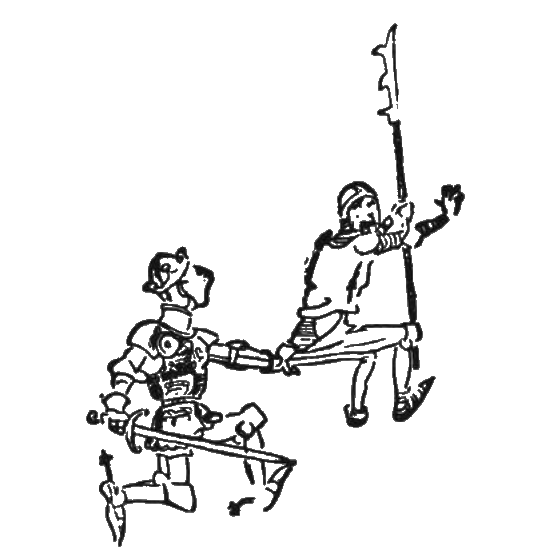
Conditions in France were favourable to Henry since the French King, being mad, had entrusted the government of the country to a dolphin and the command of the army to an elderly constable. Charles VI’s bouts of madness (e.g., thinking he was made of glass) led to factional rule; the dauphin was heir apparent. Charles I d'Albret, Constable of France, led the French army at Agincourt (1415) against Henry V. After capturing some breeches at Harfleur (more than once) by the original expedients of disguising his friends as imitation tigers, stiffening their sinews, etc., In Shakespeare’s Henry V, Henry's speech that opens with "Once more unto the breach" continues: “Then imitate the action of the tiger; / Stiffen the sinews, summon up the blood”. Henry was held up on the road to Calais by the constable, whom he defeated at the utterably memorable battle of Agincourt (French Poictiers Poitiers was an earlier battle in 1356 against King John II. ). He then displaced the dolphin as ruler of Anjou, Menjou, Poilou, Maine, Touraine, Againe, and Againe, and realizing that he was now too famous to live long expired at the ideal moment.
Chapter 28
Henry VI: A Very Small King
The next King, Henry VI, was only one year old and was thus rather a Weak King; indeed the Barons declared that he was quite numb and vague. When he grew up, however, he was such a Good Man that he was considered a Saint, or alternatively (especially by the Barons) an imbecile. Henry VI acceded as an infant (1422) and was noted for piety and fragility; he is informally regarded as a saint and canonization was ongoing when Henry VIII broke with Rome.
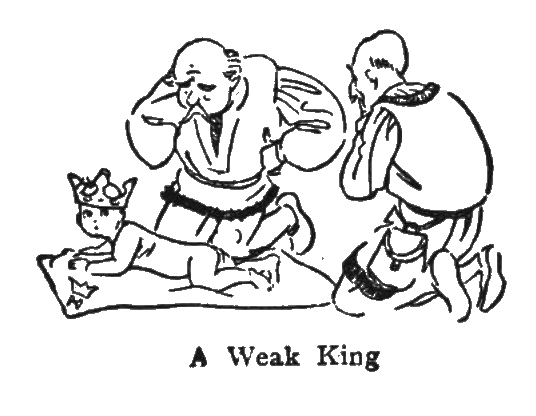
Joan of Ark
During this reign the Hundred Years' War was brought to an end by Joan of Ark, a French descendant of Noah who after hearing Angel voices singing Do Ré Mi became inspired, thus unfairly defeating the English in several battles. Indeed, she might even have made France top nation if the Church had not decided that she would make an exceptionally memorable martyr. Thus Joan of Ark was a Good Thing in the end and is now the only memorable French saint. Joan of Arc, inspired by voices of saints, aided the relief of Orléans (1429) and saw Charles VII crowned; she was executed in Rouen (1431) and canonized in 1920.
The Wars of the Roses
Noticing suddenly that the Middle Ages were coming to an end, the Barons now made a stupendous effort to revive the old Feudal amenities of Sackage, Carnage, and Wreckage and so stave off the Tudors for a time. They achieved this by a very clever plan, known as the Wars of the Roses (because the Barons all picked different coloured roses in order to see which side they were on). The Wars of the Roses (c. 1455–1487) were dynastic struggles between Lancaster (red rose) and York (white rose).
Warwick the Kingmaker
One of the rules in the Wars of the Roses was that nobody was ever really King but that Edmund Mortimer Yorkist claimant to the throne and, in Shakespeare's Henry VI, Part 1, a conflation of three historical figures: Sir Edmund Mortimer, his brother Sir John, and his nephew Edmund Mortimer. really ought to be: any Baron who wished to be considered King was allowed to apply at Warwick the Kingmaker's, where he was made to fill up a form, answering the following questions:
- Are you a good plain crook?
- Are you Edmund Mortimer? If not, have you got him?
- Have you ever been King before? If so, state how many times; also whether deposed, beheaded, or died of surfeit.
- Are you insane? If so, state whether permanently or only temporarily.
- Are you prepared to marry Margaret of Angoulme? Perhaps conflation with Margaret of Anjou, Henry VI's queen; Marguerite of Angouleme (1492-1549) was noticeably later and married to King Henry II of Navarre. If Isabella of Hainault 1170-1190, betrothed to a different Henry before marrying King Philip II. preferred, give reasons. (Candidates are advised not to attempt both ladies.)
- Have you had the Black Death?
- What have you done with your mother? (If Nun, write None.)
- Do you intend to be I (a) a Good King. (b) a Bad King. (c) a Weak King. II (a) a Good Man. (b) a Bad Man. (Candidates must not attempt more than one in each section.)
- How do you propose to die? (Write your answer in Block Capitals.)
Chapter 29
Cause of the Tudors
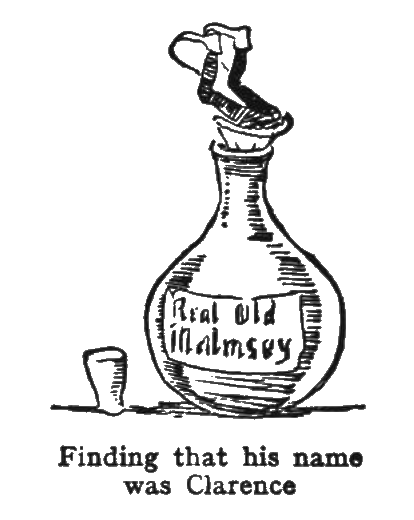
During the Wars of the Roses the Kings became less and less memorable (sometimes even getting in the wrong order) until at last one of them was nothing but some little princes smothered in the Tower, and another, finding that his name was Clarence, had himself drowned in a spot of Malmsey wine; The “little princes” are Edward V and Richard, Duke of York. George, Duke of Clarence, was drowned in Malmsey (1478). while the last of all even attempted to give his Kingdom to a horse. “My kingdom for a horse!” is Shakespeare’s line for Richard III. It was therefore decided, since the Stuarts were not ready yet, to have some Welsh Kings called Tudors (on account of their descent from Owen Glendower) The Tudors traced Welsh ancestry through Owen Tudor, who was in the line of Owain Glyndwr, the last native-born Welshman to claim the title of Prince of Wales. who, it was hoped, would be more memorable.
The first of these Welsh Kings was Henry VII, who defeated all other Kings at the Battle of Boswell Field and took away their roses. After the battle the crown was found hanging up in a hawthorn tree on top of a hill. Henry VII won at Bosworth Field (1485). Tradition says Richard III’s crown was found on a hawthorn and set on Henry’s head on the field. This is memorable as being the only occasion on which the crown has been found after a battle hanging up in a hawthorn tree on top of a hill.
Henry VII's Statecraft
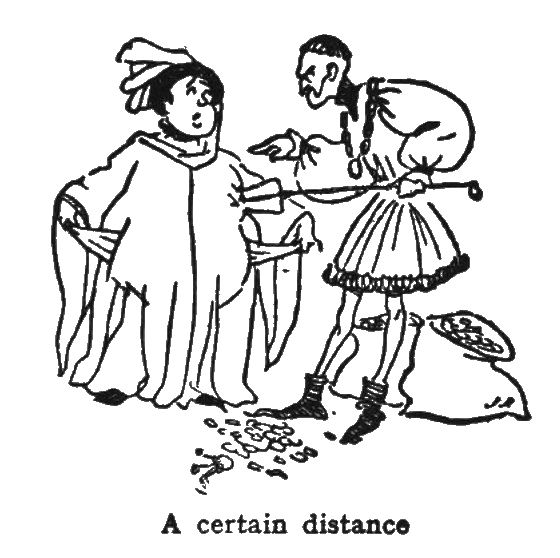
Henry VII was a miser and very good at statecraft; he invented some extremely clever policies such as the one called Morton's Fork. This was an enormous prong with which his minister Morton visited the rich citizens (or burghlers as they were called). If the citizen said he was poor, Morton drove his Fork in a certain distance and promised not to take it out until the citizen paid a large sum of money to the King. As soon as this was forthcoming Morton dismissed him, at the same time shouting 'Fork Out' so that Henry would know the statecraft had been successful. If the burghler said he was quite rich Morton did the same thing: it was thus a very clever policy and always succeeded except when Morton put the Fork in too far. Morton’s Fork is attributed to Archbishop John Morton: those living modestly were saving and could pay; those living lavishly were clearly able to pay.
Chapter 30
Lambert Simnel and Perkin Warbeck
English History has always been subject to Waves of Pretenders. These have usually come in small waves of about two an Old Pretender and a Young Pretender, their object being to sow dissension in the realm, and if possible to contuse the Royal issue by pretending to be heirs to the throne.
Two Pretenders who now arose were Lambert Simnel Lambert Simnel claimed to be the Earl of Warwick; after defeat (1487) he was spared and employed in the royal household, later as a kitchen scullion. and Perkin Warbeck Perkin Warbeck claimed to be Richard, Duke of York; he was captured and executed in 1499. , and they succeeded in confusing the issue absolutely by being so similar that some historians suggest they were really the same person (i.e. the Earl of Warbeck).
Lambert Simnel (the Young Pretender) was really (probably) himself, but cleverly pretended to be the Earl of Warbeck. Henry VII therefore ordered him to be led through the streets of London to prove that he really was. Simnel was paraded through the streets on the shoulders of "the tallest man of the time", Sir William Darcy. When Henry found out, we also ordered the Earl of Warwick to be taken from the Tower and paraded through London to disprove rumors of his death or escape. However, since news of this travelled too slowly, a rebellion occurred despite Henry's efforts.
Perkin Warbeck (the Older and more confusing Pretender) insisted that he was himself, thus causing complete dissension till Henry VII had him led through the streets of London to prove that he was really Lambert Simnel. Upon capture, Warbeck was paraded through the streets; he then confessed to being Flemish.
The punishment of these memorable Pretenders was justly similar, since Perkin Warmnel was compelled to become a blot on the King's skitchen, while Perbeck was made an escullion. Wimneck, however, subsequently began pretending again. This time he pretended that he had been smothered in early youth and buried under a stair-rod while pretending to be one of the Little Princes in the Tower. In order to prove that he had not been murdered before, Henry was reluctantly compelled to have him really executed.
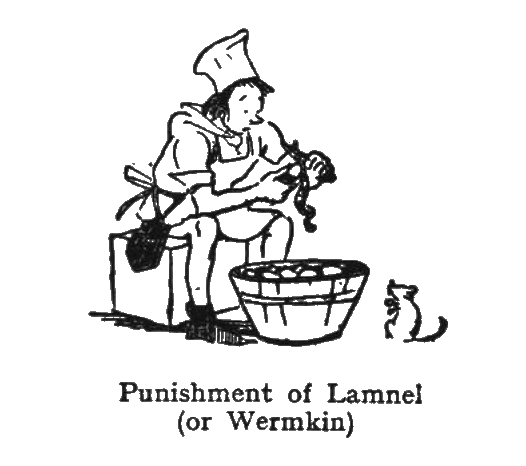
Even after his execution many people believed that he was only pretending to have been beheaded, while others declared that it was not Warmneck at all but Lamkin, and that Permnel had been dead all the time really, like Queen Anne. The phrase "Queen Anne is dead" is used ironically as an example of old news. The OED lists the first usage as follows, from Yorick's Jests (1770). "The wise mayor perceiving the words Anno Domini, immediately sent for and abused the painter for committing such a gross blunder as putting Anno Domini; ‘when, says he, don't you know that Queen Anne is dead, and therefore it should be Georgio Domini.’"
Poyning's Lam
Henry VII was very good at answering the Irish Question, and made a Law called Poyning's Law by which the Irish could have a Parliament of their own, but the English were to pass all the Acts in it. This was obviously a very Good Thing. Poynings’ Law (1494–95) required Irish parliamentary legislation to be approved by the English king and council before introduction.
Age of Daring Discoveries
The reign of Henry VII marks the end of the Middle Ages. These were succeeded by an age of daring discoveries, such as when Caprornicus observed the Moon while searching the skies with a telescope, thus causing the rotation of the Earth, crops, etc. Emboldened by this, Caprornicus began openly discussing the topic of capricorns, for which he was unanimously put to death. Copernicus died naturally.
The greatest of these discoverers, however, was St Christophus Columba, the utterly memorable American, who, with the assistance of the intrepid adventurers John and Sebastian Robot, discovered how to make an egg stand on its wrong end. John and Sebastian Cabot explored for England in the 1490s. The “standing egg” refers to the anecdote of Columbus making an egg stand upright by cracking it, demonstrating that an impossible task is easy once understood. (Modern History is generally dated from this event.)
TEST PAPER III
Up to the End of Henry VII
- Contract, Expand, and Explode (a) The Charters and Garters of the Realm. (b) The Old Suspender.
- How did any one of the following differ from any one of the other? (1) Henry IV Part I. (2) Henry IV Part II.
- The end of the closing of the 2nd stage of the Treaty of Bretigny marks the opening of a new phase in the 1st stage of the termination of the Hundred Years? War.' (Confute.) The Treaty of Brétigny (1360) marks the end of the first phase of the Hundred Years' War.
- `Know ye not Agincourt?' (Confess.)
- `Uneasy lies the head that wears a Throne.' "Uneasy lies the head that wears a crown" is from Shakespeare's Henry IV, Part II. (a) Suggest remedies, or (b) Imitate the action of a Tiger.
- Intone interminably (but inaudibly) i. The Pilgrims? Grace, ii. `Cuccu'. An English round Sumer is icumen in is also known as the "Cuckoo Song". I doubt it's a reference to cuccù, an Italian card game.
- Do not draw a sketch-map of the Battle of Bannockburn, but write not more than three lines on the advantages and disadvantages of the inductive historical method with special relation to ecclesiastical litigation in the earlier Lancastrian epochs.
- How would you confuse (1) The Wars of the Roses? (2) Lamnel Simkin and Percy Warmneck? (3) The Royal issue?
- Why do you picture John of Gaunt as a rather emaciated grandee? In Shakespeare's Richard II, John of Gaunt is an aging nobleman who delivers a dying monologue attempting to stir patriotism in the King.
- Describe in excessive detail (a) The advantages of the Black Death. (b) The fate of the Duke of Clarence. (c) A Surfeit.
N.B. Candidates should write on at least one side of the paper.
Chapter 31
Bluff King Hal
Henry VIII was a strong King with a very strong sense of humour and VIII wives, memorable amongst whom were Katherine the Arrogant, Anne of Cloves, Lady Jane Austin, and Anne Hathaway. The six wives were Catherine of Aragon, Anne Boleyn, Jane Seymour, Anne of Cleves, Catherine Howard, Catherine Parr. “Anne Hathaway” was Shakespeare’s wife. His beard was, however, red.
In his youth Henry was fond of playing tennis and after his accession is believed never to have lost a set. He also invented a game called "Bluff King Hal" which he invited his ministers to play with him. The players were blindfolded and knelt down with their heads on a block of wood; they then guessed whom the King would marry next.
Cardinal Wolsey, the memorable homespun statesman and inventor of the Wolsack, played this game with Henry and won. Cardinal Wolsey rose from modest origins; the “woolsack” is the Lord Chancellor’s seat in the House of Lords. But his successor, Cromwell (not to be confused with Cromwell), after winning on points, was disqualified by the King (who always acted as umpire), and lost. “Cromwell” here is Thomas Cromwell, not Oliver Cromwell.
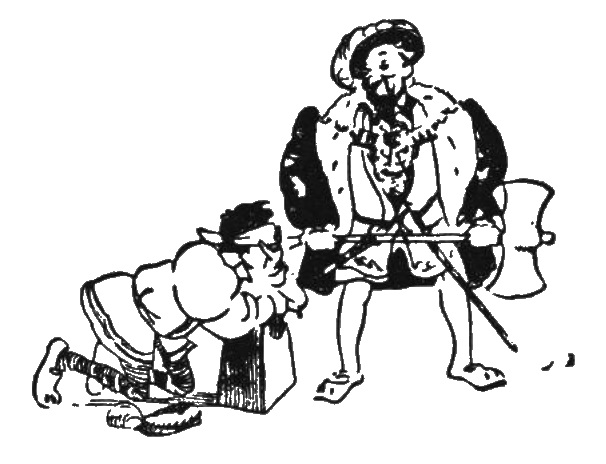
In the opinion of Shakespeare (the memorable playwriter and Top Poet) his unexpected defeat was due to his failure to fling away ambition. Wolsey’s lines in the play Henry VIII: “Vain pomp and glory of this world… Had I but served my God with half the zeal…”
The Restoration
Henry wanted the Pope to give him a divorce from his first wife, Katherine. He wanted this because (a) she was Arrogant. (b) he had married her a very long time ago. (c) when she had a baby it turned out to be Broody Mary, and Henry wanted a boy. (d) he thought it would be a Good Thing.
The Pope, however, refused, and seceded with all his followers from the Church of England. This was called the Restoration. Reformation.
Henry's Plan Fails
Curiously enough Henry had all the time had an idea about a new wife for himself called Anne, who, he thought, looked as if she would be sure to have a son. So when the Divorce was all over (or nearly) he married her; but he was wrong about Anne, because she had a girl too, in a way (see Elizabeth).
After this Henry was afraid his reign would not be long enough for any more divorces, so he gave them up and executed his wives instead.All except Anne of Cloves, whom he had on approval from Belgium and sent back on discovering that she was really not a queen at all but a `fat mare with glanders'. Anne of Cleves was a German princess from the Duchy of Cleves; the historian Gilbert Burnet wrote (likely incorrectly) in 1679 that Henry referred to her as a "Flanders mare". He also got less interested in his wives and gave himself up to Diplomacy, spending a great deal of his time playing tennis, etc., with the young King of France in a field called the Field of the Crock of Gold. The Field of the Cloth of Gold (1520) was a summit between Henry VIII and Francis I near Calais.
End of Wolsey
Cardinal Wolsey, although (as is well known) he had not thought to shed a tear about all this, did ultimately shed a memorable one. Having thus fallen from grace (indeed he had already been discovered entertaining some Papal Bulls) Wolsey determined to make a Pilgrimage to Leicester Abbey, saying to himself: `If I had served my God as I have served my King, I would have been a Good Thing.' See . Having thus acknowledged that he was a Bad Man, and being in due course arrived at the Abbey, Wolsey very pluckily expired after making a memorable speech to the Prior, beginning, `Father Abbot, I come to lay my bones among you, Not to praise them...' Wolsey died at Leicester Abbey in 1530; George Cavendish, his biographer, recorded his last words as "Father Abbot, I come to lay my bones among you". Cf. Antony's speech in Shakespeare's Julius Caesar, "I come to bury Caesar, not to praise him".
The Monasteries
One of the strongest things that Henry VIII did was about the Monasteries. It was pointed out to him that no one in the monasteries was married, as the Monks all thought it was still the Middle Ages. So Henry, who, of course, considered marrying a Good Thing, told Cromwell to pass a very strong Act saying that the Middle Ages were all over and the monasteries were all to be dissolved. This was called the Disillusion of the Monasteries. The Dissolution of the Monasteries (1536–1541) transferred monastic property to the Crown under Thomas Cromwell’s direction.
Chapter 32
Edward VI and Broody Mary
Edward VI and Broody Mary were the two small Tudors who came in between the two big ones, Henry VIII and Elizabeth. Edward VI was only a boy and consequently was not allowed to have his reign properly, but while he was sitting on the throne everyone in the land was forced to become Protestant, so that Broody Mary would be able to put them to death afterwards for not being Roman Catholics. A good many people protested against this treatment and thus it was proved that they were Protestants, but most of the people decanted and were all right. Broody Mary's reign was, however, a Bad Thing, since England is bound to be C. of E., so all the executions were wasted. Edward VI’s government advanced Protestant reforms (Book of Common Prayer, 1549/1552). Mary I (1553–1558) restored Roman Catholicism and executed Protestant leaders; the nickname “Bloody Mary” comes from later Protestant polemic.
Cramber and Fatimer
It was about this time that a memorable Dumb Crammer and one of Henry VIII's wives called Fatimer, who had survived him, got burnt alive at Oxford, while trying to light a candle in the Martyr's memorial there: it was a new candle which they had invented and which they said could never be put out. Thomas Cranmer, with Hugh Latimer and Nicholas Ridley, was burned at Oxford in 1555–1556; Latimer said to Ridley that “we shall this day light such a candle, by God’s grace, in England, as I trust shall never be put out”. The Martyrs’ Memorial itself dates from the 19th century.
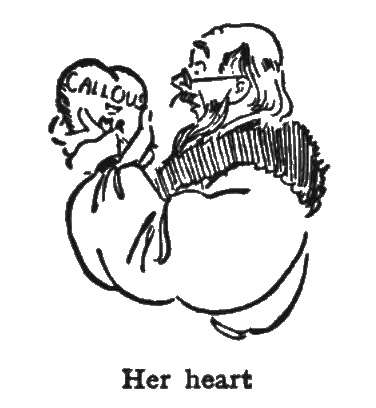
Shortly after this the cruel Queen died and a postmortem examination revealed the word 'callous' engraved on her heart. Refers to a (likely apocryphal) remark by Mary recorded in Holinshed's Chronicles: "When I am dead and opened, you shall find 'Philip' and 'Calais' lying in my heart". Calais, England's only remaining possession in France, fell only months before Mary's death.
Chapter 33
Elizabeth
Although this memorable Queen was a man, she was constantly addressed by her courtiers by various affectionate female nicknames, such as Auroraborealis, Rumania, Black Beauty (or Bête Noire), and Brown Bess. “Brown Bess” was a nickname for an 18th century British infantry musket; it is believed to have never been a nickname for Queen Elizabeth, and instead refer to a mistress or prostitute. She also very graciously walked on Sir Walter Raleigh's overcoat whenever he dropped it in the mud An apocryphal anecdote states that Sir Walter Raleigh dropped his coat in the mud so Queen Elizabeth's shoes wouldn't get dirty. and was, in fact, in every respect a good and romantic Queen.
Wave of Beards
One of the most romantic aspects of the Elizabethan age was the wave of beards which suddenly swept across History and settled upon all the great men of the period. The most memorable of these beards was the cause of the outstanding event of the reign, which occurred in the following way.
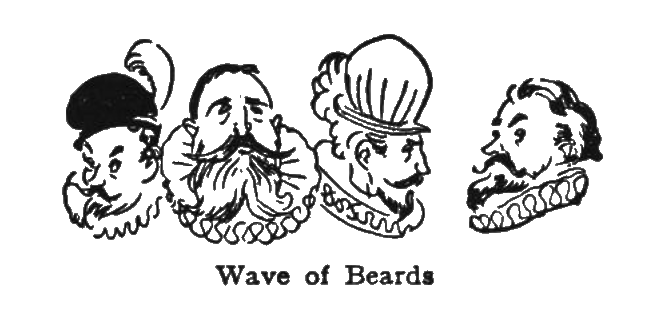
The Great Armadillo
The Spaniards complained that Captain F. Drake, the memorable bowlsman, When told the Armada was approaching, Drake reportedly finished his lawn bowls game at Plymouth before sailing out. The earliest account of this incident was printed 37 years later, and it is likely apocryphal. had singed the King of Spain's beard (or Spanish Mane, as it was called) one day when it was in Cadiz Harbour. In 1587 Francis Drake raided Cádiz; the exploit was later dubbed “singeing the King of Spain’s beard”. The Spanish Main refers to the Spanish colonies in the mainland Americas (i.e., excluding the Caribbean islands). Drake replied that he was in his hammock at the time and a thousand miles away. Newbolt's poem Drake's Drum (1897) opens with "Drake he’s in his hammock an’ a thousand miles away". It is named after Drake's Drum, which is an actual snare drum that Sir Francis Drake took with him when he circumnavigated the globe. The King of Spain, however, insisted that the beard had been spoilt and sent the Great Spanish Armadillo to ravish the shores of England. The Spanish Armada attacked England in 1588.
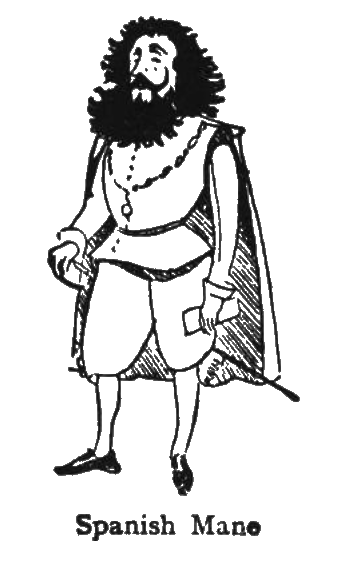
The crisis was boldly faced in England, especially by Big Bess herself, who instantly put on an enormous quantity of clothing and rode to and fro on a white horse at Tilbury Elizabeth addressed troops at Tilbury in August 1588: “I know I have the body of a weak and feeble woman; but I have the heart and stomach of a king.” a courageous act which was warmly applauded by the English sailors.
In this striking and romantic manner the English were once more victorious.
The Queen of Hearts
A great nuisance in this reign was the memorable Scottish queen, known as Mary Queen of Hearts on account of the large number of husbands which she obtained, e.g. Cardinale Ritzio, Boswell, and the King of France: most of these she easily blew up at Holywood. Mary, Queen of Scots, married Francis II of France; Henry Stuart, Lord Darnley; and later the Earl of Bothwell. David Rizzio (spelled Rizzio) was her secretary, murdered at Holyrood in 1566. Darnley was killed by an explosion at Kirk o’ Field (1567); Boswell is the biographer while Bothwell was Mary's third husband.
Unfortunately for Mary, Scotland was now suddenly overrun by a wave of Synods led by Sir John Nox, the memorable Scottish Saturday Knight. John Knox led Scotland’s Protestant Reformation. Unable to believe, on account of the number of her husbands, that Mary was a single person, the Knight accused her of being a `monstrous regiment of women', and after making this brave remark had her imprisoned in Loch Lomond. “The First Blast of the Trumpet against the Monstrous Regiment of Women” (1558) attacked female sovereigns. Mary was held at Loch Leven Castle in 1567 and forced to abdicate. Loch Lomond is a lake in Scotland (and a whisky), but the reference here is likely to the traditional song "The Bonnie Banks o’ Loch Lomond". Mary, however, escaped and fled to England, where Elizabeth immediately put her in quarantine on the top of an enormous Height called Wutheringay. Mary was confined at Fotheringhay Castle, where she was later tried.
As Mary had already been Queen of France and Queen of Scotland many people thought that it would be unfair if she was not made Queen of England as well. Various plots, such as the Paddington Plot, the Threadneedle Conspiracy and the Adelfi Plot, were therefore hatched to bring this about. Paddington is a district and Threadneedle a street; the Adelphi Theatre is a West End theatre (founded in 1806). Major conspiracies linked to Mary include the Babington (1586), Throckmorton (1583), and Ridolfi (1571) plots. Elizabeth, however, learning that in addition to all this Mary was good-looking and could play on the virginals, Presumably a pun between the Virgin Queen and the musical instrument. recognized that Mary was too romantic not to be executed, and accordingly had that done.
Massacre of St Bartholomew
Further evidence of Queen Elizabeth's chivalrous nature is given by her sympathy towards the French Protestants or Hugonauts (so called on account of their romantic leader Victor Hugo). These Arguenots were very much incensed at this time about St Bartholomew, a young Saint, who had been unjustly massacred for refusing to tie a white handkerchief round his arm. The Huguenots were French Protestants; the St Bartholomew’s Day Massacre (1572) saw mass killings of Huguenots in Paris and beyond. During the massacre, Catholics identified each other by wearing a white cross or white handkerchief; Millais's painting A Huguenot, on St Bartholomew’s Day shows a Catholic girl trying to tie a white scarf on her Huguenot lover's arm to save his life, illustrating the corresponding scene from Meyerbeer's Les Huguenots. After the massacre the French King, Henry of Navarre, turned Roman Catholic and made his memorable confession 'Paris is rather a Mess'; Henry of Navarre (Henri IV) reputedly said “Paris is well worth a Mass” on converting in 1593. whereupon Queen Elizabeth very gallantly sent her favourite, Leicester, to find out whether this was true, thus rendering valuable assistance to the Hugonot cause. Robert Dudley, Earl of Leicester, led an English expedition to support Dutch Protestants (1585–87).
Elizabeth and Essex
Memorable amongst the men with beards in Elizabeth's reign was the above-mentioned favourite, Essex (Robert Dudleigh, Earl of Leicester), whom she brought to execution by mistake in the following romantic manner. Robert Devereux, 2nd Earl of Essex was executed (not Robert Dudley, Earl of Leicester, who died in 1588). Essex was sent to Ireland to quell a rebellion which the Irish were very treacherously carrying on in a bog in Munster. Essex campaigned in Ireland (in the region of Munster) in 1599 during the Nine Years’ War. It was a disaster both militarily and politically. Essex secured loyalty of his officers by conferring knighthood (a rather rare title); by the end of his campaign, half of the knights in England owed their rank to him. After a few inconclusive engagements and key losses, Essex entered an unfavorable truce and left Ireland, leaving the queen to remark that if she had wished to abandon Ireland it would scarcely have been necessary to send him there. Becoming fatigued with the rebellion, however, he dashed out of the bog straight into the Queen's bedroom. Essex returned from Ireland although his return was expressly forbidden; he then arrived into the queen’s bedchamber before she was properly wigged and gowned. The queen placed him under house arrest. For this Essex was sent to the Tower, where he was shortly afterwards joined by other favourites of the Queen (such as Burleigh, Sidneigh, Watneigh, Hurlingham, etc.). Lord Burghley (William Cecil) was Elizabeth's chief minister; Philip Sidney was a poet/courtier; Walter Raleigh was a courtier and is punned with Watney, a brewery in the early 20th century; the Hurlingham Club is a posh polo club in London. Essex had a secret arrangement with Queen Elizabeth that he was to give her a ring whenever he was going to be executed, and she would reprieve him. But although, according to the arrangement, he tried to get into communication with the Queen, he was given the wrong number and was thus executed after all, along with the other favourites. The anecdote of the Essex ring likely originated in the early 17th century; it was widely repeated (e.g., in Hume's History of England) and popularized in various portrayals (e.g., Donizetti's Robert Devereux).
`God may forgive you,' was Brown Bess's memorable comment to the operator, `but I never will.' The ring falls in the hands of the Countess of Nottingham, the enemy of Essex; she confesses to the Queen on her deathbed two years after Essex's execution. The Queen then supposedly responds with this line.
Chapter 34
James I: A Tidy King
James I slobbered at the mouth and had favourites; he was thus a Bad King. He had, however, a very logical and tidy mind, and one of the first things he did was to have Sir Walter Raleigh executed for being left over from the previous reign. Sir Walter Raleigh was executed in 1618 after a failed Guiana venture and to appease Spanish complaints. He also tried to straighten out the memorable confusion about the Picts, who, as will be remembered, were originally Irish living in Scotland, and the Scots, originally Picts living in Ireland. James tried to make things tidier by putting the Scots in Ulsters and planting them in Ireland, The Plantation of Ulster (from 1609) settled Protestant colonists from Scotland and England in northern Ireland. but the plan failed because the Picts had been lost sight of during the Dark Ages and were now nowhere to be found.
Gunpowder Plot
There were a great many plots and Parliaments in James I's reign, and one of the Parliaments was called the Addled Parliament because the plots hatched in it were all such rotten ones. The “Addled Parliament” sat in 1614 and passed no legislation. One plot, however, was by far the best plot in History, and the day and month of it (though not, of course, the year) are well known to be utterly and even maddeningly memorable.
The Gunpowder Plot arose in the following way: the King had recently invented a new table called Avoirduroi, The weight system avoirdupois. which said:
1 New Presbyter = 1 old priest.
0 Bishop = 0 King.
The Church of Scotland was attempting to replace the previous religious system of bishops, dioceses, and parishes with a Presbyterian system run by ministers and elders. Milton criticized this in his On the New Forcers of Conscience, which concluded with the line "New Presbyter is but Old Priest writ Large". James supported the Church of England; he equated the English Puritans with the Scottish Presbyterians, and thus refused their petitions with the following remark: "No bishop, no King. When I mean to live under a presbytery I will go to Scotland again."
James was always repeating, `No Bishop, No King', to himself, and one day a certain loyal citizen called Sir Guyfawkes, a very active and conscientious man, overheard him, and thought it was the slogan of James's new policy. The Gunpowder Plot to blow up Parliament was uncovered on 5 November 1605; Guy Fawkes was arrested guarding the explosives. So he decided to carry it out at once and made a very loyal plan to blow up the King and the bishops and everybody else in Parliament assembled, with gunpowder.Recently invented by Francis Bacon, author of Shakespeare, etc. Refers to the Baconian theory of Shakespeare authorship. Although the plan failed, attempts are made every year on St Guyfawkes' Day to remind the Parliament that it would have been a Good Thing. “Guy Fawkes Day” is commemorated annually on 5 November with bonfires and fireworks.
Pilgrims' Progress
It was at this time that some very pious Englishmen, known as the Early Fathers, who were being persecuted for not learning Avoirduroi, sailed away to America in a ship called the Mayfly; this is generally referred to as the Pilgrims' Progress and was one of the chief causes of America. The Pilgrims (Separatists) sailed on the Mayflower in 1620 and founded Plymouth Colony.
Chapter 35
Charles I and the Civil War
With the ascension of Charles I to the throne we come at last to the Central Period of English History (not to be confused with the Middle Ages, of course), consisting in the utterly memorable Struggle between the Cavaliers (Wrong but Wromantic) and the Roundheads (Right and Repulsive). Charles I reigned 1625–1649; Royalists were nicknamed Cavaliers, Parliamentarians Roundheads.
Charles I was a Cavalier King and therefore had a small pointed beard, long flowing curls, a large, flat, flowing hat, and gay attire. The Roundheads, on the other hand, were clean-shaven and wore tall, conical hats, white ties, and sombre garments. Under these circumstances a Civil War was inevitable.
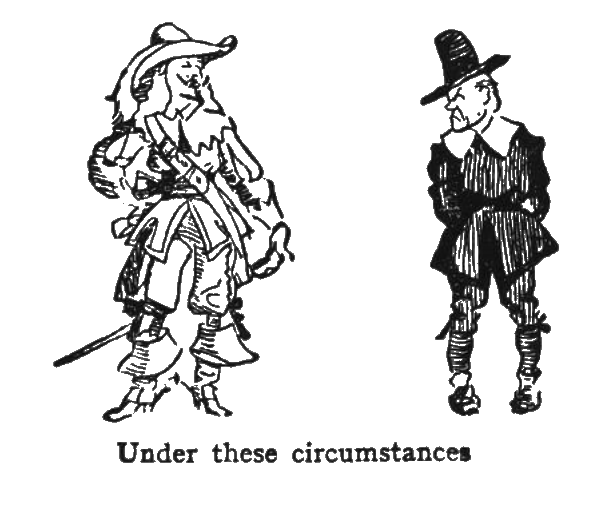
The Roundheads, of course, were so called because Cromwell had all their heads made perfectly round, in order that they should present a uniform appearance when drawn up in line. “Roundhead” referred to close-cropped hair; Oliver Cromwell only emerged as the leading Parliamentarian general later in the war.
Besides this, if any man lost his head in action, it could be used as a cannon-ball by the artillery (which was done at the Siege of Worcester). The Siege of Worcester involved cannon fire.
For a long time before the Civil War, however, Charles had been quarrelling with the Roundheads about what was right. Charles explained that there was a doctrine called the Divine Right of Kings, which said that:
(a) He was King, and that was right.
(b) Kings were divine, and that was right.
(c) Kings were right, and that was right.
(d) Everything was all right.
But so determined were the Roundheads that all this was all wrong that they drew up a Petition called the Petition of Right to show in more detail which things were wrong. This Petition said: The Petition of Right (1628) asserted due process and limits on non-parliamentary taxation and imprisonment.
(a) That it was wrong for anyone to be put to death more than once for the same offence.
(b) Habeas Corpus, which meant that it was wrong if people were put in prison except for some reason, and that people who had been mutilated by the King, such as Prynne, who had often had his ears cut off, should always be allowed to keep their bodies. William Prynne, a Puritan pamphleteer, had his ears cropped by court sentence (1630s).
(c) That Charles's memorable methods of getting money, such as Rummage and Scroungeage, were wrong. Tonnage and poundage (duties added to the medieval wine duties of prisage and butlerage) ended in the reign of Charles I. But the most important cause of the Civil War was
Ship Money
Charles I said that any money which was Ship Money Ship money referred to an additional tax on coastal towns; Charles decided to levy ship money on every county in England without Parliament, overburdening inland populations. belonged to him; but while the Roundheads declared that Ship Money could be found only in the Cinq Ports, The Cinque Ports were five southeastern coastal towns owing naval service to the crown. Charles maintained that no one but the King could guess right which was Ship Money and which wasn't. This was, of course, part of his Divine Right. The climax came when a villager called Hampden (memorable for his dauntless breast) advised the King to divine again. John Hampden, a gentleman landowner, refused to pay and lost his case. In Thomas Gray's Elegy Written in a Country Churchyard one may find the line "Some village-Hampden, that with dauntless breast". This so upset Charles that he went back to Westminster, and after cinquing several ports burst into the House of Commons and asked in a very royal way for some birds which he said were in there. In January 1642 Charles attempted to arrest the Five Members in the Commons; they had already fled, leaving him to remark "all my birds have flown". The Parliament, who were mostly Puritans, were so shocked that they began making solemn Leagues and Countenances. The Solemn League and Covenant (1643) allied Parliament with Scottish Covenanters. Charles therefore became very angry and complaining that the birds had flown raised his standard at Nottingham and declared war against Hampden and the Roundheads. War began in 1642; the royal standard was raised at Nottingham that August.
The War
At first the King was successful owing to Prince Rupert of Hentzau, his famous cavalry leader, who was very dashing in all directions. Prince Rupert of the Rhine commanded Royalist cavalry in early campaigns. After this, many indecisive battles were fought at such places as Newbury, Edgehill, Newbury, Chalgrove Field, Newbury, etc., in all of which the Cavaliers were rather victorious. Edgehill (1642), Newbury (1643, 1644), and Chalgrove Field (1643) featured mixed outcomes; Hampden was mortally wounded at Chalgrove.
The Roundheads therefore made a new plan in order to win the war after all. This was called the Self-Denying Ordnance and said that everyone had to deny everything he had done up to that date, and that nobody was allowed to admit who he was: thus the war could be started again from the beginning. The Self-Denying Ordinance (1645) required members of Parliament to resign military commands, paving the way for the New Model Army. When the Roundheads had done this they were called the New Moral Army and were dressed up as Ironclads and put under the command of Oliver Cromwell, whose Christian name was Oliver and who was therefore affectionately known as `Old Nick'. The New Model Army formed in 1645 under Sir Thomas Fairfax, with Cromwell as lieutenant-general of the cavalry, which was known as Ironsides; ironclads were 19th century armoured ships. Cromwell's nickname was Old Noll; Noll was a contraction of Oliver. Cromwell was not only moral and completely round in the head but had a large (round) wart on the nose. In almost all of his portraits, Cromwell insisted on having his portraitist include his warts; the OED notes the first use of the idiom "warts and all" when Walpole's Vertue's Anecdotes of Painting quotes Cromwell: "Mr Lely, I desire you would use all your skill to paint my picture truly like me, and not flatter me at all; but remark all these roughnesses, pimples, warts, and every thing as you see me, otherwise I will never pay a farthing for it." He was consequently victorious in all the remaining battles such as Newbury, Marston Moor, Edgehill (change for Chalgrove), Naseby, Newbury, etc.

Blood and Ironclads
When Charles I had been defeated he was brought to trial by the Rump Parliament so-called because it had been sitting for such a long time and was found guilty of being defeated in a war against himself, which was, of course, a form of High Treason. He was therefore ordered by Cromwell to go and have his head cut off (it was, the Roundheads pointed out, the wrong shape, anyway). So romantic was Charles, however, that this made little difference to him and it is very memorable that he walked and talked Half an hour after his Head was cut off.
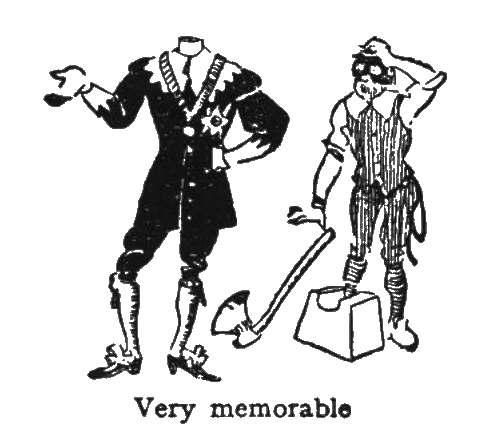
On seeing this, Cromwell was so angry that he picked up the mace (the new and terrible Instrument of Government which he had invented) and, pointing it at the Head, shouted: `Take away that Marble,' and announced that his policy in future would be just Blood and Ironclads. In order to carry out this policy he divided the country into twelve districts and set a Serjeant-Major over each of them. The Instrument of Government (1653) made Cromwell Lord Protector. When dissolving the Rump Parliament, Cromwell picked up the parliamentary mace and told his soldiers to "take away that bauble". Much later, Otto von Bismarck gave a famous "blood and iron" speech (1862) about the unification of Germany. Cromwell divided England and Wales into ten military districts ruled by major-generals.
Rule of the Serjeant-Majors
Nothing sickened the people of the rule of the Serjeant Majors so much as their cruel habit of examining little boys viva-voce. For this purpose the unfortunate children were dressed in their most uncomfortable satins and placed on a stool. The Serjeant-Major would then ask such difficult questions as `How's your Father?' or `Animal, Vegetable, or Mineral?' and those who could not answer were given a cruel medicine called Pride's Purge. All this was called the Crommonwealth and was right but repulsive. Col. Thomas Pride’s exclusion of MPs in 1648 is known as Pride's Purge; “Commonwealth” was the official name of the republican regime.
The Crowning Mercy
The Roundheads at length decided to offer Cromwell the Crown. Cromwell, however, was unwilling and declared it was a Crowning Mercy when he found that it would not fit, having been designed for a Cavalier King. Cromwell declined the crown in 1657 under the Humble Petition and Advice; “crowning mercy” was his phrase for the victory at Dunbar (1650). Soon after, Cromwell died of a surfeit of Pride, Purges, Warts, and other Baubles. See .
Chapter 36
Charles II: A Merry Monarch
Charles II was always very merry and was therefore not so much a king as a Monarch. During the civil war he had rendered valuable assistance to his father's side by hiding in all the oak-trees he could find. After defeat at Worcester (1651), Charles hid in the “Royal Oak” at Boscobel House while fleeing; he related details of the event directly to Samuel Pepys. The Royal Oak thereafter became one of the most popular pub names in England, and thus the passage arguably suggests heavy drinking. He was thus very romantic and popular and was able after the death of Cromwell to descend to the throne.
Though now no longer arboreal, Charles remained very much interested in natural beauty and kept a great number of pets at his court, including his famous King Charles's Spaniards, the most memorable of whom was Catherine of Braganza; but, although married to Catherine, Charles was even fonder of an orange girl called Elinor Gwyn. He was thus a Bad Man. Catherine of Braganza was queen consort; Nell Gwyn was Charles’s famed mistress, who previously sold oranges on the street at the Theatre Royal, which eventually led to her career as an actress. “King Charles spaniels” are the toy breed associated with him.
The Reformation
Charles II was famous for his wit and his inventions. Among the latter was an unbridled and merry way of behaving and writing plays, called the Reformation. The term is the Restoration (of the monarchy), not the Reformation; Restoration comedy, known for its immorality, characterized plays of the time. This was a Good Thing in the end as it was one of the earliest causes of Queen Victoria's determination to be good.
Examples of Charles's Wit
Most of Charles's witty remarks were of an unbridled nature and are therefore (fortunately) not memorable.
He instituted, however, a number of witty Acts of Parliament. Amongst these were:
(a) The Act of Indemnity and Oblivion, which said that everyone had to pay an indemnity to the King and then forget that he had paid it. The Indemnity and Oblivion Act (1660) pardoned most participants in the Interregnum (i.e., the period of the Commonwealth of England).
(b) The Act of Uniformity, which said that everyone had to be the same as everyone else. The Act of Uniformity (1662) mandated use of the Book of Common Prayer and ejected nonconforming clergy.
(c) The Five Mile Act, which said that no schoolmasters or clergymen were to go within five miles of each other. (This was, obviously, a Good Thing.) The Five Mile Act (1665) restricted nonconformist ministers from towns and former parishes.
(d) The Corporation Act, which said that everyone had to be as fat as possible (except Nell Glyn). The Corporation Act (1661) required municipal officials to conform to the Church of England.
After each of these Charles became merrier still and though some of them, particularly the Corporation Act, were considered rather unfair, he made up by passing a new Habeas Corpus Act which said that all the people might keep their bodies, and thus everyone was contented. The Habeas Corpus Act (1679) was passed by what became known as the Habeas Corpus Parliament; it is possible this is referring to the 1640 Habeas Corpus Act, which of course preceded the Corporation Act. Later, Charles became even merrier and made a Declaration of Indulgence saying that people could do anything they liked and a Test Act was passed soon after to see if they had done it (and, if so, what). The Declaration of Indulgence (1672) suspended penal laws; the Test Acts (from 1673) imposed oaths excluding Catholics and dissenters from office.
Admiral De Trap in the Channel (Reuter)
It was at this period that the Navigation Acts were first made by the English. These Acts pointed out to the other countries that no foreign ships knew how to navigate the seas, and that their only chance was to steer for English ports. Although this was really part of the Rule Britannia (see Chap. 2, Freedom of the Seas), it caused some wars against the Dutch who were treacherously attempting to be top nation on the sea at that time. For a short while the Dutch ships were successful under their memorable Admiral, Van Broom, who is famous for blowing his own Trompet up the Medway until the sound was heard in the streets of London. Dutch admirals Maarten Tromp and Michiel de Ruyter led the Anglo-Dutch Wars; De Ruyter’s raid up the Medway occurred in 1667. The war, however, soon came to an end, since the Dutch are quite small and can never be top nation really.
Quaker Oates
A great deal of excitement was caused in this reign by Titus Oates, the memorable Quaker, who said that a Roman Catholic plot had been made with the objects (a) of murdering the King, (b) of blowing up the people, (c) of restoring the Roman Catholic religion instead. Titus Oates, an Anglican cleric, fabricated the Popish Plot (1678); he was not a Quaker. The Popish Plot alleged that the Catholics were conspiring to assassinate Charles II; the resulting anti-Catholic hysteria led to show trials and executions of at least 22 men. These would probably have been a Bad Thing, if they had been achieved, and the King was so enraged that he immediately introduced a Disabling Act which said that everyone except the heir to the throne was to be disabled. Later when he had relented, he had another Habeas Corpus Act passed, saying that the disabled people might keep their bodies. The Exclusion Crisis sought to bar the Catholic Duke of York (later James II). In 1678 an act was passed disabling Catholics from sitting in Parliament. The Habeas Corpus Act (1679) strengthened judicial review of imprisonment, requiring detainees to be brought before a judge promptly.
Two Good Things
During Charles II's reign the Great Plague happened in London. This was caused by some rats which had left a sinking ship on its way from China, and was very fortunate for the Londoners, since there were too many people in London at the time, so that they were always in bad health.
In the following year, therefore, London was set on fire in case anyone should have been left over from the Plague, and St Paul's Cathedral was built instead. This was also a Good Thing and was the cause of Sir Christopher Wren, the memorable architect. Sir Christopher Wren designed the new St Paul’s.
Pepys
Among the famous characters of the period were Samuel Pepys, who is memorable for keeping a Dairy and going to bed a great deal, and his wife Evelyn, who kept another memorable Dairy, but did not go to bed in in it. Samuel Pepys and John Evelyn both kept diaries chronicling Restoration life; Pepys’s spouse was Elizabeth Pepys.
Chapter 37
James II: A Maddening King
Although a Good Man, James II was a Bad King and behaved in such an irritating and arbitrary way that by the end of his reign the people had all gone mad.
Judge Jeffreys
One of the first things that happened was a rebellion by Monmouth, an indiscriminate son of Charles II who, landing incorrectly in Somerset, was easily defeated at Newbury, Sedgehill, Marston Moor, Newbury, etc. (see Civil War). The Monmouth Rebellion ended with defeat at Sedgemoor (1685). The Rebels were ferociously dealt with by the memorable Judge Jeffreys who was sent out by James as a Justice in Ire in the West, where he made some furious remarks about the prisoners, known as `The Bloody Asides'. Jeffreys’s “Bloody Assizes” were mass trials and executions following Sedgemoor. A justice in eyre was the high-ranking magistrate in English law.
Madnesses of James II
James II further enraged his subjects by (a) attempting to repeal the Habeas Corpus Act, saying that nobody might have a body after all, and (b) claiming the Dispensing Power which was a threat to revive Pride's Purge and do the dispensing of it himself; (c) suspending (probably a modified form of hanging) the Vice-Chancellor at Cambridge, who was apparently mad too, for refusing to have a Benedictine. James asserted a dispensing/suspending power to override laws, provoking opposition; he clashed with Oxford and Cambridge over admitting Catholics.
England's Answer
The final and irreparable madness of the people was brought on by James's action in bringing to trial Seven Bishops (Bancroft, Sancroft, and Sacheveral others) for refusing to read Charles II's Declaration of Indulgence (which they thought would be dangerous under the circumstances), and when in addition it became known that James had confined his infant son and heir in a warming-pan the people lost control of themselves altogether and, lighting an enormous number of candles, declared that the answer was an Orange. James was thus compelled to abdicate. Seven bishops were tried and acquitted in 1688 for resisting James’s Declaration of Indulgence. Rumors claimed the prince (James Francis Edward) was smuggled in a warming-pan. William of Orange was invited to intervene; James fled and effectively abdicated.
Chapter 38
Williamanmary: England Ruled by an Orange
Williamanmarry for some reason was known as The Orange in their own country of Holland, and were popular as King of England because the people naturally believed it was descended from Nell Glyn. See . It was on the whole a good King and one of their first Acts was the Toleration Act, which said they would tolerate anything, though afterwards it went back on this and decided that they could not tolerate the Scots. William III and Mary II reigned jointly from 1689; the Toleration Act (1689) granted limited freedom of worship to Protestant dissenters.
A Darien Scheme
The Scots were now in a skirling uproar because James II was the last of the Scottish Kings and England was under the rule of the Dutch Orange; it was therefore decided to put them in charge of a very fat man called Cortez and transport them to a Peak in Darien, where it was hoped they would be more silent. Keats's "On First Looking into Chapman's Homer" reflects his sense of wonder upon first reading the Chapman translation of the Odyssey; it includes the line "Or like Stout Cortez when with eagle eyes / He stared at the Pacific—and all his men / Look'd at each other with a wild surmise— / Silent, upon a peak in Darien". Keats conflated two scenes from Robertson's History of America, which described both Cortez's view of the Valley of Mexico and Balboa's view of the Pacific; he then mentions Darien, which neither explorer ventured to. Scotland’s Darien scheme (1698–1700) attempted a colony on the Isthmus of Panama; it was financially backed by approximately 20 percent of all money in Scotland, and thus its rapid failure left the entire Scottish Lowlands in financial ruin.
Massacre of Glascoe
The Scots, however, continued to squirl and hoot at the Orange, and a rebellion was raised by the memorable Viscount Slaughterhouse (the Bonnie Dundee) and his Gallivanting Army. Finally Slaughterhouse was defeated at the Pass of Ghilliekrankie and the Scots were all massacred at Glascoe, near Edinburgh (in Scotland, where the Scots were living at that time); after which they were forbidden to curl or hoot or even to wear the Kilt. (This was a Good Thing, as the Kilt was one of the causes of their being so uproarious and Scotch.) John Graham of Claverhouse, Viscount Dundee (“Bonnie Dundee”), won at Killiecrankie (1689) but was killed; the Massacre of Glencoe occurred in 1692. A general ban on Highland dress came later (after 1746).
Blood-Orangemen
Meanwhile the Orange increased its popularity and showed themselves to be a very strong King by its ingenious answer to the Irish Question; this consisted in the Battle of the Boyne and a very strong treaty which followed it, stating (a) that all the Irish Roman Catholics who liked could be transported to France, (b) that all the rest who liked could be put to the sword, (c) that Northern Ireland should be planted with Blood Orangemen. William defeated James II at the Boyne (1690); the Treaty of Limerick (1691) allowed Jacobite troops to depart for France (“Flight of the Wild Geese”). The Ulster Plantation predated this (early 1600s); the Orange Order formed later (1795).
These Blood-Orangemen are still there; they are, of course, all descendants of Nell Glyn and are extremely fierce and industrial and so loyal that they are always ready to start a loyal rebellion to the Glory of God and the Orange. All of which shows that the Orange was a Good Thing, as well as being a good King. After the Treaty the Irish who remained were made to go and live in a bog and think of a New Question.
The Bank of England
It was Williamanmary who first discovered the National Debt and had the memorable idea of building the Bank of England to put it in. The Bank of England was founded in 1694 to help finance government debt. The National Debt is a very Good Thing and it would be dangerous to pay it off, for fear of Political Economy.
Finally the Orange was killed by a mole while out riding and was succeeded by the memorable dead queen, Anne. William III died in 1702 after a fall from his horse, said to have stumbled on a molehill; Anne succeeded him. See for why she's dead. Due to this incident, the Jacobites developed a traditional toast to "the little gentleman in the black velvet waistcoat", i.e., the mole.
TEST PAPER IV
Up to the End of the Stuarts
- Stigmatize cursorily (a) Queen Mary, (b) Judge Jeffreys's asides. (Speak out.) “Queen Mary” here is Mary I (“Bloody Mary”); Jeffreys’s “asides” are the Bloody Assizes.
- Outline joyfully (1) Henry VIII, (2) Stout Cortez. See .
- Who had what written on whose what?
- What convinces you that Henry VIII had VIII wives? Was it worth it?
- Conjugate briefly Ritzio and Mary Queen of Scots.
- In what ways was Queen Elizabeth a Bad Man but a Good Queen?
- `To the exercise of Despotic Monarchy the Crown is more essential than the Throne.' (Refute with special reference to anything you know.)
- Which do you consider was the stronger swimmer, (a) The Spanish Armadillo, (b) The Great Seal?
- Who was in whose what, and how many miles away?
- Cap'n, art thou sleeping there below?N.B. Do not attempt to answer this question. "Capten, art tha sleepin' there below?" is a line in Drake's Drum by Newbolt.
- Deplore the failure of the Gunpowder Plot, stating the day and month (but not, of course, the year) usually assigned to it.
- Examine the state of mind of (1) Charles I, half an hour after his head was cut off (2) Charles II, half a moment after first sighting Nell Gwyn.
- Why on earth was William of Orange? (Seriously, though.)
- How can you be so numb and vague about Arabella Stuart? Arabella Stuart (1575-1615) was an English noblewoman with a plausible claim to the throne as a great-granddaughter of Henry VII; she married William Seymour, was imprisoned, tried to escape, and died in the Tower.
- Estimate the medical prowess of the period with clinical reference to (a) Pride's Purge, (b) The Diet of Worms, (c) The Topic of Capricorns. See for Pride's Purge; the Diet of Worms (1521) summoned Martin Luther to renounce his views, which he instead defended; Tropic of Capricorn is the southern tropic.
Chapter 39
Anne: A Dead Queen
Queen Anne was considered rather a remarkable woman and hence was usually referred to as Great Anna, or Annus Mirabilis. “Great Anna” possibly refers to Pope's mock-heroic poem The Rape of the Lock, "Here thou, great Anna! whom three realms obey, / Dost sometimes counsel take—and sometimes tea." Besides being dead See . she was extremely kind-hearted and had a very soothing Act passed called the Occasional Conformity Act which said that people only had to conform with it occasionally: The Occasional Conformity Act (1711) penalized “occasional conformity” by Dissenters who briefly took Anglican communion to qualify for office; it was repealed in 1719. this pleasant trait in her character was called Queen Anne's Bounty. Queen Anne’s Bounty (founded 1704) redirected the Crown’s “First Fruits and Tenths” to augment poor clergy incomes. (The Occasional Conformity Act was the only Act of its kind in History, until the Speed limit was invented.)
The Queen had many favourites (all women), the most memorable of whom were Sarah Jenkins and Mrs Smashems, who were the first Wig and the first Tory. Sarah “Jenkins” is Sarah Jennings (Duchess of Marlborough), a leading Whig; “Mrs Smashems” is Abigail Masham, a Tory ally who displaced her. Up Jenkins is a drinking game where a player conceals a coin in one palm; the opposing team yells "Up Jenkins", and the player holds two fists; the opposing team yells "Bang Ems" or "Smash Ems", and the player slaps both palms on the table; the opposing team then guesses which hand holds the coin. It is referenced in 1920s literature to an oddly large extent. Sarah Jenkins was really the wife of the Duke of Marlborough, the famous General, inventor of the Ramillies Whig) of which Sarah wore the first example. John Churchill, Duke of Marlborough, won at Ramillies (1706); the “Ramillies wig” became a fashion.
Succession of Wars
All through the eighteenth century there was a Succession of Wars, and in Queen Anne's reign these were called the Spanish Succession (or Austrian Succession) because of The Infanta (or The Mariatheresa); The War of the Spanish Succession (1701–1714) concerned the Spanish inheritance; the War of the Austrian Succession was later (1740–1748) and involved Maria Theresa, the Habsburg claimant whose succession sparked the later War of the Austrian Succession. The Infanta is the title given to the eldest daughter of the monarch of Spain. they were fought mainly on account of the French King L/XIV (le grand Monomarque) saying there were no more Pyrenese, thus infuriating the Infanta who was one herself. Louis XIV, “le Grand Monarque”. Due to the 1659 Treaty of the Pyrenees, Manuel de Oms, the Spanish diplomat, exclaimed to Louis XIV that “there are no more Pyrenees” to evoke the diplomatic unification of France and Spain.
Probably the Wars could never have been fought properly but for the genius of Marlborough, who could always remember which side the Bavarians and the Elector Pantomime of the Rhine were supposed to be on: The Elector Palatine and the Elector of Bavaria were key German princes; alliances shifted, but Marlborough coordinated the Grand Alliance. this unique talent enabled him to defeat his enemies in fierce battles long before they could discover which side he himself was on. Marlborough, however, was a miser in politics and made everyone pay to go into his party; he was therefore despised as a turnstyle. a turncoat is a person who deserts one party or cause in order to join an opposing one.
In this reign also occurred the memorable Port Wine Treaty with Portugal, directed against Decanters (as the Non-Conformists were now called), The Methuen Treaty (1703) with Portugal favored English woollens and Portuguese wines (port). as well as a very clever Act called the Schism Act which said that everybody's religion was to be quite different from everybody else's. The Schism Act (1714) restricted Dissenters from teaching; it received assent shortly before Anne’s death and was not enforced under George I. Meanwhile the Whigs being the first to realize that the Queen had been dead all the time chose George I as King. George I succeeded in 1714 under the Act of Settlement (1701), which prioritized Protestant succession.
Chapter 40
The XV and the XLV
Although the Whigs said that George I was King, many of the Tories thought that the Old Pretender was. The “Old Pretender” was James Francis Edward Stuart, claimant to the British thrones. The Old Pretender did not raise the standard of rebellion much and is only famous for being late for his own Rebellion, which had been easily put down long before he landed with his memorable XV in Scotland. The 1715 Jacobite rising (“the ’Fifteen”) failed before James arrived. His standard was of blue silk with the motto `Nemo me impune lacessit', but when it was raised the top fell off. “Nemo me impune lacessit” (“No one provokes me with impunity”) is associated with Scotland and the Order of the Thistle. A traditional Jacobite ballad records the golden ball on the top of the staff fell when the standard was raised; Marshall's Our Island Story reports that this "made the Highlanders very sad".
The Young Pretender, whose followers were called the XLV, was quite different, his standard being of red silk with the motto "Tandem Triumphans", and the top didn't fall off. The 1745 rising (“the ’Forty-Five”) was led by Charles Edward Stuart, the “Young Pretender”; his standard was raised at Glenfinnan. At Preston Pans the English commander was the first to run away and bring the news of his own defeat, which was thus immediately believed. The Jacobites defeated government forces at Prestonpans (1745). The hero of these adventures was the memorable Bonnie Prince Charlie (the Young Chandelier), who after being bloodily defeated by a Butcher at Flodden in Cumberland, The Jacobites were decisively defeated at Culloden (1746) by the Duke of Cumberland (nicknamed “the Butcher” after his victory at Culloden, for which Handel wrote an oratorio); Flodden (1513) was a different battle. Bonnie Prince Charlie and the Young Chevalier were alternative nicknames for the Young Pretender. was helped to escape by his many Scottish lovers, such as Flora MacNightingale (the fair maid of Perth), Amy Robsart, Lorna Doone, Annie Laurie, the Widow with Thumbs, etc. Flora MacDonald aided Charles’s escape, not the nurse Florence Nightingale; the others are literary figures and songs (Scott’s Novel Fair Maid of Perth, Scott's character Amy Robsart in Kenilworth, Blackmore’s novel Lorna Doone, the Scottish song “Annie Laurie”, and Barrie's novella A Window in Thrums). Upon arriving in France, Bonnie Prince Charles was received as a hero: he regularly attended the Opera and theaters to elicit enthusiastic standing ovations (partly due to his Jacobite claque); he distributed medals, rings, and maps of Scotland that indicated his exploits during the '45; and his supporters adopted the Tuileries as their haunt, which earned it the new nickname of promenade des anglais. However, the Treaty of Aix-la-Chapelle ending the War of the Austrian Succession (the signing of which was celebrated in London by Handel's Music fo the Royal Fireworks, specifically composed for the occasion) required his return to England by Louis XV. Edward publicly denounced the treaty and "went around Paris with loaded pistols, determined to resist any attempt to arrest him or, if confronted with overwhelming force, to commit suicide" (Poetry and the Police). The French government feared an armed uprising due to his popularity. Consequently, he was seized by soldiers with drawn bayonets at the Opera, forced into a carriage, and rapidly sent over the eastern border. Strict censorship prevented Parisian newspapers from discussing the affair or his whereabouts; this led to a large number of Edward-lookalikes being spotted throughout Europe.
The Southsea Bubble
About this time nearly everybody in London stupidly got involved in an enormous bubble that appeared at Southsea. The South Sea Bubble (1720) was a stock speculation crash tied to the South Sea Company. Numerous sources report that Isaac Newton lost a fortune in the bubble. Some were persuaded that it would be a Good Thing if all the money in the country, including the National Debt, were sunk in it; others got into it merely with the object of speculating how soon it would be before it burst. Among these was a very clever man called Walpole who got out of the bubble in time, thus bursting it and becoming the first Prime Minister. Robert Walpole stabilized finances afterward and is regarded as Britain’s first de facto prime minister. Walpole was a Good Prime Minister: the Southsea bubble was thus a Good Thing.
'Let Sleeping Dogs Lie' (Walpole)
Walpole ought never to be confused with Walpole, who was quite different; it was Walpole who lived in a house with the unusual name of Strawberry Jam and spent his time writing letters to famous men (such as the Prime Minister, Walpole, etc.). Horace Walpole (son of Robert) owned Strawberry Hill House and was famed for his letters and for The Castle of Otranto. Walpole is memorable for inventing the new policy of letting dogs go to sleep. “Let sleeping dogs lie” was said to be oft-quoted by Robert Walpole.
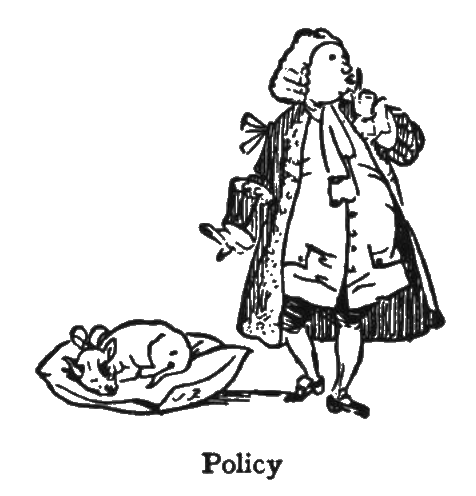
This was a Good Thing really, but it so enraged the people (who thought that a dog's life should be more uncomfortable) that they rang all the bells in London. At first Walpole merely muttered his policy, but eventually he was compelled to rouse himself and become actively memorable by remarking: `They are ringing the bells now; I shall be wringing their necks soon.' On the declaration of war with Spain, Walpole said "They now ring the bells, but they will soon wring their hands".
Chapter 41
Rules of Wars in the Eighteenth Century
Although the Succession of Wars The War of the Spanish Succession (1701-1714) began upon the death of the childless Charles II of Spain. (He wasn't very healthy: the autopsy reported that his "heart was the size of a peppercorn; his lungs corroded; his intestines rotten and gangrenous; he had a single testicle, black as coal, and his head was full of water".) He named his heir as Philip of Anjou (who became Philip V), but the Grand Alliance (the Dutch, English, and Habsburgs) supported Archduke Charles of Austria. went on nearly the whole time in the eighteenth century, the countries kept on making a treaty called the Treaty of Paris (or Utrecht). The war was ended by the Peace of Utrecht (1713) and treaties at Rastatt and Baden (1714). Dozens of treaties are referred to as Treaty of Paris; somewhat contemporaneous ones include 1763 for the Seven Years' War and 1783 for the American Revolution.
This Treaty was a Good Thing and laid down the Rules for fighting the wars; these were:
(1) that there should be a mutual restitution of conquests except that England should keep Gibraltar, Malta, Minorca, Canada, India, etc.; Britain gained Gibraltar and Menorca from Spain, as well as some Canadian colonies from France.
(2) that France should hand over to England the West Indian islands of San Flamingo, Tapioca, Sago, Dago, Bezique and Contango, while the Dutch were always to have Lumbago and the Laxative Islands; None of the island names are correct; Dago is a derogatory term for an Italian/Spanish/Portuguese speaker, bezique is a French card game, and lumbago is an outdated medical term for lower back pain.
(3) that everyone, however Infantile or even insane, should renounce all claim to the Spanish throne; Philip V of Spain kept his throne but renounced his position in the line of succession to the French throne. "Infante" is the term for the Spanish royal prince.
(4) that the King (or Queen) of France should admit that the King (or Queen) of England was King (or Queen) of England and should not harbour the Young Pretender, but that the fortifications of Dunkirk should be disgruntled and raised to the ground. The treaty secured the (Protestant) succession of the House of Hanover to the British throne. The treaty required that the French port and fortifications at Dunkirk were demolished; these served as the primary base for French privateers ("Dunkirkers", from which the word dunning is derived) escaping British patrols in the English Channel. As discussed in , the Young Pretender was the Stuart claimant to the British throne in the 1740s, who was supported by France due to his Catholicism.
Thus, as soon as the fortifications of Dunkirk had been gruntled again, or the Young Pretender was found in a harbour in France, or it was discovered that the Dutch had not got Lumbago, etc., the countries knew that it was time for the treaty to be signed again, so that the War could continue in an orderly manner.
Chapter 42
George III: An Obstinate King
George III was a Bad King. He was, however, to a great extent insane and a Good Man and his ministers were always called Pitt. George III (r. 1760–1820) suffered bouts of illness; his prime ministers included William Pitt the Elder and William Pitt the Younger. The Pitts, like Pretenders, generally came in waves of about two, an elder Pitt and a younger Pitt.
Britain Muffles Through
The elder Pitt (Clapham) William Pitt the Elder was the Earl of Chatham, not Clapham; Clapham is a district in London. at this time had the rather strategic idea of conquering Canada on the banks of the Elbe; Pitt directed British strategy in the Seven Years’ War; its first battle took place at the Elbe River in Germany, although ultimately the war led to France ceding many of its possessions (including Canada) to the British. learning, however, that it was not there, he told the famous poetic general, Wolfe, to conquer Quebec instead. General James Wolfe led the Québec campaign. According to contemporary physicist John Robison, Wolfe recited to his officers (before the Battle of the Plains of Abraham) Gray's Elegy Written in a Country Churchyard, suitable due to the line "The paths of glory lead but to the grave". He then added "Gentlemen, I would rather have written that poem than take Quebec tomorrow". Robison's authority might be doubted, however, due to his authorship of Proofs of a Conspiracy, containing the allegations of a secret agent monk. At first Wolfe complained that he would rather write Gray's Elegy, but on being told that it had been written already (by Gray) he agreed to take Quebec.
Quebec was very difficult to approach; Wolfe therefore rowed up the St Laurence with muffled drums and ordered his Highland troops to skirl up the perpendicular Heights of Abraham with muffled boots, hoots, etc., thus taking the French by surprise. In the Battle of the Plains of Abraham, Wolfe sent his troops by night along the St. Lawrence River to a landing site at the bottom of a 53 m high cliff, which the French believed to be unclimbable. The 78th (Highland) Regiment of Foot led the British charge. To skirl is to make a shrill, wailing sound with bagpipes. "Hoots mon" is a Scotticism of "hey man".
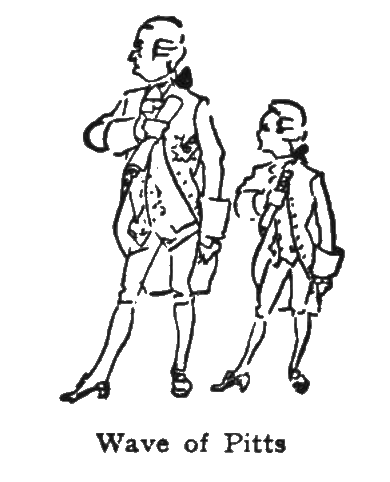
At this engagement the French had a very peculiar general with the unusual French name of Keep-calm. On receiving a muffled report to the effect that Wolfe's men had captured Quebec, one of his aides-de-calm called out: `See! They fly!' `Who fly?' asked the General, and, on being assured that it was his own men who were flying, `Thank God!' said Keep-calm, with a sigh of satisfaction: `Now, I can fly in peace!' The Marquis de Montcalm led the French troops and died of a musket shot in the back. Wolfe was shot thrice, including in the chest, supposedly leading to the following dialogue (which we quote from Parkman's account a century later). "See how they run," one of the officers exclaimed, as the French fled in confusion before the levelled bayonets. "Who run?" demanded Wolfe, opening his eyes like a man aroused from sleep. "The enemy, sir," was the reply; "they give way everywhere." "Then," said the dying general, "tell Colonel River, to cut off their retreat from the bridge. Now, God be praised, I die contented," he murmured; and, turning on his side, he calmly breathed his last breath.
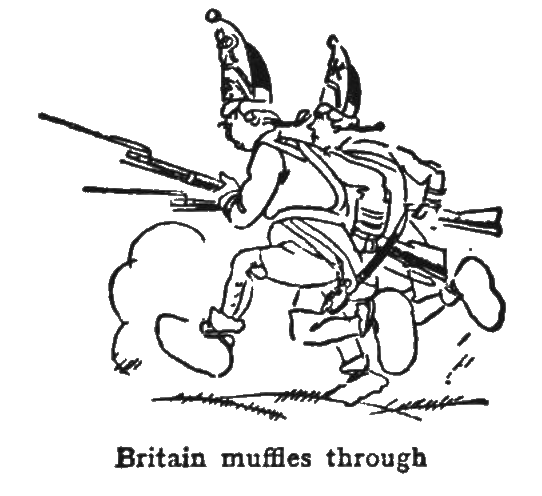
Chapter 43
India
It was in the eighteenth century that Indian History started. Indian History is a great number of wars in which the English fought victoriously against the Waratah Confederacy and various kinds of potentates called Sahibs, Wallahs, Jahs, Rajahs, Hurrahjahs, Mahurrahjahs, Jhams, and Jhelhies. Maratha Confederacy; Waratah is an Australian flower. Most memorable amongst these were the terrible Napoo Sahib, the Maharatta of Pshaw, the Chandra Gaff, and the Taj Mahal. “Napoo Sahib” conflates Nana Sahib (leader in the Indian Rebellion of 1857) and WWI slang (napoo was British military slang for the French "il n'y a plus", i.e., he's dead); the Peshwa of the Maratha refers to the chief minister of the Maratha Confederacy; the Chandra Gaff might be referring to the ancient emperor Chandragupta; the Taj Mahal is a Mughal mausoleum, not a person.
Cressey and the Black Whole
Many of these victories were due to an Englishman named Robert Clive, a typist in the East India Coy Ltd, who, after failing to commit suicide three times, made the famous raid on Arcos in conjunction with Jicks Pasha, and held it against all comers. Robert Clive (Clive of India) began as a "writer" (office clerk) in the East India Company. He rose in the military ranks and seized Arcot in 1751 with a small force during the Carnatic Wars. Pasha is ann Ottoman rank. Clive attempted to commit suicide twice in his youth and ultimately successfully cut his throat with a paper knife.
Clive then marched to Calcutta and with a Mir Jafar (or handful) of men defeated all the Indians in the utterly memorable battle of Cressey. Clive recaptured Calcutta and won the Battle of Plassey, installing Mir Jafar as Nawab of Bengal.
This battle was Clive's revenge on the Black Whole of Calcutta and especially on that destructive All-Black Waratah, the Napoo Sahib. The “Black Hole of Calcutta” refers to the 1756 imprisonment of British soldiers in a cell at Fort William. Clive defeated Siraj ud-Daulah.
The Doldrums of Oudh
Second in importance only to Clive was Laurence Hastings, well known for his rapacity towards the natives. Warren Hastings (Governor-General, 1773–1785) faced impeachment in Britain. Richard Brinsley Sheridan opened the impeachment trial by describing how Hastings ordered British soldiers into the women's quarters of the princess of Oudh; as the audience wept, Sheridan collapsed, overcome by his own rhetoric. The performance was deemed the greatest speech of ancient or modern times by William Pitt. Besides his treatment of Lo (a poor Indian with an untutored mind) recorded by the poet Poep, “Lo, the poor Indian! whose untutor'd mind” opens a passage in Alexander Pope’s Essay on Man. he very harshly extracted money from the Doldrums of Oudh, two old women without any teeth. The “Begums of Oudh” were the mother and wife of Nabob of Oudh; Hastings took their treasure, which became a central point of discussion in the impeachment. For this he was impaled before the House of Commons, and after being cross-examined by Burke and Hare for seven and a half years, Edmund Burke led Hastings’s impeachment, which lasted seven years (1788–1795); Hastings was acquitted. Burke and Hare were 1820s Edinburgh bodysnatchers. was finally acquitted and became Viscount Senlac of Oudh. Hastings became a baron, not a viscount. Senlac was the hill where Harold II stood at the Battle of Hastings (1066, obviously).
Chapter 44
The Boston Tea-Party
One day when George III was insane he heard that the Americans never had afternoon tea. This made him very obstinate and he invited them all to a compulsory tea-party at Boston; the Americans, however, started by pouring the tea into Boston Harbour and went on pouring things into Boston Harbour until they were quite Independent, thus causing the United States. The Boston Tea Party (1773) protested the Tea Act; the American Declaration of Independence followed in 1776. These were also partly caused by Dick Washington who defeated the English at Bunker's Hill (`with his little mashie', as he told his father afterwards). George Washington commanded the Continental Army; Dick Whittington was a medieval merchant whose life was popularized in an excessively popular play. The Battle of Bunker Hill (1775) was an early engagement in which British troops took the ground with heavy losses. A mashie is a golf club (now known as the 5-iron), punning on sand bunkers in golf.
The War with the Americans is memorable as being the only war in which the English were ever defeated, and it was unfair because the Americans had the Allies on their side. France (1778), Spain (1779), and the Dutch Republic (1780) allied against Britain. In some ways the war was really a draw, since England remained top nation and had the Allies afterwards, while the Americans, in memory of George III's madness, still refuse to drink tea and go on pouring anything the English send them to drink into Boston Harbour. After this the Americans made Wittington See . President and gave up speaking English and became U.S.A. and Columbia and 100%, etc. The first U.S. president was George Washington; “Columbia” was a poetic name for America (e.g., "Hail, Colubmia!" is a patriotic song). During WWI, the "100 percent American" movement took off, creating a popular nationalist slogan. This was a Good Thing in the end, as it was a cause of the British Empire, but it prevented America from having any more History.
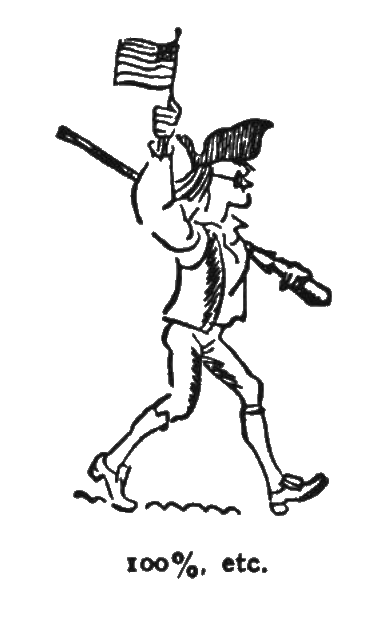
Chapter 45
The French Revolution
Soon after America had ceased to be memorable, the French Revolution broke out (in France). This, like all other Revolutions, was chiefly due to Liberty, Fraternity, Equality, etc., but also to the writings of Madame Tousseau, the French King's mistress, who believed in everyone returning to a state of nature and was therefore known as la belle sauvage. Rousseau (not Tousseau, which presumably is a joke about Madam Tussauds, who lived during the French Revolution and produced a depiction of Rousseau) believed that Man is innately good, i.e., “le bon sauvage”; Belle Sauvage was a famous London public house.
The French Revolution is very interesting and romantic; quite near the beginning of it Dante and Robespear, the revolutionary leaders (or Jacobites as they were called), Danton and Robespierre were leading Jacobins; the political club ascended to power during the Reign of Terror. met in the beautiful and historic Chamber of Horrors at Versailles and decided to massacre everyone in September. The September Massacres (1792) executed thousands of royalist prisoners. The Chamber of Horrors is an exhibition at Madame Tussauds in London. This was called the Glorious First of June and was done in accordance with a new National Convention. The “Glorious First of June” was a British naval battle in 1794. Memorable amongst those who were massacred were Robespear himself, who was executed in his own gelatine, and Marat, who was murdered in his bath by Madame Tousseau. Robespierre was guillotined in 1794; Jean-Paul Marat was assassinated in 1793 by Charlotte Corday. Madame Tussauds made a sketch of the room and a death mask for Marat.
Chapter 46
Napoleon
The English were disgusted by this new French Convention and so decided to go in for The War again, thus causing Nelson and the Duke of Wellington. The War was now called the Napoleonic War, after Napoleon, a Corsican, whose real name was Bonuapart, and who had cleverly made himself First Consort by means of a whiff of grape-nuts. (This is called the Napoleonic Legend.) Napoleon Bonaparte, Corsican-born as "Buonaparte", became First Consul in 1799. Thomas Carlyle recorded that Napoleon gave his opponent a “whiff of grapeshot” when, as a young general, he quelled a royalist revolt. Grape-Nuts is a brand of cereal from 1897.
The French Revolution caused great loss of life, liberty, fraternity, etc., and was, of course, a Good Thing, since the French were rather degenerate at the time; but Napoleon now invented a new Convention that the French should massacre all the other nations and become top nation, and this, though quite generate, was a Bad Thing.
Chapter 47
Nelson
Napoleon ought never to be confused with Nelson, in spite of their hats being so alike; they can most easily be distinguished from one another by the fact that Nelson always stood with his arm like this, while Napoleon always stood with his arms like that.
Nelson was one of England's most naval officers, and despised weak commands. At one battle when he was told that his Admiral-in-Chief had ordered him to cease fire, he put the telephone under his blind arm and exclaimed in disgust: `Kiss me, Hardy!' Nelson put a telescope to his blind eye at Copenhagen (1801) to deliberately ignore a signal. “Kiss me, Hardy” were supposedly his last words at Trafalgar (1805), addressed to Captain Thomas Hardy; conflicting accounts exist.
By this and other intrepid manoeuvres the French were utterly driven from the seas.
Pitt and Fox
Meanwhile at home the War was being helped on a good deal by the famous remarks of the politicians, such as Pitt and Fox. William Pitt the Younger led wartime governments; Charles James Fox was his Whig rival and often critical of the war. On one occasion Fox said in the House of Commons that the French Revolution was a Good Thing; whereupon the younger Pitt (Balham) Unlike the elder Pitt (who was the Earl of Chatham), the younger was not an earl. Balham is a London district rose slowly to his feet and, pointing at Fox, exclaimed: 'Roll up that chap: he will not be wanted these ten years.' Upon hearing of Napoleon's success at the Battle of Austerlitz (a major French victory), Pitt said "Roll up the map: it will not be wanted these ten years." Having thus made his most memorable saying, Pitt was carried out of the House and died almost immediately of a surfeit of austerlitz. Pitt died in 1806 shortly after news of Austerlitz (1805). The plans of Napoleon were thus gradually thwarted.
Chapter 48
Wellington
But the most important of the great men who at this time kept Britain top nation was an Irishman called John Wesley, who afterwards became the Duke of Wellington (and thus English). Arthur Wellesley (not John Wesley) became the Duke of Wellington; he was born in Dublin. John Wesley established Methodism (which then branched off from the C. of E.). When he was still Wolseley, Wellington made a great name for himself at Plassaye, in India, where he remarking afterwards, `It was the bloodiest battle for numbers I ever knew.' Wellesley’s key Indian victory was Assaye (1803), which he called “the bloodiest for the numbers that I ever saw”. See for Plassey. It was, however, against Napoleon and his famous Marshals (such as Marshals Ney, Soult, Davos, Mürren, Soult, Bleriot, Snelgrove, Ney, etc.) that Wellington became most memorable. Principal marshals opposing Britain included Ney, Soult, Davout, Murat, and Berthier. Bleriot was a French aviator who made the first flight across the channel; Murren and Davos are Swiss towns; Marshall & Snelgrove was a London department store. Napoleon's armies always used to march on their stomachs, The proverb "an army marches on its stomach" is often attributed to Napoleon Bonaparte; it was first attributed to Frederick the Great. shouting: 'Vive I'lnterieur!' Vive l’Empereur! and so moved about very slowly (ventre-à-terre, as the French say This literally translates to "belly to the ground" and idiomatically (in French) means "at full speed".), thus enabling Wellington to catch them up and defeat them. When Napoleon made his troops march all the way to Moscow on their stomachs they got frozen to death one by one, and even Napoleon himself admitted afterwards that it was rather a Bad Thing. Napoleon’s 1812 invasion of Russia ended in disastrous retreat due to winter and logistics.
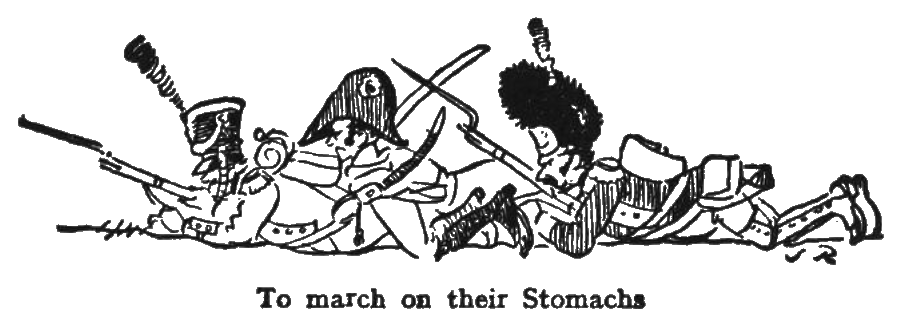
Gorilla War in Spain
The second part of the Napoleonic War was fought in Spain and Portugal and was called the Gorilla War on account of the primitive Spanish method of fighting. Armed civilians, often led by regular army officers, led guerilla warfare in the Peninsular War. The war started when Spain agreed for Napoleon to conquer Portugal by transiting through Spain; Napoleon proceeded to also occupy Spain.
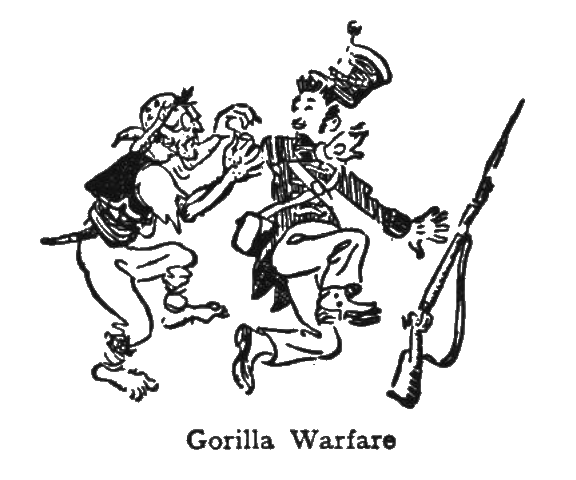
Wellington became so impatient with the slow movements of the French troops that he occupied himself drawing imaginary lines all over Portugal and thus marking off the fighting zone; he made a rule that defeats beyond these lines did not count, while any French army that came his side of them was out of bounds. The Lines of Torres Vedras were fortifications protecting Lisbon, pivotal to Allied defense (1810–1811). Having thus insured himself against disaster, Wellington won startling victories at Devalera, Albumina, Salamanda, etc. Major victories include Vimeiro (1808), Albuera (1811), Salamanca (1812), Vitoria (1813). Eamon de Valera led the 1916 Easter Rising in Ireland (against British rule).
Waterloo
After losing this war Napoleon was sent away by the French, since he had not succeeded in making them top nation; but he soon escaped and returned just in time to fight on the French side at the battle of Waterloo. Napoleon abdicated in 1814, returned for the Hundred Days in 1815, and was defeated at Waterloo. This utterly memorable battle was fought at the end of a dance, on the Playing Fields of Eton, and resulted in the English definitely becoming top nation. The Duchess of Richmond’s ball was interrupted by the Duke of Wellington upon hearing news of Napoleon's unexpected advance. Wellington apocryphally said that Waterloo was won on the “playing fields of Eton”, crediting his education at Eton; this quote likely originated from Count de Montalembert three years after the Duke's death. It was thus a very Good Thing. During the engagement the French came on in their usual creeping and crawling method and were defeated by Wellington's memorable order, `Up Jenkins and Smashems'. A letter from Captain Batty of the Foot Guards quotes Wellington as saying "Up, Guards, and at them again." This is often misquoted as “Up, Guards, and at 'em!” See on Up Jenkins.
This time Napoleon was sent right away for ever by everybody, and stood on the deck of a ship in white breeches with his arms like that. Napoleon was exiled to Saint Helena, where he died in 1821.
Chapter 49
The Industrial Revelation
During these Wars many very remarkable discoveries and inventions were made. Most memorable among these was the discovery (made by all the rich men in England at once) that women and children could work for twenty-five hours a day in factories without many of them dying or becoming excessively deformed. This was known as the Industrial Revelation and completely changed the faces of the North of England.
The Tractarian Movement
The Industrial Revelation would never have occurred but for the wave of great mechanical Inventors, e.g. Arkwright, who invented the Spinning Jenny, or unmarried textile working girl; James Hargreaves invented the spinning jenny (c. 1764); Richard Arkwright patented the water frame (1769). subsequently, however, this kind of work was done by mules, the discovery of a man called Crompton. Samuel Crompton invented the spinning mule (c. 1779). Other benefactors were Sir Isaak Watts who invented steam-kettles, James Watt improved the steam engine; Isaac Watts was a hymn writer. Sir Robert Boyle who had them legalized, Boyle's Law: `Watts pots never boyle.' and finally Robert Louis Stevenson, who put wheels on to them, thereby inventing Railway trains, steam-rollers, and other tractarian engines. Robert Stephenson (with his father George) pioneered railway locomotives and lines; Robert Louis Stevenson was a novelist.
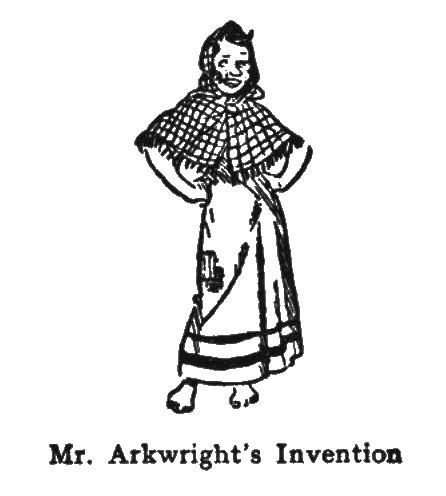
Factory Acts
The new situation created by the Industrial Revelation was boldly met by the statesmen of the day with a wave of Acts, such as Tory Acts, Factory Acts, Satisfactory Acts and Unsatisfactory Acts. The Factory Acts were a series of acts that limited child labor and regulated hours and conditions. The most soothing of these enacted that children under five years of age who worked all day in factories should have meals (at night). This was a Good Thing, as it enabled them to work much faster.
Enclosures
At the same time there was an Agricultural Revelation which was caused by the invention of turnips and the discovery that Trespassers would be Prosecuted. “Turnip” Townshend promoted crop rotation; parliamentary enclosures consolidated fields and restricted common rights. This was a Good Thing too, because previously the Land had all been rather common, and it was called the Enclosure movement and was the origin of Keeping off the Grass. The movement culminated in the vast Royal Enclosure at Ascot which nobody is allowed on except His Majesty the King (and friend). The Royal Enclosure, established in the 19th century as an area for guests of the royal family, is an exclusive area of the Ascot racecourse.
The Combinations Law
All this gave rise to considerable discontent, but it was not until the memorable Combinations Law was passed that the people were roused to fury. This unjust law said that Combinations (or Union suits) were legal, or (in some cases) illegal, both for employers and employees, and resulted in the The Combination Acts (1799–1800) restricted trade unions and collective action; repealed in 1824–1825. A Union suit is men's one-piece long underwear known as "combinations" in Britain.
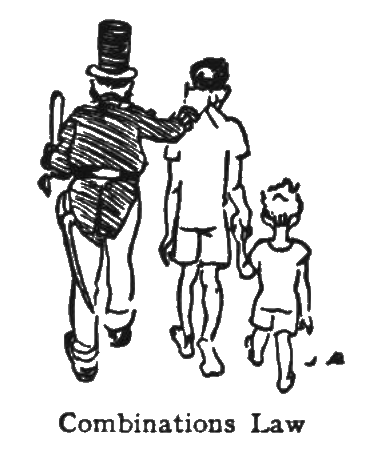
Blankester Massacre
Gradually the people had become so discontented with the Combinations Law that they had begun wearing Blankets, especially in the North of England; this was of course, sedition, and resulted in a battle near Manchester, in which all the people in blankets were accidentally massacred. The Blanketeers marched in Manchester to protest the state of the textile industry. It culminated in the Peterloo Massacre (1819) at St Peter’s Field, Manchester, which saw cavalry charge a large reform meeting.
The Government then very cleverly passed the famous Six Acts, all of which said that it was quite all right for people in blankets to be massacred. Since which the people in the North have ceased to be seditious, and even wear bowler hats for lunch, bathing, etc. The Six Acts (1819) tightened controls on meetings, the press, and arms after Peterloo.
Munroe Doctrine
Meanwhile in foreign affairs, Canning, the memorable foreign minister, started a new anti-English or Liberal policy by saying that he had `called the New World into existence to upset the Balance of the Old'. George Canning (Foreign Secretary) claimed to have “called the New World into existence to redress the balance of the Old” regarding recognition of Latin American states. This was known as the Munroe Doctrine and proves that it is wrong for anyone to have wars in North or South America (except the United States Marines). The Monroe Doctrine (1823) declared the Americas closed to further European colonization; it was a U.S. policy, though Britain tacitly supported it at sea.
Chapter 50
George IV: A Gentleman King
During these disturbances George III had died and had been succeeded by his son, George IV, who was the Prince Regent and an Inventor and very Bad. George IV served as Prince Regent during his father’s incapacity (1811–1820) and reigned 1820–1830. George IV's most memorable invention was Gentlemen and he was the First Gentleman in Europe: “First Gentleman in Europe” was a contemporary nickname on account of his style and manners; Wikipedia cites The Diary of Prince Pückler-Muskau (1828), which apparently quite a good read.
Examples of George IVs Badness and Gentlemanliness
1. He was very fat.
2. He was a friend of Beau Brocade, the memorable Dandy Dinmont or man-about-town of those days.
Beau Brummell was a famous Regency dandy; Beau Brocade is a 1907 novel by Baroness Orczy. Dandie Dinmont is a character in Scott's Guy Mannering; a Dandie Dinmont Terrier is an extremely short-legged Scottish dog breed named after him.
3. He was a member of White's and many other notorious Knight clubs.
White’s is a long-established London gentlemen’s club in St James’s.
4. He was hostile to his wife and attempted to give her pains by means of an Act of Parliament.
His marriage to Caroline of Brunswick led to a failed “Pains and Penalties Bill” (1820) to dissolve it.
Death of George IV
Besides gentlemen, George IV had invented Regent Street, the Regent Canal, etc., before he came to the throne, and afterwards he invented the Brighton Marine Aquarium. Regent Street and the Regent’s Canal were Regency urban projects; at Brighton he built the Royal Pavilion as an exotic seaside palace based on the Taj Mahal, and he thoroughly enjoyed seaside spas. The Brighton Aquarium opened in 1872 and is the oldest continuously operating aquarium in the world. He was thus a Bad Thing. Finally he died of a surfeit of Aquaria, Pavilia, Gentlemen, etc., probably at Brighton. He died in 1830 at Windsor of heart and gastric illness.
Chapter 51
William IV: A Sailor King
The marine tendency of George IV was inherited by his brother William IV, who was known as the Sailor King on account of his readiness to create any number of piers at moments of political crisis. William IV had served in the Royal Navy and was nicknamed the “Sailor King”. He reluctantly created peers to force the Reform Act of 1832 through the House of Lords due to the Reform Riots in favor of the act. Apart from this, however, William IV would not have succeeded in being memorable at all except for his awkward and uncalled-for irruption into the Georgian succession. His reign (1830–1837) interrupts the run of “Georges” between George IV and Victoria’s later “Victorian” branding. An irruption is a sudden, violent, or forcible entry.
Rotten Burrows
During this reign the Great Reform Bill was passed on account of the Rotten Burrows: this was because the Old Landlords said that new places like Manchester were rotten burrows and shouldn't have votes. “Rotten boroughs” were tiny, often depopulated constituencies still electing MPs; new industrial towns like Manchester lacked representation. A great deal of confusion was caused by these rotten burrows which were undermining the Constitution, but eventually Lord Grey invented the Great Reform Bill which laid down clearly who had votes and who hadn't. Earl Grey’s Reform Act 1832 redistributed seats and widened (but still limited) the franchise. Many rotten boroughs lost MPs; some seats were transferred to counties and large towns.
Reform Bill
This Bill had two important clauses, which said:
(1) that some of the Burrows were rotten and that the people who lived in them should not be allowed either to stand or to have seats.
(2) that 'householders leaseholders and copyholders who had £10 in the towns or freeholders who paid 40s. in the country for 10 years or leaseholders (in the country) and copyholders for 21 years in the towns (paying a rent of £50) should in some cases (in the towns) have a vote (for 1 year) but in others for 41 years (in the country) paying a leasehold or copyhold of £10 should not.' The real act tied the vote to franchise to small landowners, tenant farmers, shopkeepers, and all householders who paid a yearly rental of £10 or more.
When this unforgettable Law was made known there was great rejoicing and bonfires were lit all over the country.
Later Reform Bills
Later in the century, other Reform Bills were passed, such as Gladstone's Reform Bill which added householders (in the country) for one year to freeholders and kettleholders worth £10 a year, and gave a vote to anyone who lived in lodgings (for 21 years) or spent £10 in the Post Office. Gladstone’s 1867–1868 reform work is blended here with later 1884 reforms (known as the Third Reform Act) under his prime ministership. And there was also Disraeli's Reform Bill, which gave the vote to any lodger who paid £10 and lodged in the same lodgings for one year. Disraeli steered the 1867 Reform Act (known as the Second Reform Act). This, however, was naturally thought very rash and was quite rightly characterized by the penetrating Lord Salisbury, in a brilliant phrase, as `A Sleep in the Dark'. Derby, an MP, reused a phrase coined by Disraeli and referred to the 1867 Reform Act as a "leap in the dark", which was popularized by a Punch cartoon. Lord Salisbury supported the doctrine of splendid isolation, where British foreign policy aims "to float lazily downstream, putting out the occasional diplomatic boathook". The Reform Bills were a Good Thing except for a few Old Landlords who were deprived of their seats. Nowadays Flappers are allowed to vote and men have to put up with this even if they live in the same lodgings all their lives. This is a Bad Thing and is called Manhold Suffrage. “Flappers” are young women; women over 30 got the vote in 1918, over 21 in 1928. “Manhood suffrage” becomes “Manhold” to suggest men being put upon.

Chapter 52
Queen Victoria: A Good Queen
On the death of William IV, Queen Victoria, though asleep at the time and thus in her nightdress, showed great devotion to duty by immediately ascending the throne. Victoria succeeded in 1837 aged 18 upon receiving the news from the Archbishop of Canterbury at 6am in her dressing gown, according to a passage in her diary. In this bold act she was assisted by Lord Melbourne and the Archbishop of Canterbury, who were both properly dressed. Lord Melbourne was her first prime minister and early political mentor.
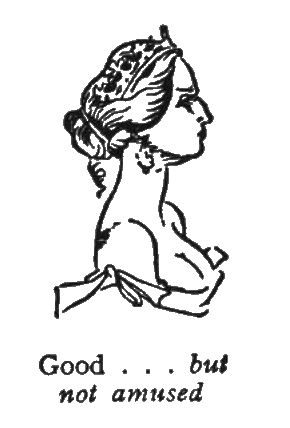
Finding herself on the throne, Queen Victoria immediately announced her intention of being Good and plural but not amused. “We are not amused” is a likely apocryphal response by Victoria to an inappropriate joke; “plural” refers to the royal “we”. This challenge was joyfully accepted by her subjects, and throughout her protracted reign loyal and indefatigable attempts to amuse her were made by Her Majesty's eminently Victorian ministers and generals.
Attempts to Amuse Queen Victoria
One of the first of these attempts was Lord Melbourne's memorable political rule that it did not matter what the Cabinet said so long as they all answered at once. This he called the Collective Responsibility of the Cabinet; the Queen, however, was not amused. Cabinet collective responsibility refers to the convention that ministers publicly support agreed policy. The convention is associated with Melbourne due to his comment to his Cabinet in 1841 on the Corn Laws. "Bye the bye, there is one thing we haven't agreed upon, which is, what are we to say? Is it better to make our corn dearer, or cheaper, or to make the price steady? I don't care which: but we had better all tell the same story."
Next, Mr Rowland Hill invented penny stamps. Rowland Hill introduced the uniform Penny Post and the first adhesive postage stamp (1840). The Queen, however, without hesitation Knighted him.
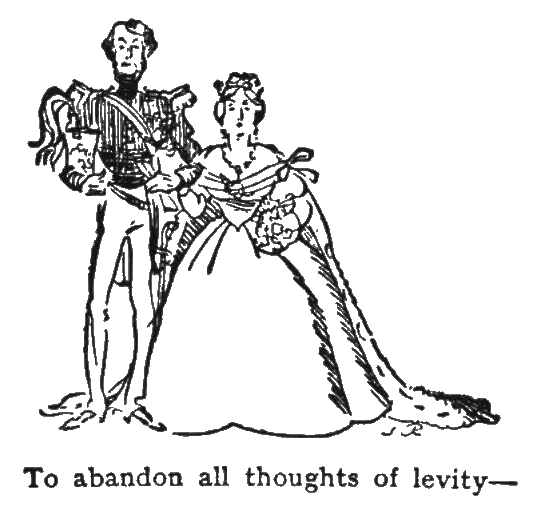
The loyal task therefore devolved on a more active group of men called the Chartists who nearly succeeded by drawing an enormous Chart showing the position of affairs and signing it with imaginary names. The Chartists (1830s–1840s) petitioned for political reforms, publishing the People’s Charter in 1838. In 1848, the Chartists declared that their petition was signed by 6 million people, but House of Commons clerks announced that it was 1.9 million. Signatures included "Queen Victoria" and "Mr. Punch". This resulted in a succession of riots amongst the imaginary people, and necessitated the passing of the memorable Poor Law which laid down that everybody in the country was poor (except the rich). The New Poor Law of 1834 tightened relief and encouraged the workhouse system.
These endeavours having failed, the Queen was allowed to abandon for the time being all thoughts of levity and to marry her beautiful cousin (the memorable Prince Consaught), a Good German whom she had met during the great International Expedition to Hyde Park. Prince Albert of Saxe-Coburg and Gotha (in Germany), became the Prince Consort upon marriage; their son Prince Arthur became the Duke of Connaught. The Great Exhibition of 1851 was held in Hyde Park.
Sir Robert Repeel. Potato Duties in Ireland
About this time the famous Tory statesman, Sir Robert Repeel, noticed that the Irish had had nothing to eat for some years owing to the fact that the potatoes, which it was their Duty to eat, had all gone bad. Sir Robert Peel was Conservative prime minister; the Irish Potato Famine began with blight in 1845.
The Tory Government were for long divided between two policies, one section insisting that the Irish ought to eat the potatoes, the other insisting that they need not.
Sir Robert, however, boldly passed his famous Corn Laws which abolished the Duty and permitted the Irish to eat bread, thus dissociating himself from the Tories who doggedly maintained that the Irish had only two alternatives: (a) to eat the potatoes, and (b) not to. Peel in fact repealed the Corn Laws (1846), which had established tariffs on imported grain. Sir Robert, having thus destroyed his own Party, bethought himself of The Queen and invented Policemen. Peel created the Metropolitan Police in 1829; “Bobbies” / “Peelers” are named after him. Her Majesty, however, ...
Chapter 53
Crimean War
Not very long after this the memorable Crimean War broke out against the Russians. This war was exceptionally inevitable and was caused by a number of causes.
Causes of the Crimean War
(a) The English had not yet fought against the Russians,
(b) The Sick Man of Europe (cured later by Florence Nightingown).
“Sick Man of Europe” refers to the declining Ottoman Empire; Florence Nightingale reorganised nursing in the war.
(c) Russia was too big and was pointing in the direction of India.
Fear of Russian expansion towards India was a persistent British concern (the Great Game).
(d) The Holy Places. The French thought that the Holy Places ought to be guarded (probably against the Americans) by Latin Monks, while the Turks, who owned the Places, thought that they ought to be guarded by Greek Monks.
Disputes over Christian holy sites in Palestine between Catholic (French-backed) and Orthodox (Russian-backed) interests helped trigger the crisis.
England therefore quite rightly declared war on Russia, who immediately occupied Roumania.
Russia occupied parts of the Danubian Principalities (Moldavia and Wallachia) in 1853.
The war was consequently fought in the Crimea (near Persia) in the following romantic manner:
1. The Bank of Inkerman, so called because the soldiers on both sides fought in the dark as well as the Generals: the English were, naturally, victorious. The Battle of Inkerman (1854) was fought in fog and confusion; it thus earned the nickname "The Soldier's Battle".
2. The Siege of Sir Pastobol (the memorable Russian General) who was quite besieged, and the English were very victorious. Sebastopol was the main Russian fortress and port on the Crimean Peninsula.
3. The Battle of Balaclava, famous for the Charge of the Fire Brigade by Lord Tennyson and 599 other gallant men who, armed with Cardigans and Balaclava helmets, advanced for a league and a half (4 1/2 miles) and back (9 miles), with the object of proving that someone had thundered the wrong order. (In which they were completely successful.) The Charge of the Light Brigade (1854) was commemorated in Tennyson’s poem, which opens with the lines "Half a league, half a league, / Half a league onward / All in the valley of Death / Rode the six hundred". “Cardigan” is Lord Cardigan, their commander, who (according to the OED) "was particularly concerned that his regiment should be smartly turned out, and contributed significant sums of his own money to this end"; balaclava as a clothing item also originates from the Crimean village of Balaclava, where the Charge of the Light Brigade took place. The charge occurred because the cavalry received a miscommunicated order from Lord Raglan through Captain Nolan; Tennyson also writes that "Someone had blunder’d" (not thundered).
4. Flora MacNightshade. The troops in the Crimea suffered terribly from their Cardigans and Balaclava helmets and from a new kind of overcoat invented by Lord Raglan, the Commander-in-Chief. They were also only allowed to wear boots on their left feet until the memorable intervention of Flora MacNightlight (the Lady with the Deadly Lampshade), who gave them boots for their right feet and other comforts, and cured them of their sufferings every night with doses of deadly lampshade. Florence Nightingale was nicknamed “the Lady with the Lamp”; deadly nightshade is the toxic plant (also known as belladonna due to its historical use in cosmetics). A raglan coat (sleeves cut in one piece with the shoulder) was indeed named after Lord Raglan, who (according to the OED) "is said to have used this style of coat following the amputation of his arm after the Battle of Waterloo"; the first usage of the term appears during the Crimean War, when it was popularized. An oft-repeated anecdote popularized decades after the war claimed that a shipload of only left-footed boots arrived for the soldiers; numerous other bureaucratic failures characterized the British effort.
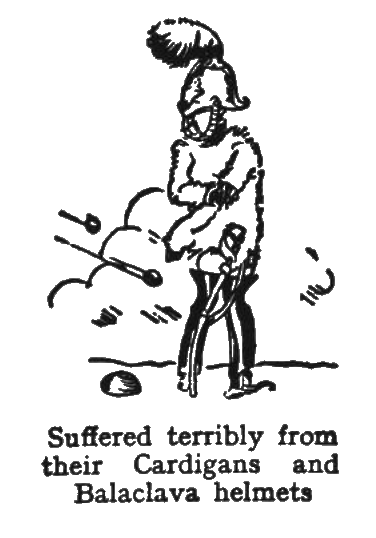
Chapter 54
The Indian Mutiny
This was also inevitable on account of:
(a) The Natives. These believed that the English were going to make them bite their greasy cartileges (Chuputti). This they treacherously believed to be contrary to their religion and therefore a Bad Thing. The 1857 uprising was sparked in part by rumours that rifle cartridges were greased with cow and pig fat, offensive to Hindu and Muslim soldiers. Chapati is an Indian flatbread.
(b) The Anglo-Indians. The natives were unable to realize that these were a Good Thing.
Consequently an outbreak of very serious Meeruts occurred at Cawnpore and elsewhere and a descendant of the Great Mohawk was set up as Emperor at Dulwich (the old capital of India). The mutiny began at Meerut; the siege of Cawnpore occurred when British soldiers were duped into a false assurance of safe passage out of Cawnpore, but were massacred upon leaving the city by Nana Sahib's forces. “Great Mohawk” is the Great Mughal; Bahadur Shah II was proclaimed emperor at Delhi. Dulwich is a London neighborhood.
Most terrible among the Indian leaders was a native Pundit called the Banana Sahib Nana Sahib, who was not from Punjab. who by means of his treacherous disguise lured famished British regiments to destruction. The Mutiny, however, was a Good Thing as it was the cause of Lucknow being relieved by Generals Havelock, Ellis, etc., and Lord Roberts got the V.C. and stayed on for forty-one years. The siege of Lucknow was the prolonged defence of the British Residency in Lucknow from rebel sepoys, which concluded with the somewhat successful evacuation of the defenders and civilians after 87 days. Sir Henry Havelock was one relief commander; Havelock Ellis was a British sexologist. Lord Roberts later won the Victoria Cross in India and wrote a popular memoir titled Forty-One Years in India.
The Results of the Mutiny were:
(a) The Sepoy (or Governor-General) of India was brought under the control of the Crown. After 1858 the East India Company’s rule ended and the British Crown took direct control.
(b) The Queen was declared to be the Great Mohawk of India. Victoria was proclaimed Empress of India in 1876.
Chapter 55
`Pal'
Meanwhile, at home, fresh attempts to galvanize the Queen resulted in the promotion of Lord Palmerston (`Pal') Lord Palmerston (PM 1855–1858, 1859–1865) was nicknamed Pam. to the Premiership a rather matey minister who always wore green gloves Strachey's Queen Victoria records Palmerston's first visit to the widowed Victoria after Albert's death. "But when Lord Palmerston arrived at Osborne, in the pink of health, brisk, with his whiskers freshly dyed, and dressed in a brown overcoat, light grey trousers, green gloves, and blue studs, he did not create a very good impression." and sucked a straw Palmerston was often depicted in cartoons with a straw or sprig of myrtle between his lips, accentuating his jaunty ostler character. and altered the Despatches after the Queen had signed them, so that they became surprises for her. Palmerston crossed Queen Victoria while foreign secretary due to his handling of the Don Pacifico affair, in which Palmerston blockaded Greece without satisfying his obligation to notify the Crown before taking action. Prince Albert shortly thereafter complained that Palmerston had sent a dispatch regarding the political situation in France without first showing the queen. Palmerston resigned in protest of these accusations despite his popularity among the public. It was not, however, until he conceived and carried through his heartless Conspiracy to Murder Bill that the Good (but now Horrified) Queen dismissed him. The 1858 Conspiracy to Murder Bill, prompted by the Orsini affair in which Italian nationalists backed by English radicals plotted to assassinate Napoleon III, was an effort by Lord Palmerston to make conspiracy to murder a felony. The unpopularity of this proposal was exploited by Disraeli to end Palmerston's prime ministership. After which `Pal' spent his time taking special trains in all directions Strachey's Queen Victoria records that one day, Palmerston 'found that he had missed the train to London; he ordered a special, but the station master told him that to put a special train upon the line at that time of day would be dangerous and he could not allow it. Palmerston insisted declaring that he had important business in London, which could not wait. The station-master supported by all the officials, continued to demur the company, he said, could not possibly take the responsibility. "On MY responsibility, then!" said Palmerston, in his off-hand, peremptory way whereupon the station-master ordered up the train and the Foreign Secretary reached London in time for his work, without an accident.' and galloping to Harrow on a cream-coloured pony, thus endearing himself to the People and becoming an object of terror and admiration to all foreign governments. Palmerston was educated at Harrow. He was distrusted by the Crown and foreign governments, in part due to his widespread popularity among the British public.
Chapter 56
Fresh Attempts to Amuse the Queen. Wave of Justifiable Wars
Owing to the inability of the Queen's ministers to amuse the Crown, superhuman attempts were now made by her Majesty's generals at home and abroad to provide military diversions. These took the form of a wave of Justifiable Wars, including:
1. War with China. Fought on moral grounds, because the Chinese government were disposed to impede the importation of Empire Opium into China. The British thus became indispensable to the Chinese and, after several bloody engagements, Hong Kong, the best port of China, was ceded to the British Throne. The Opium Wars (1839–1842, 1856–1860) enforced British opium trade; Hong Kong was ceded by the Treaty of Nanking (1842).
2. War with Afghanistan. Owing to the size, direction, etc., of Russia, it was imperative that the King of Afghanistan, whose name was Just Mohammed, should sit on his throne in a friendly attitude. The First and Second Anglo-Afghan Wars (1839–1842, 1878–1880) aimed to control Afghan alignment against Russia. During the First Anglo-Afghan War, the British replaced Dost Mohammed with their own puppet (Shah Shuja). The King, however, (Just) declined to do this and the British Army was cut to pieces in the Fippa Passes to such an extent that Dr Brydle rode half alive (or, according to some historians, half dead) into Jallallaballad. Dr William Brydon was inaccurately but popularly characterized (e.g., in a painting) as the sole survivor of the British forces to reach Jalalabad after the 1842 retreat from Kabul via the passes around Gandamak. He fled by horseback; part of his skull had been sheared off by sword, but he survived the blow because he had stuffed a copy of Blackwood's Magazine in his hat to stave off the cold. Pippa Passes is a popular verse drama by Robert Browning about a silk-winding girl wandering through Asolo. After this, however, several bloody battles were fought, and the Kings of Afghanistan were compelled to sit in a more friendly attitude.
3. Sheikh War. Cause: Death of Ranji Tsinji (a huge Sheikh). The Sheikhs were very tall men on the frontier of India who obscured the Imperial outlook. A bloody strife ensued. Sir Hew Golf annihilated the Sheikhs, subsequently compelling them to present the Queen with a huge pencil called the Koh-in-Oor. The Sheikhs were thus reduced in every way and were afterwards on our side and a Good Thing. The Sikh Wars (1840s) began when Maharajah Ranjit Singh died; Ranjitsinhji was a cricket player. Sir Hugh Gough led the British army; following the conclusion of the Second Anglo-Sikh War, the treat ceded the Koh-i-Noor diamond to Queen Victoria. A standard British military cliché characterized the Sikh soldiers as extraordinarily tall.
4. 2nd Burmese War. Cause: there had only been one Burmese war. Burmese cut to pieces. Burma ceded to the Crown. Peace with Burma. There were three Anglo-Burmese Wars (1824–26, 1852–53, 1885–86), ending with full annexation.
5. War against Abyssinia. Object: to release the Europeans in Abyssinia, all of whom had been incarcerated by the King, Theodore, who was a Christian and would not see their point of view. The war was divided into two parts (1) Sir Robert Rapier demands release of prisoners. Prisoners released. (2) War declared against Abyssinia. King Theodore blown up with Magnesia, the capital of Abyssinia. Theodore commits suicide. Sir Robert becomes Lord Rapier of Magnesia. Peace with Abyssinia. The 1868 British expedition to Abyssinia (Ethiopia), led by Sir Robert Napier, freed hostages and captured Emperor Tewodros II at Magdala; Napier became Lord Napier of Magdala.
6. War against A Shantee. Coffee, King of a Shantee, worsted and burnt by Sir Garment Wolsee, who becomes Viscount Coffee. Peace with the Shantee. The Third Anglo-Ashanti War (1873-1874, in present-day Ghana) was between the British forces, led by Sir Garnet Wolseley, and the Ashanti, whose king was Kofi Karikari.
7. War against Zulus. Cause: the Zulus. Zulus exterminated. Peace with Zulus. The Anglo-Zulu War (1879) broke up the Zulu kingdom.
All these attempts having failed, news was brought to the Queen that the Fiji Islands were annexed to the British `by the desire of the inhabitants'. One of the Fijian chiefs offered to cede the islands to Britain in 1852 on the condition that he retains his title; this was considered unacceptable by both the British and his fellow chiefs. In 1872, he repeated his offer and Britain took control over the islands. At this point, according to some (seditious) historians, Her Majesty's lip was observed to tremble.
Spheres of Interference. Egypt
It was during these wars that Spheres of Interference were discovered: these were necessary in all Countries inhabited by their own natives.
The first of the Spheres was Egypt which now became memorable for the first time since Potiphar, the well-known Egyptian Pharaoh. Potiphar is the biblical Egyptian officer in Genesis. Egypt was put under the Duel Control of England and France and was thus declared bankrupt; Anglo-French Dual Control supervised Egyptian finances from 1879; Egypt's financial crisis triggered nationalist unrest. Alibaba, the Mowhgli, and other Pasha-Beziques Alibaba is from Arabian Nights; Mowgli is in Kipling's Jungle Book; bashi-bazouks were irregular (and notorious) Ottoman soldiers; bezique is a card game. were therefore immediately exterminated by Sir Garment Wolsey and subsequently by Kitchener of Kartoon at the terrible French battle of Homme de Man. Sir Garnet Wolseley led an expedition in 1882; Lord Kitchener marched to Khartoum and won the Battle of Omdurman in 1898 against Mahdist forces. This was because of Chinese Gordon (leader of the famous Gordon Riots Due to the justifiable looting of Pekin by the Allies. in Pekin) and was called the Pagoda Incident and is remarkable as being the only (memorable) Incident in History. Charles “Chinese” Gordon, nicknamed for his role with Imperial Chinese forces during the Taiping Rebellion, was sent to Sudan and died at Khartoum (1885). The Gordon Riots were anti-Catholic riots in London in 1780 led by Lord George Gordon. The Fashoda Incident was a standoff between British and French troops over a territorial dispute in East Africa. The "looting of Pekin" refers to a quote by an American journalist concerning the Boxer Rebellion: the Allied occupation of Beijing became "the biggest looting expedition since Pizarro". According to American missionary Luella Miner, the "conduct of the Russian soldiers is atrocious, the French are not much better, and the Japanese are looting and burning without mercy". The British enacted a system where all loot was auctioned off at the British Legation every afternoon except Sunday, and the U.S. Army chaplain complained that the American rule against looting was "totally ineffectual".
Chapter 57
Disraeli and Gladstone
Not very much is known about these two extremely memorable ministers, except that
(a) Disraeli `brought back Peace with Honour' after the famous Balkan Treaty of Berlin, which said: Upon returning from the 1878 Congress of Berlin, which revised Balkan borders after the Russo-Turkish War, Disraeli said that “Lord Salisbury and myself have brought you back peace—but a peace I hope with honour, which may satisfy our sovereign and tend to the welfare of our country.” These was often paraphrased as "peace with honour — and Cyprus too."
1. that Bosnia should be ceded to Herzegovina;
2. that Herzegovina should be ceded to Bosnia (this is called the Eastern Question);
In reality, Austria-Hungary occupied Bosnia and Herzegovina; the “Eastern Question” concerned the fate of Ottoman territories.
3. that Bulgaria should be divided into two parts (later, Bulgaria was re-divided into one part by Mr Gladstone);
At the conclusion of the Russo-Turkish War (1877-78), a "Greater Bulgaria" was created under Russian influence; this alarmed Britain, so Bulgaria was partitioned into the Principality of Bulgaria and Eastern Rumelia in the Treaty of Berlin (1878). Gladstone was a champion of the Bulgarian cause and attacked the Disraeli government for supporting the Ottomans in the Bulgarian April Uprising of 1876; when he became prime minister in 1880, Bulgarians hoped he would favor a reunification. In 1885 Bulgarian unification occurred under the coordination of the Bulgarian Secret Central Revolutionary Committee; they consulted beforehand with Gladstone's government, which did not accept the plans.
4. that anyone found in Armenia should be gradually divided into twelve pans. (Mr Gladstone subsequently criticized the effect of this clause.)
The Treaty of Berlin also ostensibly protected Armenians from Kurds and Circassians, but this failed miserably in the Hamidian massacres of the 1890s. The twelve likely references a rather horrific Bible passage.
Disraeli also very generously purchased the Panama Canal from the Khalif Disraeli arranged for Britain to buy almost half the shares in the Suez Canal (1875) from the Khedive of Egypt. and presented it to Queen Victoria with a huge bunch of primroses (his favourite flower), The primrose was reportedly Disraeli's favorite flower, and the queen would send him bunches of them. His death was then commemorated by Primrose Day. thus becoming Lord Beaconsfield and a romantic minister. Disraeli become close to the Queen upon his wife's death; Victoria wrote that Disraeli was "full of poetry, romance and chivalry". Victoria made Disraeli the Earl of Beaconsfield, in part because he made her Empress of India via the Royal Titles Act. The Queen, however, remained obdurately plural and not amused, even when Disraeli romantically called her a Faery Queen. Disraeli called Victoria the Faerie Queen in a reference to Faery Spenser's The Faerie Queene (1590s), which celebrated Elizabeth I.
(b) Gladstone, on the other hand, endeavoured (quite unsuccessfully) to please Her Majesty by chewing a milk pudding seventy-nine times every day, and by his memorable inventions; amongst the latter were an exceptionally uncomfortable collar which he inhabited for sixty-two years on the floor of the House of Commons, Gladstone was much disliked by Victoria for his pomposity (she wrote that he "always addresses me as if I were a public meeting"). He likely apocryphally endorsed chewing each mouthful 32 times, one for each tooth. (This may have influenced Fletcherism, which claimed that chewing even liquids would turn "a pitiable glutton into an intelligent epicurean".) In 1893, St. James's Gazette reported that Gladstone "is very fond of rice pudding… he would, if the etiquette of the dinner table permitted it, make an entire meal". Gladstone popularized the now eponymous Gladstone collar. and an extremely simple kind of bag which he designed to enable the Turks to be driven out of Europe Bag and Baggage. In his writings supporting Bulgaria against the Turks, Gladstone asked the Turks to "carry away their abuses in the only possible manner, namely by carrying off themselves…one and all, bag and baggage". The Gladstone bag is a kind of small suitcase named after William Gladstone. Gladstone also invented the Education Rate by which it was possible to calculate how soon anybody could be educated, The 1870 Elementary Education Act introduced elected school boards funded by local rates. and spent his declining years trying to guess the answer to the Irish Question; unfortunately, whenever he was getting warm, the Irish secretly changed the Question, so that as he grew older and older Gladstone became angrier and angrier, and grander and grander, and was ultimately awarded the affectionate title of `the G.P.O.' Gladstone was nicknamed the “G.O.M.” (“Grand Old Man”); “G.P.O.” stands for General Post Office. Gladstone was thus clearly a Good Man but a Bad Thing (or, alternatively, a Bad Man but a Good Thing).
Queen Victoria's Jamboree
Finally, all attempts (even by Gladstone and Disraeli) to amuse her, and to prevent her being good, having failed, the Queen held a Jamboree in Westminster Abbey and Crowned Heads and Oriental Patentees from all parts of the world came to acknowledge publicly the Good Queen's Victory over all her ministers and generals. Victoria’s Golden Jubilee was in 1887.
Chapter 58
The Boerwoer
The last event in Queen Victoria's reign was the Borewore, or, more correctly, Boerwoer (Dutch), which was fought against a very tiresome Dutch tribe called the Bores, because they were left over from all previous wars. The Second Boer War (1899–1902) saw Britain fight the Boer republics of Transvaal and the Orange Free State.
The War was not a very successful one at first, and was quite unfair because the Boers could shoot much further than the English, and also because they were rather despicable in wearing veldt hats and using PomPom bullets. Boer commandos were skilled marksmen with modern rifles. Veldt is a type of open rural landscape in southern Africa; it specializes into highveld, lowveld, thornveld, sandveld, hardveld, bushveld, etc. The pom-pom was the nickname of a British autocannon that the Boers had purchased from Britain before the war.
Numerous battles were fought against the Bore leaders (such as Bother, Kopje, and Stellenbosch) at Nek's Creek, Creek's Nek, Knock's Knee, etc., Botha fought in the Boer War and eventually was the first prime minister of South Africa. (He also captured Churchill during the Boer War, which Churchill did not realize until they met at a luncheon many years later when Botha was seeking loans to assist his country's reconstruction.) Kopje is South African English for a small hill; Stellenbosch is a town in South Africa, and "to stellenbosch" means to send an officer to the sidelines, since English officers who did poorly during the Boer war were stereotypically sent to Stellenbosch to look after the horses. Nek means mountain pass and hence many battles were fought at various neks. and much assistance was given to the British cause by Strathcoma's memorable horse (patriotically lent by Lord Strathcoma for the occasion) Lord Strathcona raised Strathcona’s Horse, a Canadian mounted regiment that served in the Boer War. and by the C.I.D., who fought very bravely and were awarded a tremendous welcome on their return to London after the war. The City Imperial Volunteers (C.I.V.) were raised in London for the Boer War; the C.I.D. (Criminal Investigation Department) refers to Scotland Yard.
Finally, the people at home took upon themselves the direction of the War and won it in a single night in London by a new and bracing method of warfare known as Mafeking. Thus the English were once more victorious. The end of the siege of Mafeking (1900) during the Second Boer War sparked extraordinarily large street celebrations in London; the celebrating was referred to as mafficking.
Memorable Results
The Barwar was obviously a Good Thing in the end because it was the cause of Boy Scouts and of their memorable Chief Scout, General Baden Powell (known affectionately as 'the B.O.P.'), and also because it gave rise to a number of very manly books, such as 40 Years Beating About The Bush, 50 Years Before The Mast, 60 Years Behind The Times, etc. Robert Baden-Powell, who won the siege of Mafeking, become enormously popular and founded the Boy Scout movement upon his return. He was widely known as B-P. The B.O.P. is The Boy's Own Paper, a British story paper aimed at young boys. B-P contributed to several issues of the B.O.P.; he wrote numerous books, such as Scouting for Boys; and he contributed to books including Fifty Years Against the Stream.
Death of Queen Victoria
Meanwhile Queen Victoria had celebrated another Jamboree, called the Diamond Jamboree (on account of the discovery of Diamond mines at Camberley during the Borewore) The Diamond Jubilee took place in 1897. Diamond fields were at Kimberley in South Africa; Camberley is a town by London. and after dying of a surfeit of Jamborees, Jokes, Gladstone, etc., had been succeeded by her son, Edward VII. Victoria died in 1901 and was succeeded by Edward VII.
Chapter 59
Wave of Inventions
The reign of Queen Victoria was famous for the numerous discoveries and inventions which happened in it. One of the first of these was the brilliant theory of Mr Darwin propounded in his memorable works, Tails of a Grandfather, The Manx Man, Our Mutual Friends, etc. Charles Darwin’s key books are On the Origin of Species (1859) and The Descent of Man (1871); Tales of a Grandfather is by Scott, The Manxman is by Caine, and Our Mutual Friend is by Dickens. This was known as Elocution or the Origin of Speeches and was fiercely denounced in every pulpit.
Another memorable invention was called the Oxford Movement: this was a form of sinuflection which led men gradually in the direction of Rome; the movement was first made by Cardinal Newton at Oxford, and later, Feeble and Pusey Colleges were found there to commemorate his assistants. The Oxford Movement (or Tractarianism) began in the 1830s; leaders included John Henry Newman and Edward Bouverie Pusey. The movement eventually developed into Anglo-Catholicism. Keble College and Pusey House are Oxford institutions. Many illustrated manuals and pamphlets were written by Cardinals Newton and Feeble, giving directions for the movement.
There was also in Queen Victoria's reign a famous inventor and poet called Oscar Wilde who wrote very well but behaved rather beardsley; he made himself memorable by inventing Art, Asceticism, etc., and was the leader of a set of disgusting old gentlemen called `the naughty nineties'. Oscar Wilde epitomised 1890s aestheticism and decadence; Aubrey Beardsley was an illustrator associated with the supposed decadence of the movement (and with several of Wilde's works). The Naughty Nineties is indeed the traditional British term for the decade (cf. the Sentimental Seventies and Elegant Eighties).
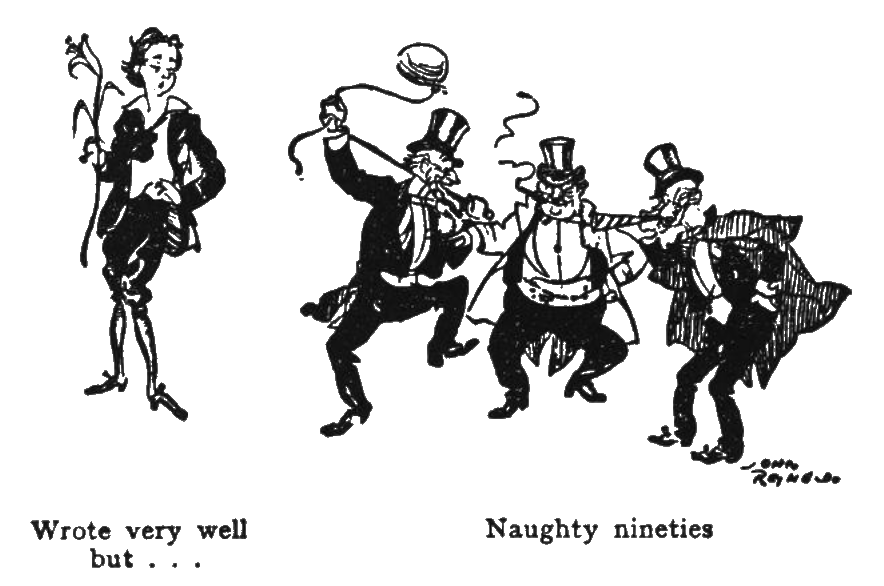
But most memorable of all were the McCanical inventions of the age, nearly all of which were kinds of Progress and invented by Scotsmen and Bad Things. Amongst these were Bicycles which caused Tricycles, coasting, bloomers, etc., and Roads (invented by Lord Macadam and his son Lord Tarmac) for them to go along. Coasting downhill became popular on the penny-farthing, where riders would take their feet off the pedals and put them over the tops of the handlebars so in the event of a pitch, they would land feet-first instead of head-first. John Loudon McAdam developed macadamised road surfaces (compact layers of stone), which preceded tar-bound macadam (tarmac). Other inventions were Thermometers (invented by Lord Farqualqhounheit) which caused Temperatures, inflolqhouenza, etc.; Gabriel Fahrenheit devised the Fahrenheit temperature scale; Scottish surnames (e.g., Colquhoun and Farquharson) are parodied. Telegrams which caused betting, Bismark, etc.; The Ems telegram was a report of a meeting between King William I and the French ambassador, which Bismarck edited to successfully provoke the Franco-Prussian War. Mackintoshes (invented by another Scottish nobleman whose name is now forgotten); Charles Macintosh patented waterproofed fabric; the raincoat bears his name. and the memorable line invented by Mr Plimsoll (see diagram below). Samuel Plimsoll campaigned for a load-line on ships to prevent overloading; the “Plimsoll line” on the hull of a ship shows the safe loading limit.
Most of these inventions, however, were too numerous to be mentioned.
Chapter 60
Edward VII: Almost a Monarch
Eedward VII was quite old when he came to the throne, but this was only on account of Queen Victoria, and he was really a very active man and had many romantic occupations; for instance, he went betting and visited Paris and was sometimes late for dinner; in addition he was merry with actresses and kind to gypsies. Edward VII (reigned 1901–1910) was known for his affairs with actresses (e.g., Sarah Bernhardt and Lillie Langtry) and aristocracy (leading to scandal over Edward's testimony in court regarding the wife of MP Charles Mordaunt), as well as his fondness for Parisian brothels. He testified in court concerning a player's cheating in the Royal baccarat scandal of 1890; it was a scandal because baccarat was illegal at the time. (The game also led to the ruin of Beau Brummell.)
Besides all this Edward VII smoked cigars, was addicted to entente cordials, married a Sea-King's daughter, and invented appendicitis. He encouraged the 1904 Entente Cordiale with France; his wife was Alexandra of Denmark, a maritime kingdom; he survived an operation for appendicitis in 1902, which helped normalise the surgery. Edward VII was thus a very Good King, besides being a Good Thing and amused and, in fact, almost a Monarch. He is also memorable because he preferred making peace instead of war.
Chapter 61
The Great War
King Edward's new policy of peace was very successful and culminated in the Great War to End War. This pacific and inevitable struggle was undertaken in the reign of His Good and memorable Majesty King George V and it was the cause of nowadays and the end of History. The First World War (1914–1918) was called “the war to end war”; George V reigned 1910–1936.
Causes of the Great War
The Great War was between Germany and America and was thus fought in Belgium, one of the chief causes being the murder of the Austrian Duke of Sarajevo by a murderer in Servia. The war began between the Central Powers and the Entente; the immediate trigger was the assassination of Archduke Franz Ferdinand at Sarajevo by a Bosnian Serb. The war began with the invasion of Belgium as the Schlieffen Plan mobilized the German army.
There were many other Causes of the Great War, such as
1. German Governesses, a wave of whom penetrated Kensington in King Edward's reign and openly said that Germany ought to be top nation, and Approximately two-thirds of the foreign-born governesses in England were German; the remainder were largely French. The stereotypes were well-developed: an English governess was a proper spinster with "high principles of conduct and low opinions of foreign countries", a French governess excelled at "the intricacies of social presentation, but neglected moral and intellectual training", and the German governess was "given to parading her knowledge" but, perhaps most importantly, could command salaries above the norm due to their musical education. In the years leading up to WWI, many were believed to be spies: one German nanny was fired "because she was a good cyclist and for that reason alone must be a spy".
2. The Kaiser, who sent a telegram consisting entirely of ems to one of the memorable Boerwar leaders.And, during a subsequent crisis, a panther to Agaçiers (a brutal act and quite contrary to the Haig Convention). Kaiser Wilhelm II congratulated President Kruger of the Transvaal by telegram after the failed Jameson Raid (1896), angering Britain. The 1911 Agadir Crisis saw Germany send the gunboat Panther to Morocco. The Hague Conventions of 1899 and 1907 negotiated the laws of war; Douglas Haig was the British commander-in-chief on the Western Front.
These are now agreed to have been causes of the War though at the time the newspapers (rather conceitedly) declared that it was caused by a strip of paper. After Germany took Belgium, the German Chancellor was informed that Britain would go to war with Germany; he responded in disbelief of British action over a "scrap of paper".
The War
The War lasted three years or the duration, the Americans being 100% victorious. During WWI, the "100 percent American" movement took off, creating a popular nationalist slogan. At the beginning the Russians rendered great assistance to the American cause by lending their memorable steam-roller and by passing silently through England one Sunday morning before breakfast with snow on their boots. The Russian army was nicknamed “steamroller” due to its size. A myth circulated during WWI that Russian soldiers, identified by the snow on their boots, landed in Scotland en route to the Western Front. The Americans were also assisted by the Australians (AZTECS) and some Canadians, and 51 Highlanders. The Australia and New Zealand Army Corps (ANZAC) and Scottish 51st Highland Division fought in WWI.
The Peace to End Peace
Though there were several battles in the War, none were so terrible or costly as the Peace which was signed afterwards in the ever-memorable Chamber of Horrors at Versailles, and which was caused by the only memorable American statesmen, President Wilson and Col. White House, who insisted on a lot of Points, including The Treaty of Versailles (1919) was shaped by U.S. President Woodrow Wilson’s “Fourteen Points”; Colonel House was his adviser. The Chamber of Horrors was a Tussauds attraction in London (until 2016).
1. that England should be allowed to pay for the War: this was a Good Thing because it strengthened British (and even American) credit; Germany was formally saddled with reparations; Britain also incurred huge debts, especially to the U.S.
2. that the world should be made safe for democracy, i.e. anyone except pillion-riders, pedestrians, foreigners, natives, capitalists, communists, Jews, riffs, R.A.F.S., gun-men, policemen, peasants, pheasants, Chinese, etc.; Wilson gave a speech before Congress announcing that the “world must be made safe for democracy”.
3. that there should be a great many more countries: this was a Bad Thing as it was the cause of increased geography; The post-war settlements created or recognised states such as Poland, Czechoslovakia, and the Baltic republics.
4. the Freedom of the Seas: this was a Good Thing as it did not apply to Britain or America (or Switzerland); “Freedom of the seas” was one of Wilson’s points, which Britain opposed as a naval power; it was ultimately rejected by the German Government. Switzerland is obviously landlocked.
5. that the Kaiser should be hanged: this was a Good Thing as it was abandoned, together with Mr Lloyd George, the Irish Question, etc. Ex-Kaiser Wilhelm II fled to the Netherlands and was never tried; Lloyd George served as PM at the end of the war and was an "unrivalled negiotiator… full of bounce" according to historian Lentin, but was soon afterwards marginalized in politics.
Chapter 62
A Bad Thing
America was thus clearly top nation, and History came to a .
TEST PAPER V
Up to the End of History
1. Sketch vaguely, with some reference to the facts: (1) The Southsea Bubble, (2) The Ramillies Wig.
2. Would it have been a Good Thing if Wolfe had succeeded in writing Gray's Elegy instead of taking Quebec?
3. Analyse and distinguish between The Begums of Oudh. Would they have been deceived by the Banana ib?
4. `An Army marches on its stomach' (Napoleon). Illustrate and examine.
5. Account (loudly) for the success of Marshal Ney as a leader of horse. Marshal Michel Ney began his career as a cavalry officer and later commanded the French rearguard in Napoleon's failed invasion of Russia, for which he was called “the bravest of the brave” by Napoleon.
6. `What a city to boot!' Who said this, Wellington or Blücher or Flora McNightingown? Wellington boots and blucher shoes are footwear.
7. Did anybody say `I know that no one can save this country and that nobody else can?' If not, who did say it? At the outbreak of the Seven Years' War, poor British policy allowed William Pitt the Elder to ascend to power; he said "I am sure I can save this country and nobody else can".
8. Ruminate fearlessly on (1) Lord Cardigan, (2) Clapham. –
9. Do not attempt to remember what Mr Gladstone said in 1864 but account for the paramountcy of (1) Milk Puddings, (2) Bags, in his political career.
10. Comment Quietly on (a) Tariff Reform. (b) Mafeking Night. (c) The Western Front. Tariff reform was a platform led by Chamberlain to establish large tariffs in the early 20th century; the Western Front was the main WWI theatre.
11. Refrain from commenting on The Albert Memorial, The September Massacres, The Dardanelles, The O.B.E., or any other subjects that you consider too numerous to mention. (The better the fewer.) The Albert Memorial in Kensington Gardens was commissioned by Queen Victoria upon her husband's death; the Dardanelles refers to the failed Gallipoli campaign in WWI.
12. Write not more than two lines on The Career of Napoleon Buonaparte, or The Acquisition of our Indian Empire, or The Prime Ministers of England.
13. What price Glory? What Price Glory? is a 1924 war play about the U.S. Marines in France.
N.B. Do not on any account attempt to write on both sides of the paper at once.