
Field Work at our Research Sites
 |
| Setting up our field filtering apparatus to process samples for E.coli analysis. |
 |
 |
|
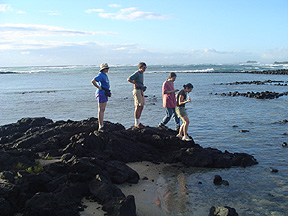
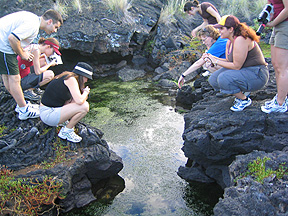
| Climbing down to the nearshore at Kaloko to do a Hydrolab measurement. | Professor Lisa Moore organizing sampling efforts at an anchialine pond. |
 |
 |
|
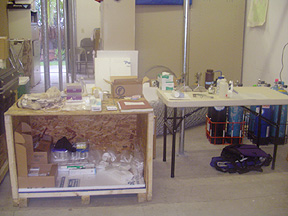
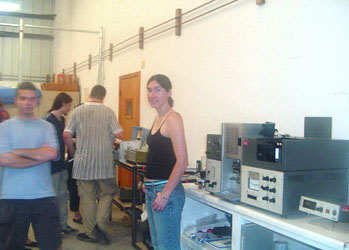
| Our mobile wet chemistry lab set up at park headquarters. | Our group at park headquarters with the Flame Atomic Absorption Spectrophotometer we had shipped to Hawai'i to enable trace metal analyses. |
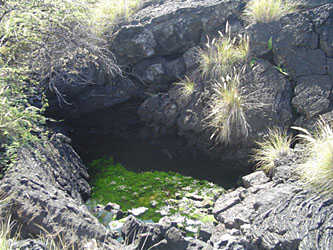 |
| One of the more pristine anchialine ponds within the boundaries of Kaloko - Honokohau NHP. |
 |
 |
|
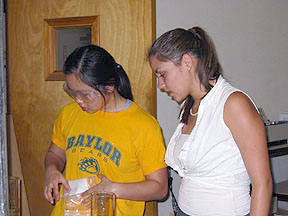
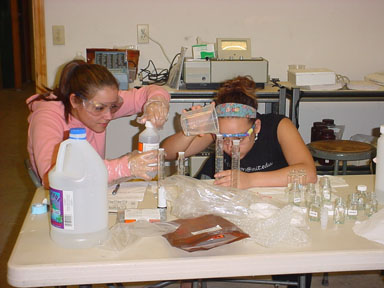
| Suzanne and Veronica preparing some samples. | Veronica and Adrianna, our Civil Engineering students, carefully preparing standards for the nitrate analyses. |
 |
 |
|
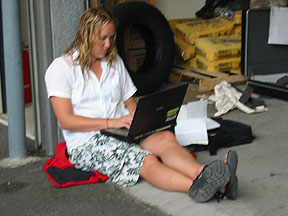
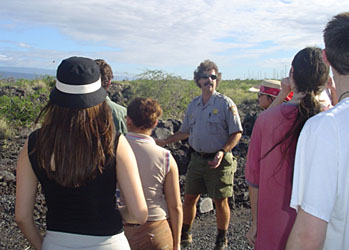
| Candace relaxes on the floor while entering one day's data. | Stan Bonds, park archaeologist, points out Petroglyphs in Kaloko to our group. |
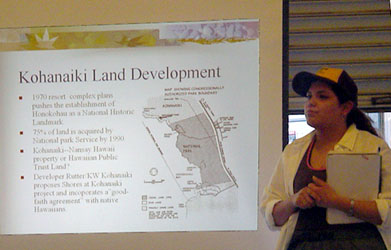 |
| Jazz presenting her talk on the impacts of nearby construction to the park's anchialine ponds. Park officials were impressed by our students and their presentations. |
 |
 |
|
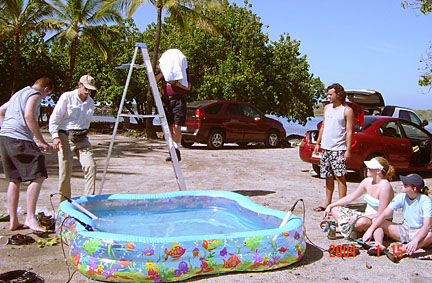
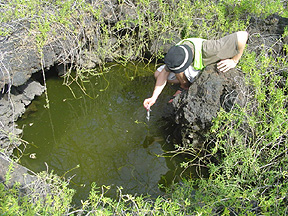
| A children's swimming pool, filled with cold water, allowed us to calibrate the FLIR camera and examine angle distortion. | Measuring temperature at another anchialine pond. |
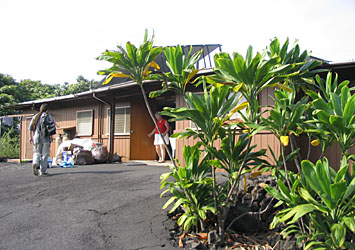 |
| The dormitory where we all stayed. It is operated by the Pu'uhorua o Honanau National Historical Park. |
 |
 |
|
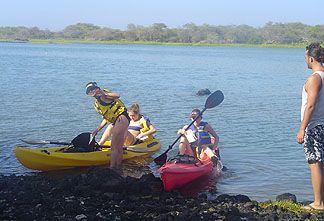
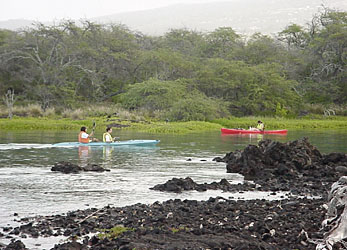
| Prof. Kaeo Duarte looks on as student teams return with their data. | Kayaking on Kaloko Pond. This team is taking conductivity, temperature, depth, and pH measurements. |
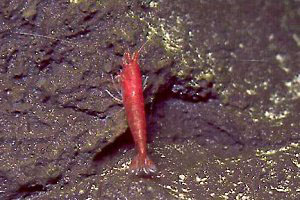 |
| Anchialine ponds have evolved rare and diverse biota many of which are endemic to individual pools. These smallest of red-colored rock shrimp are an example. It's Hawaiian name is Opae'ula. |
 |
 |
|
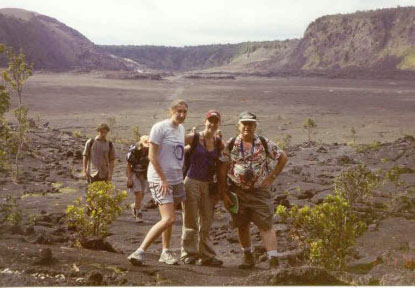
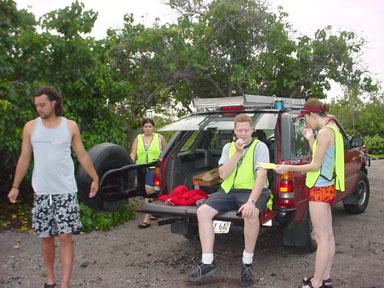
| Prof. Besancin, a geology professor, with Dr. Becky Mattison, both of Wellesley College, took our group on a 5 mile hike through Kilauea Iki Crater on Mt. Kilauea and lectured on Volcanology. | Students in radio contact with sampling teams recording data. |
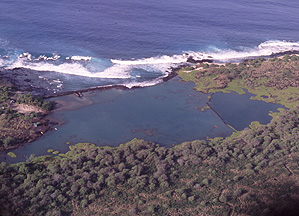 |
| Aerial photo of Kaoloko Pond. |
 |
||
 |
||
 |
 |
 |