 Active pressure depends of shape of non-spherical particles through reorientation at the boundary.
Boundary asymmetry, curvature, and corner
Active pressure depends of shape of non-spherical particles through reorientation at the boundary.
Are there macroscopic consequences of activity for spherical particles (no wall-induced reorientation)?
N. Nikola, A.P. Solon, Y. Kafri, M. Kardar, J. Tailleur, R. Voituriez, Phys. Rev. Lett. 117, 098001 (2016);
Asymmetric boundaries:
Tangential Ratchet force: Asymmetric walls support a current and net tangential force:
(Another macroscopic consequence of the absence of time reversibility at microscopic scale.)
Curving boundaries:
(Density along and into the wall is non-uniform, depending on curvature as well as potential)


 Sharp corners:
Simulations: 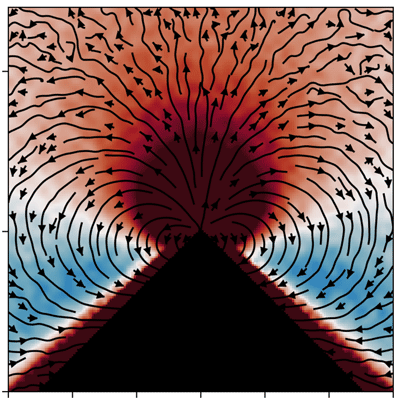
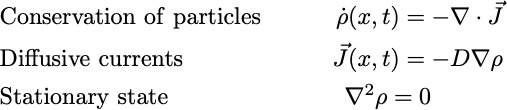
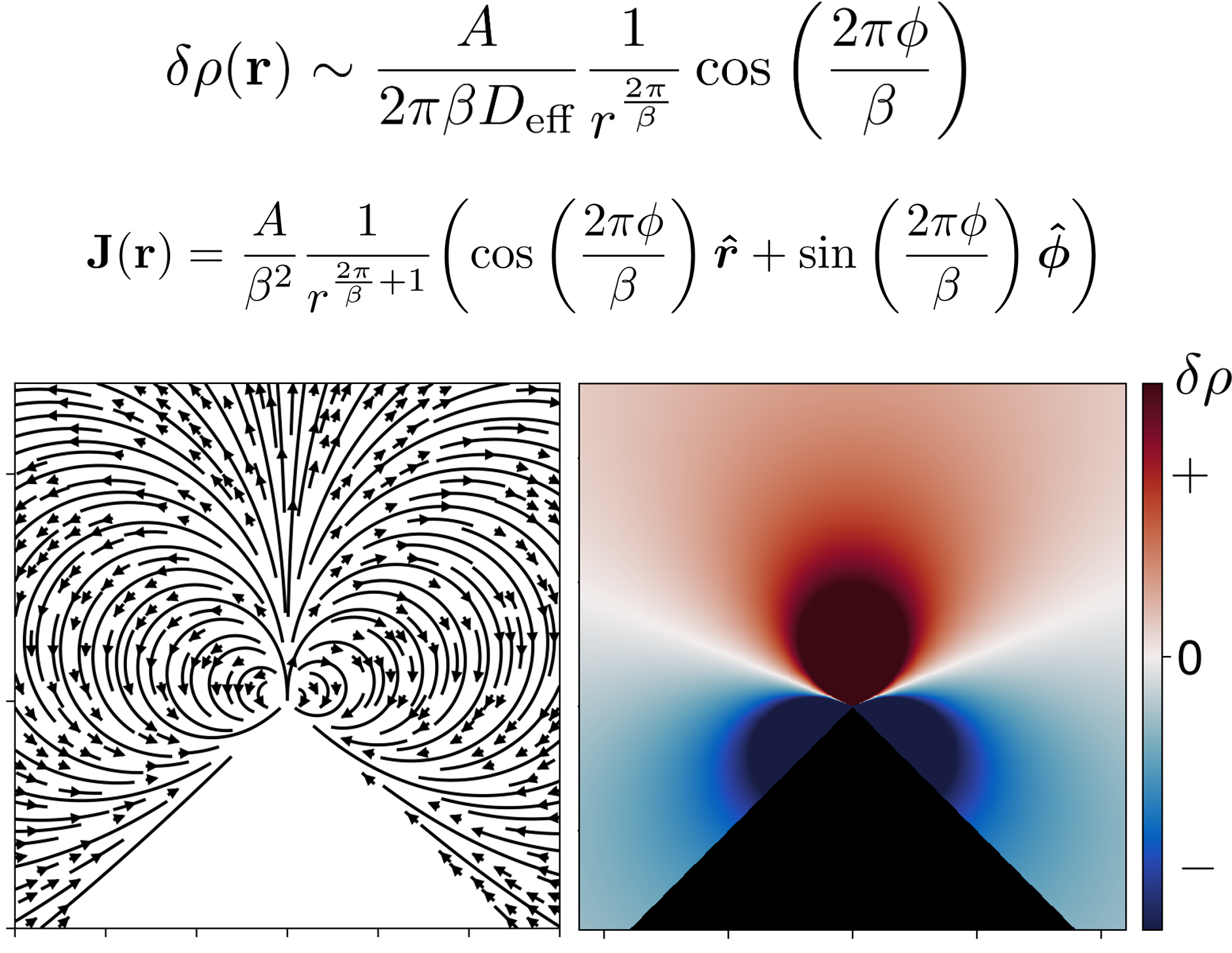
The strength of resulting currents and corresponding pressure depend on the opening angle.
Bendable soft boundary:

 + stabilizing nonlinearities

G. Junot, G. Briand, R. Ledesma-Alonso, and O. Dauchot, PRL 119, 028002 (2017)


