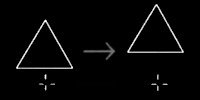
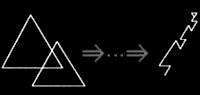
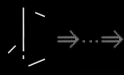
As more students and researchers explore the possibilities of
putting shape grammars into practice, questions of authoring a shape grammar for
practical applications are emerging. These questions are different for original design
applications and for analysis (pure or hybrid) applications. In
original design applications, the author and user of a grammar are the same: a designer.
Are some kinds of shape grammars more suitable than others for designers to work with?
Like computer implementation issues, consideration must be given to the power and
generality of a grammar on the one hand, and ease of use on the other. Knight has proposed
that simple, restricted types of grammars with a minimum of shape grammar paraphernalia
(parameters, labels, etc.) may be best suited for the early, conceptual stages of design  . Restricted grammars are easy to design, easy to
understand, and they can generate a multitude of innovative design possibilities.
Generated designs can be elaborated either by elaborating the grammar or by traditional
means. . Restricted grammars are easy to design, easy to
understand, and they can generate a multitude of innovative design possibilities.
Generated designs can be elaborated either by elaborating the grammar or by traditional
means. |
Different approaches to connecting grammars and goals have
been suggested. One approach is direct. It involves writing rules with the foreknowledge
that the generated designs will meet, or start to meet, given goals. In order to do this,
the behaviors and outcomes of rules must be predictable in some way. In a 1987 paper,
Flemming recognized the problem of predictability, writing “There is, at the present
time, no body of theory available that would allow us to predict the properties of shapes
generated by a grammar solely from an inspection of its rules.” Recently though, Knight has attempted to
establish just such a theory . Assuming a lack of theory, Flemming suggested: “In order to assure
that a grammar is properly constructed, we often have to enumerate a substantial number,
if not all of the shapes it generates. This process is tedious and error-prone if done
manually and could clearly gain from automation.” This implies an alternate, indirect approach to connecting grammars
and goals that has also been researched in recent years. With this alternate approach,
grammars are developed without a clear idea of their outcomes. An automated search and
test strategy is then used to explore the space of designs generated, sampling designs and
testing them to see if they meet given goals. Cagan’s shape annealing technique is a
successful example of this approach. In analysis applications of shape grammars, the
author and the users of a grammar are different. Traditional analytic shape grammars were
intended for a diverse audience from historians to designers who use the grammars for
educational purposes--to understand a particular style. Criteria for authoring a
successful analytic grammar for a style were spelled out early by Stiny and Mitchell.
Requirements of a grammar are that: “(1) it should clarify the underlying commonality
of structure and appearance manifest for the buildings in the corpus; (2) it should supply
the conventions and criteria necessary to determine whether any other building not in the
original corpus is an instance of the style; and ( 3) it should provide the compositional
machinery needed to design new buildings that are instances of the style.”
In newer, hybrid analysis/original design applications of grammars, the author and the
users of a grammar are also different. However, unlike pure analytic grammars, these
grammars are intended for an audience who use the grammars for practical design purposes
as well as educational ones. New criteria for authoring these new grammars are called for.
These criteria depend in part on the desired level and kind of user interaction with the
grammar. For example, computations in a grammar can be automated and controlled minimally
and indirectly by a user through the input of constraints or goals. These constraints can
guide computations to produce certain designs, or they can be used to evaluate and select
certain designs that are output by computations. Maximum user interaction might involve a
user choosing which rule to apply and how to apply it in each step of a computation. In
this case, the user’s role more closely approximates the role of a designer.
When a user has liberal control over computations, then the grammar must be structured
in a designerly way in order to be practicable. Most traditional analytic grammars are not
structured in this way. In other words, the way in which choices are presented to a user
may not make sense from a design point of view. This is particularly true for choices
relating to parameters. With some architectural grammars, for example, a user must decide
the dimensions of individual spaces in a plan before the arrangement of the spaces with
respect to one another is decided. In the first stage of the Palladian grammar, for
instance, the modules of a grid plan are generated individually to define the underlying
plan of a villa. As each module is added, it must also be dimensioned. Thus, the user must
decide the dimensions and proportions of individual modules before knowing (generating)
the size and proportions of the overall grid. In the Wright prairie-house grammar, the
dimensions and proportions of some spaces in the core unit of a house must be decided
before the functions of these spaces are assigned. Problems such as these arise because
shape grammars do not easily allow for the separation of dimensioning from other choices.
More generally, dependencies among different properties of designs are sometimes difficult
to structure practically in a shape grammar. Choices about local properties must often be
made prior to the determination of global properties.
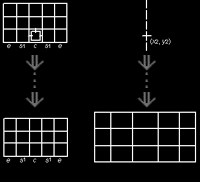
In his work on the Yingzao Fashi building system, Li is exploring a solution to
problems such as these with the use of parallel grammars . Parallel grammars allow different properties and representations of
designs to be separated into different computations, while allowing for these computations
to communicate with and influence one another in appropriate ways. Duarte and Colakoglu
are also exploring the use of parallel grammars in their work, not only as a solution to
the parameter problem but as a way of generating multiple representations of designs. |
When a user has minimal control over computations in a
grammar, then different authoring issues arise. For example, if a user’s only
interaction with a grammar is through the input of constraints or goals, then mechanisms
need to be built into the grammar to find or generate just those designs that satisfy the
constraints. (This issue is similar to the problem of connecting original grammars with
goals discussed above.) For example, Duarte’s grammar for Siza houses is intended to
be used by Siza or his clients. For clients with particular requirements (a number of
bedrooms, for example), a mechanism is needed to find or generate just those houses in the
language that satisfy the requirements. Duarte is exploring a number of automated
mechanisms either embedded within the grammar or external to it that will perform this
task. One solution to the general problem of searching through languages to find
particular designs involves the use of description grammars . A shape grammar can be linked with a parallel description grammar so
that a design and a description of the design are generated in parallel. Every design
generated by the shape grammar thus has a description (including number of bedrooms, for
example). Given some requirements, the rules for generating a description that includes
the requirements can be used as input to run the shape grammar. This input specifies which
shape rules to apply to generate a design with that description. |
a
parallel grammars
(Andrew Li)
|
 |
 |
|