


|
|
|
 |
|
|

|
||
|
Carpe diem Sloan students are seizing opportunities and running businesses while they earn their degrees
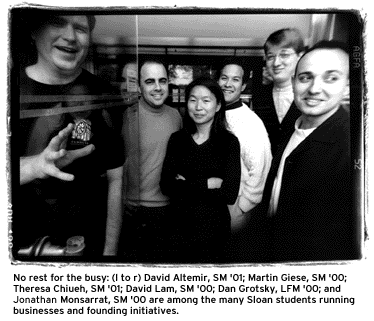
The busy members of the classes of '00 and '01 are the living embodiment of carpe diem. Take the recent "spring break"--anything but a break for students who went on personal business trips or investigated opportunities on Sloan-sponsored treks as far away as China and the Middle East. Sleep and restful recreation are the last priority for a group determined to make the most of their time and energies while at Sloan. In addition to a heavy courseload and extracurricular activities, today's "Sloanies" are creatively applying their coursework to their own business applications-and vice versa-seizing opportunities wherever they see them. Eager participants in Sloan's thriving tradition of innovation, they effect change in the business world at large and here at Sloan. Startups: holes to fillWhat sparks this spirit of innovation? According to MIT Sloan Professor Eric Von Hippel, a 25-year veteran of the Sloan faculty who teaches a course in innovative thinking, when innovators see a hole in a familiar area, they apply experiences and skills, more than creativity, to fill it. Today, a growing number of students see startups as viable and lucratives way to fill such holes. Some students, like David Altemir, SM '01, and Dan Grotsky, LFM '00, have founded companies while at Sloan. Altemir's company, AML Technologies, is developing an artificial intelligence system to help engineers and manufacturers reduce product development costs and schedules. Grotsky's Sophium uses media delivery technology to bring real-time viewing data to advertisers and networks. Others, like Jonathan Monsarrat, SM '00, founded companies before coming to Sloan. Monsarrat's company, Turbine, has produced an award-winning commercial version of a hobbyist game. "I took the basic concept," he says, "added some neat ideas, and shook it up with graphics and high production value." He handed the reins to a stand-in CEO when he came to Sloan but stays involved. He hired classmate Martin Giese, SM '00, as a consultant. Giese also works on his own enterprise, Solonventures, which he expects "to become the leading German incubator for blue-chip opportunities in telecommunications and the Internet." He spent spring break on a business trip to Germany, and reports, "After 10 weeks in business, we have the core team of six people together and about 80 people working for our first two investments." Giese and Ken Wainer, SM '01, are just two of several students focusing their initiatives abroad. Wainer and classmate Baren Rose, SM '01, are building on the groundwork Wainer laid in Brazil when he worked there as an investment banker before coming to Sloan. They are developing a business-to-business Internet company with Plano Editorial, Brazil's leading information technology trade press. The business of classesStudents' involvement with outside business ventures often blurs the line between the classroom and the real world. They tap into their startup experiences in the classroom, and draw on coursework-and each other-for their ventures. Monsarrat has based class projects on his company and his industry, which has helped him write Turbine's next business plan. During class discussions, he says, "I have a real application in mind. And I can put the tools I'm learning to immediate use." Wainer agrees, but notes that coursework and business demands sometimes conflict. "I feel like I'm serving two masters. I have a responsibility to participate in class, but also a fiduciary responsibility to shareholders in the business." He often finds himself dashing off critical company emails in the moments just before class. MIT Sloan community activistsSometimes, a student's bright idea has nothing to do with a business startup, but instead offers opportunities to the Sloan community. One initiative gaining momentum is e-MIT, a student-run online portal that brings together MIT entrepreneurs and the venture capital community. Within a month of the pilot release, more than 700 users had signed up and nearly 250 jobs were posted. States e-MIT copresident Josh Miller, LFM '01, "Each e-organization at MIT focuses on a different aspect of entrepreneurism. We're working to develop partnerships with these groups and to congregate them." Sloan2000 is a brand-new portal launched to encourage professional networking among this year's graduates. Founder Homayoun Hatami, SM '00, sees Sloan alumni networking as a work-in-progress, and is grateful for a flexible administration that allows him to make improvements. "Sloan is a lifetime investment," he explains. "Its ongoing value is proportional to the time and effort we spend networking." Given the proportion of time spent on networking and other activities, the value no doubt runs high among Sloan students. Those mentioned here admitted to only six or seven hours of sleep a night, their single concession to a lifestyle one might call driven. "I have too much joie de vivre to waste a minute on wasteful tasks like sleeping," jokes Monsarrat. He and his fellow MBAs are too busy being innovators.
|
||
| Contents |
|||
 |
The MIT Sloan Mission | ||
|
A message from Dean Schmalensee | ||
|
Innovation | ||
|
Disclosure | ||
|
Invented here | ||
|
Briefs | ||
|
Globalization | ||
|
Executive summaries | ||
|
Carpe Diem | ||
|
Upcoming events | ||