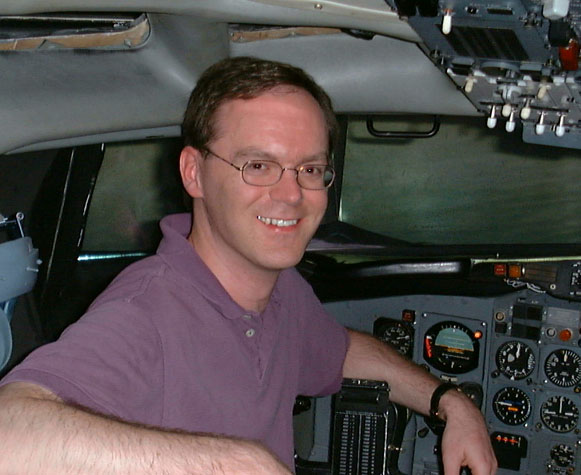
Technical Staff, MIT
Transportation safety, warning system design and evaluation, advanced displays, automation, flight simulation.
Information Integration in Decision Aids for Planning Tasks
The use of automation to integrate, filter, and display information from diverse sources can be an important asset in improving human decision-making in time-constrained problems. An important design question is to what degree automation should be involved in this integration process. As information becomes less complete or less accurate, the human may be better able to integrate, assess, and make decisions than the automation. As time pressure increases, however, automation may be more critical in aiding the human in this decision process. This project is examining issues related to the level of automated integration and filtering of information in a planning task. The project involves developing and refining a conceptual model of decision-making for the type of information integration problems to be addressed. A pilot study and two formal experiments are being undertaken to obtain quantitative and qualitative data relating the degree of automated information integration and time pressure to human decision-making performance. These data will then be used to develop quantitative links between elements in the conceptual model. Recommendations for the use of automation in complex decision-making problems will then be developed and reported.
Modeling and Analysis of Multiple Alerting System Interactions
This research project is developing a formal methodology for examining interactions between multiple independent alerting systems. The goal is to provide a means by which conflicts between alerting system commands can be identified and by which harmonized solutions can be developed and implemented. A generalized modeling approach is being used that can accept a variety of alerting system types and which produces a depiction of how real-world state inputs map into alerting decisions. Based on this mapping, inconsistencies and conflicts between systems can be identified, and potential solutions can be found and evaluated. The modeling approach will be exercised through a case study involving two or more alerting systems. Recommendations for reducing the conflict between these systems (through changes in sensor data, alerting algorithms, procedures, or alerting display methods) will be provided.
Alerting Systems for Closely-Spaced Parallel Approach

This project involves the development and analysis of on-board alerting algorithms and displays for parallel approach to runways less than 3400 ft apart in Instrument Meteorological Conditions. A model of sensors, dynamics, and human response is used to determine the probability that a collision could occur with a blundering aircraft. Alerts are generated when this probability exceeds a threshold. The system has been used in simulation studies at NASA Langley Research Center and NASA Ames Research Center. Evaluations of different collision avoidance maneuvers have also been conducted.
Enroute Conflict Alerting Logic for Free Flight
A prototype alerting logic has been developed to provide warning of potential conflicts up to 15 minutes in advance. Alert Zones have been defined based on probabilistic models of aircraft dynamics and flight plans to allow for a trade study between false alarms and level of safety. The logic has been used in studies at the NASA Ames Research Center. Current efforts are focused on incorporating datalinked intent information that describes the current flight plan of each aircraft.
Incorporation of Severe Weather Information in Route Planning Decision Aids
Most work in traffic conflict detection and resolution has been done assuming airspace without severe weather or other airspace restrictions. Models of uncertainties in weather position, extent, and severity and being used to develop algorithms to enhance automated support tools so that traffic conflicts can be resolved in a manner that is harmonized with the weather situation.
Integrating Air and Space Operations in Air Traffic Management
As air traffic and space launch operations become more frequent, the continued use of large regions of Special Use Airspace (SUA) will begin to impose increasingly greater delays and costs on air traffic. This project is examining several new concepts for reducing the impact of space launch and recovery operations on air traffic. A simulation tool has been developed to examine the potential benefits space corridors. Additionally, the policy issues affecting safety, efficiency, equity, and implementation are being examined.
Controlled Flight Into Terrain: Terrain Alerting and Display
![]()

Controlled Flight Into Terrain (CFIT) remains a major cause of civil transport accidents, as recently evidenced by the crash of a 757 near Cali, Columbia in December, 1995 and the crash of a 747 on approach to Guam in 1997. Domestic air carriers are equipped with Ground Proximity Warning Systems (GPWS) that provide alerts to the pilots if they fly toward terrain, but it is believed that advanced displays may augment safety by providing corroborating information about a terrain alert. Several projects have been performed to investigate issues related to advanced terrain awareness and alerting displays for civil transport cockpits. These studies examined issues such as database requirements, effectiveness of terrain symbology, and comparisons of plan-view contour, side profile view, and three-dimensional perspective views of terrain. Additionally, a key element of these systems is the definition of appropriate alerting logic to maximize safety and minimize nuisance alerts. This research (funded by Boeing with additional support from United Airlines, Jeppesen Sanderson, and Allied Signal) led to the development of an Enhanced Ground Proximity Warning System (seen above) from AlliedSignal/Honeywell. Additional work is also related to the development of terrain alerting systems for General Aviation and military aircraft. See also preliminary terrain studies, investigation of terrain database resolution requirements, and an evaluation of three alerting displays.
Automobile Automation / MIT AgeLab
Research investigating the application of decision-aids and alerting systems in automobiles. Potential applications include collision warning, intelligent cruise control and lane following, and map and route-planning. With the MIT AgeLab, we will also be focusing on how technology can be used in cars to help older drivers remain self-sufficient and safe when traveling by car.
Rail Automation
Issues include train separation control and signaling, speed-control aids, and system dispatching.
Questions about research can be directed to Jim Kuchar
781-981-4073
Last update: 12/01/03