Abstract
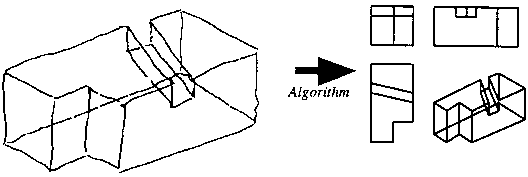
This research proposes and implements a new user interface, based on freehand sketching, for three-dimensional conceptual design. There are several difficulties in implementing this kind of interface. The primary difficulty is that the reconstruction is mathematically indeterminate because the two-dimensional sketch lacks three- dimensional depth information. Inaccuracies inherent in the freehand sketch intensify the difficulty. The proposed reconstruction algorithm operates in several stages. First, the raw sketch is analyzed, and basic geometrical entities (lines, elliptic arcs and corners) are identified and smoothed. These entities are then linked to form an edge-vertex graph representing the two-dimensional topology of the object's projection. The three-dimensional object is then reconstructed using implicit spatial cues in the sketch plane. These cues originate from three main sources: (a) geometrical regularities, (b) sketch topology, and (c) statistical distribution of entities in the sketch plane. This paper proposes a sketch-based interface, discusses the underlying algorithms and provides examples from a working implementation.
| See Also | Optimization-Based Reconstruction of a 3D Object From a Single Freehand Line Drawing |
| Identification of Faces in a 2D Line Drawing Projection of a Wireframe Object |